 Guide On Map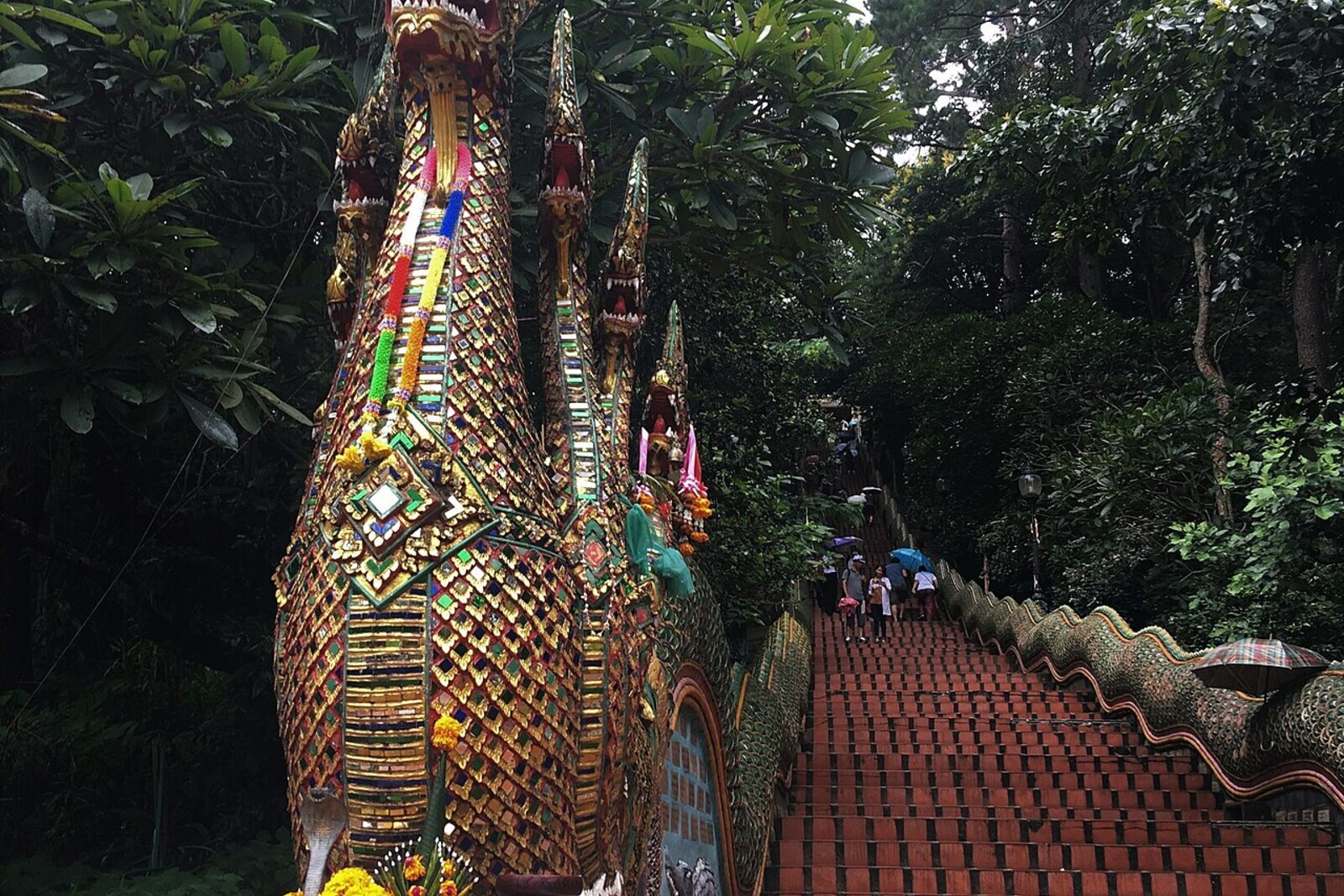
Look around first
What to notice
- 306 steps
- Seven-headed nagas
- Snake-bodied railings
The story of the place
From here, an ascent of three hundred six steps leads to the upper temple terrace; snake bodies run along both sides, with seven heads at the start. In Buddhist tradition, nagas guard sacred sites, and in Lanna such a passage was associated with a road from the human world to a heavenly abode. Their extended bodies also serve as railings, giving you something to hold on to along the steep climb. The present staircase was built to replace a deteriorated brick one: the earlier staircase had one hundred seventy-three steps, and the nagas had only one head each.
For nearly two centuries after the sanctuary on Doi Suthep was founded, no monastic community lived permanently beside the relic of Buddha. It was a venerated place at the summit, reached by climbing a mountain trail.
In the middle of the sixteenth century, the ruler Mueang Ket Klao invited the monk Yanamongkhon Phothithera here from Lamphun. He left the established Wat Asokaram and settled on the mountain. His task was to establish an active monastery here and make the way to the sacred site easier for people. Together with his disciples and laypeople, he built a brick staircase of one hundred seventy-three steps. Along both sides, the builders ran the bodies of single-headed nagas.
Nagas are snake-like beings of Buddhist mythology, guardians of sacred sites. In Lanna tradition, the staircase between their bodies was understood as a bridge connecting the human world with a heavenly abode. At the top stood the stupa containing the relic of Buddha, so the image began precisely here, at the foot of the final ascent. The naga bodies also served as railings: the sacred boundary gained a very earthly handhold.
The route built by Yanamongkhon allowed pilgrims to climb to the relic by a fixed route, while monks could live beside it permanently. Si Wichai Road, in nineteen thirty-five, only brought transport to the lower landing; the staircase entrance to the monastery had appeared nearly four centuries earlier.
The original brick steps deteriorated over time. The temple committee dismantled them and rebuilt the ascent: the number of steps increased to three hundred six, and each naga was given seven heads instead of one. Yanamongkhon's brick staircase is no longer before you. What remains of his work is the place and purpose of the ascent; the seven-headed nagas belong to the later replacement.
Useful on site
The staircase is accessible during the hours of Wat Phra That Doi Suthep; ask at the ticket office on site about the funicular, fees, and closures.
Checked: June 28, 2026. Check the official source before visiting.Do not rush to count the steps: keep a steady pace, let faster walkers pass, and rest without blocking the way.