 Guide On Map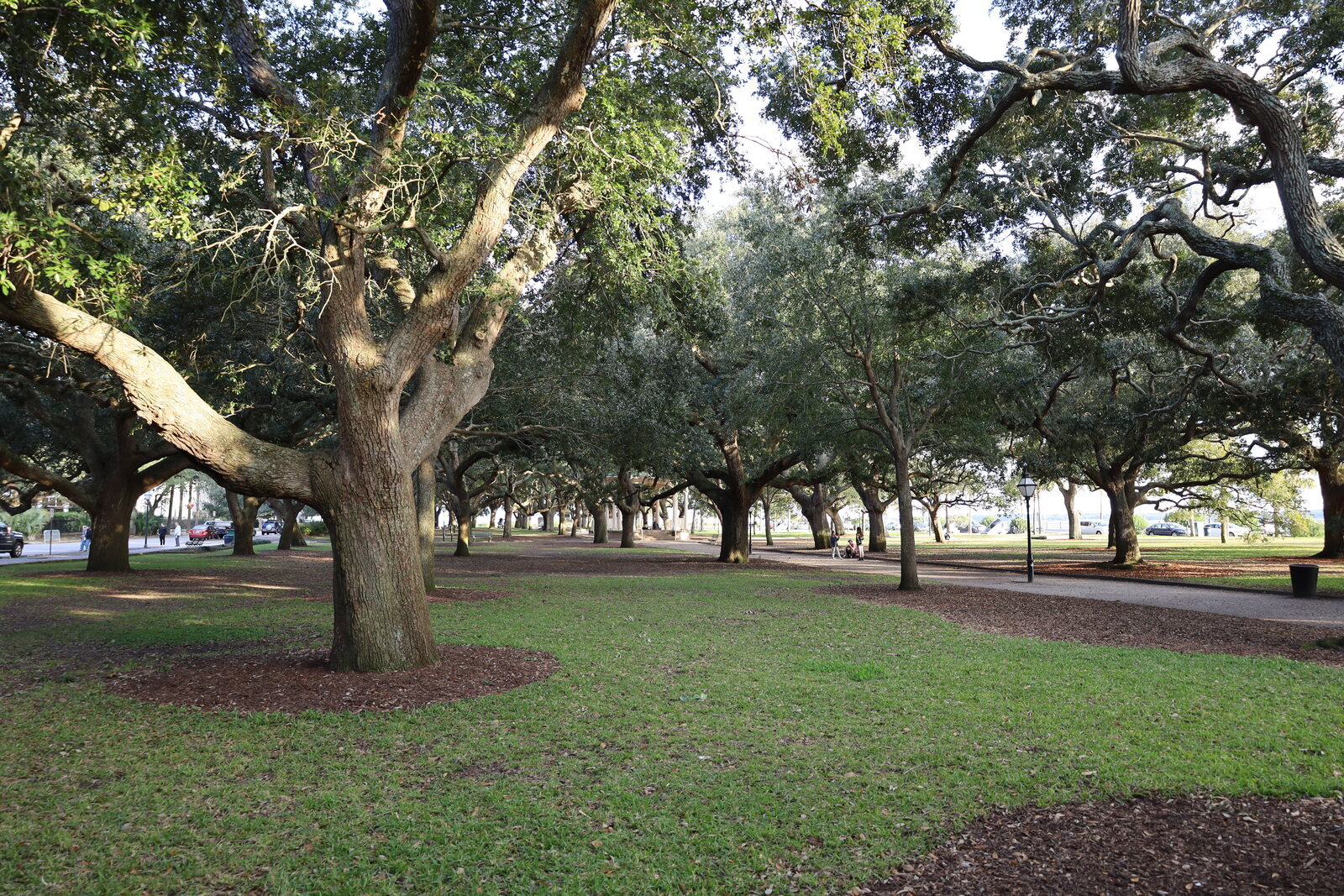
Look around first
What to notice
- Granite memorial marker
- The inscription “near this spot”
- Garden trees
- Shoreline
The story of the place
At the garden’s northeastern corner stands a granite marker dedicated to Stede Bonnet and other pirates executed at White Point. “Major” beside Bonnet’s name was a rank in the Barbados militia. That rank gave him no seafaring experience.
Bonnet lived on the income from a sugar plantation worked by enslaved people. He had a wife, three children, a position as a justice of the peace, and a prominent standing in the colony. In seventeen seventeen, he handed the management of his affairs to his wife and two trustees, secretly bought the sloop Revenge, armed it with ten guns, and hired seventy men. Documents do not explain the reason for this act. Later stories that he fled an unhappy marriage remain speculation.
In the summer of seventeen eighteen, Bonnet was in the flotilla of Edward Teach (Blackbeard). The pirates blocked the entrance to Charleston harbor, captured vessels and hostages, and then demanded medicine in exchange for the captives. Bonnet later received a royal pardon and could have returned to a lawful life. However, by then Blackbeard had taken the loot from Revenge and put part of the crew ashore. Bonnet decided to make up for his losses: he called himself Captain Edwards, renamed the sloop Royal James, and in two months attacked eleven more vessels.
Robert Johnson, governor of South Carolina, ordered Colonel William Rhett to find the pirates and stop their attacks on merchant ships. In September, Rhett caught up with Bonnet at the mouth of the Cape Fear River. After a six-hour battle, Bonnet surrendered and was brought to Charleston. He managed to escape from custody, but Rhett caught him again.
Vice Admiralty Court judge Nicholas Trott handled crimes committed at sea and pursued a verdict concerning two captured sloops—Francis and Fortune. Bonnet had no lawyer. He questioned the witnesses himself, claimed that the crew had been giving the orders, blamed Blackbeard, and insisted that he had been asleep during the capture of Francis. The jury found him guilty; on the second charge, he himself then pleaded guilty. Bonnet asked the governor to commute the death sentence, but he received no new pardon. Twenty-nine sailors from Revenge were hanged at White Point on November eighth, and Bonnet on December tenth, seventeen eighteen.
The shore was chosen under the rules of the Vice Admiralty Court. English law required convicted pirates to be executed at sea or where the tide flowed in and out. White Point was then a low promontory of white sand and oyster shells, surrounded by tidal flats. The name “White Point” came from those shells. It lay at the entrance to the city harbor, in view of passing vessels, and the area between the high- and low-tide marks exactly met the law’s requirement.
There was no garden here in Bonnet’s time. In eighteen thirty-seven, Mayor Henry Pinckney proposed creating a public promenade along the shore. Contractors enclosed part of the shallows with palmetto pilings, filled it with earth, and planted trees; the following year, White Point Garden was opened to residents. Charleston City Council later extended the fill westward, and by eighteen fifty-two the park had approached its present boundaries.
Because of this fill, the exact location of the gallows can no longer be determined. When the Charleston Historical Commission installed the memorial marker in nineteen forty-three, it cautiously engraved the words: “near this spot.” The inscription also claims that the pirates were buried beyond the low-tide line, but the execution records say nothing about their burial. No known trace of the gallows remains; the granite marker stands on land that did not yet exist in Bonnet’s time.
Useful on site
The park guide lists daily from 9:00 until sunset; access may change due to work, weather, and events.
Checked: June 29, 2026. Check the official source before visiting.Do not climb onto the cannon; for the final pause, choose a place from which both the garden and the harbor are visible.