 Guide On Map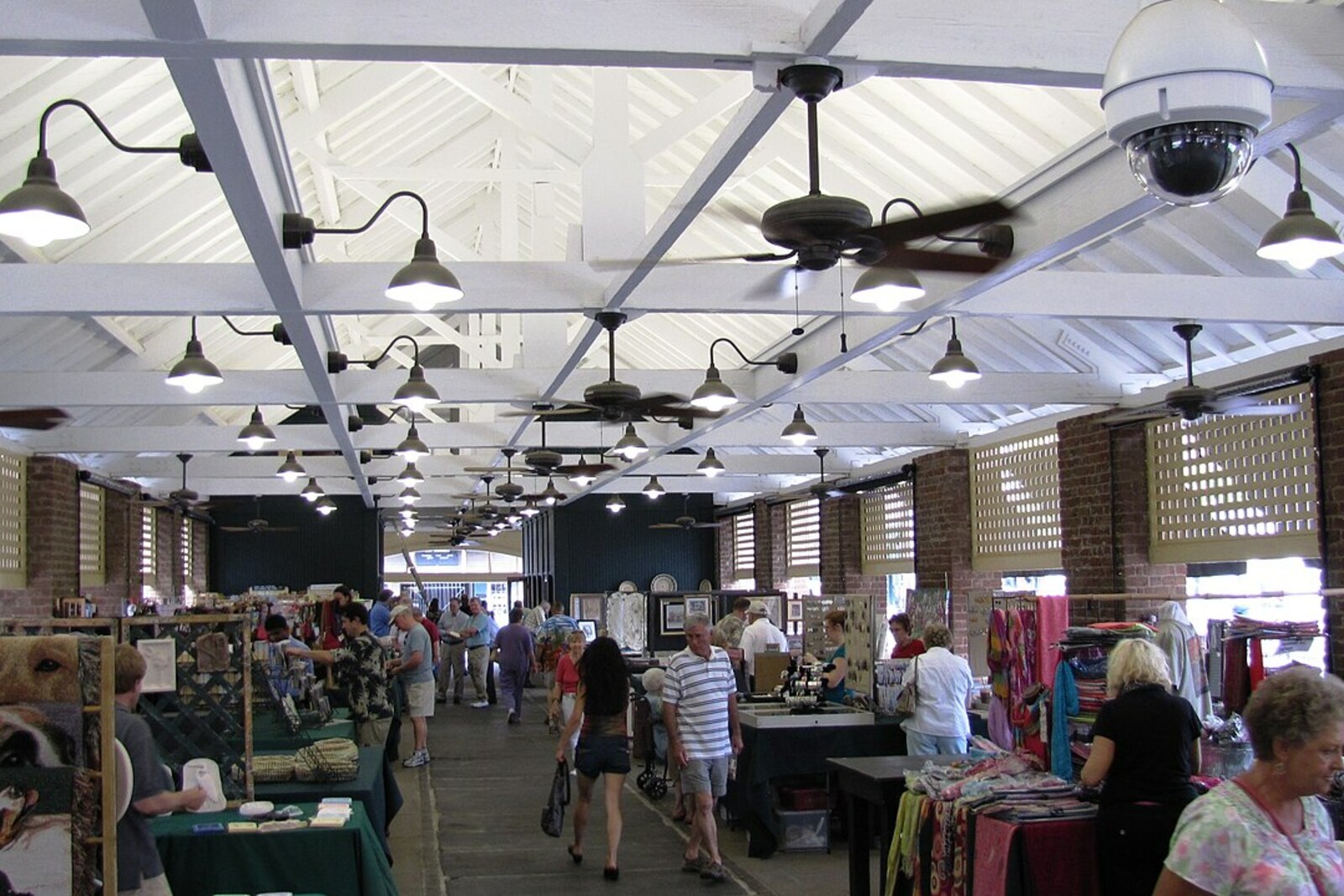
Look around first
What to notice
- Long market sheds
- Sweetgrass baskets
- Coiled rows of grass
- Palmetto strips
The story of the place
Under the long sheds of the Charleston City Market, food, jewelry, souvenirs, and sweetgrass baskets are sold. These rows were created for trading meat, fish, and vegetables. Enslaved people were not sold here: that market was on Chalmers Street. Yet the baskets now found among the food stalls did not appear by chance. In the first half of the twentieth century, Gullah women—descendants of enslaved people from West Africa—brought baskets here along with vegetables.
Their ancestors brought the technique from Africa. On rice plantations, men stitched bundles of reeds into large flat winnowing fans, used to separate grains from husks; women made household baskets. The rows of material were not woven but coiled into rings and bound with palmetto strips. At the beginning of the twentieth century, basket makers began using soft sweetgrass more often and devising small baskets for city buyers. The market made it possible to sell their work directly to the person who would use it.
On one Saturday in nineteen eighty, Mary Jackson, a Gullah basket maker from Mount Pleasant, laid out her baskets here. Both of her grandmothers had once sold vegetables and baskets at this market. Mary learned the craft from her mother and grandmother when she was only four, but as an adult she earned a living as a secretary at a medical university. Her one-and-a-half-year-old son's illness made her return to baskets: because of chronic asthma, he could not be left at daycare. Mary quit her job, worked at home all week, and on weekends her husband stayed with their child while she took the finished pieces to the market.
On that first day, customers stopped at her table. Among the familiar forms was a shallow round bowl with a high, slender curving hoop in place of the usual handle. Jackson kept the coiling technique and the same grasses, but decided to make forms she had never seen her mother or grandmother make. Here she received her first orders from collectors: they asked her to repeat precisely these unfamiliar baskets.
Four years later, Jackson applied to the Smithsonian Craft Show. She was invited to Washington, D.C., followed by museum exhibitions in Philadelphia, Chicago, and New York City. Her husband took vacation time and accompanied her on her travels. In two thousand eight, Mary Jackson received a fellowship from the MacArthur Foundation, and her works entered the collection of the Smithsonian American Art Museum.
Jackson herself no longer sells here, and her stall has not survived. Under the same sheds, other Gullah basket makers still sit beside finished baskets and bind the next row of sweetgrass with palmetto strips.
Useful on site
The official main page lists the daytime market daily from 9:30—17:30 and the night market on Fridays and Saturdays from 18:30—22:30; another page lists daytime hours until 17:00, so it is worth checking the hours again before visiting.
Checked: July 1, 2026. Check the official source before visiting.Do not call this market a slave market, and do not photograph basket makers without permission; treat a purchase as an encounter with a living family craft.