 Guide On Map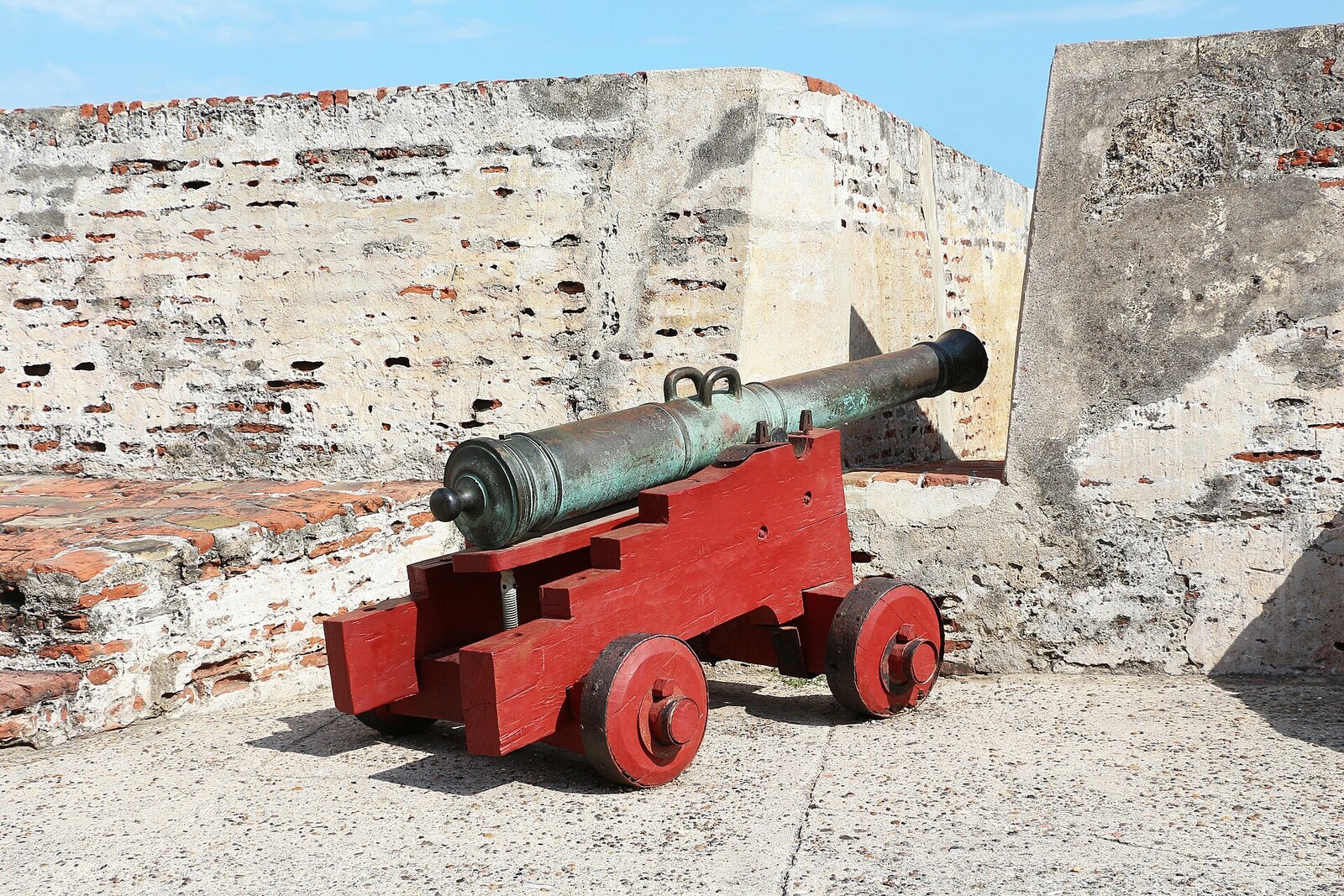
Look around first
What to notice
- Flat artillery platforms
- Stone parapets
- Embrasures
The story of the place
After the struggle for independence ended, the fortress hill passed into private hands and gradually became a quarry: fortress stone went into the walls of new houses, while clay went into bricks. The stone parapets at the summit surround the platforms of the flanking batteries, where guns were placed to defend the hill. On the site of one vanished battery, a hollow reinforced-concrete shell was later built, reproducing the old form on the outside and housing an audiovisual center inside. Along one slope, old stone stands beside the later shell.
The stone projections around the summit of San Felipe are arranged as flanking batteries. Guns stood on the flat platforms, while the walls between the embrasures protected the gun crews. The eleven guns of Redención Battery kept the approaches from Cabrero under fire, and the seven guns of Santa Bárbara Battery covered the hill and the Pie de la Popa road. A total of sixty-three guns could be placed on the slopes. Neighboring positions could fire on one another: enemy soldiers who captured one platform found themselves facing the guns of the others.
This arrangement almost disappeared without any assault at all. After the wars of independence ended, the fortress was abandoned. The land passed into private hands, and the walls became an accessible quarry: stone was taken from them for new houses and clay for bricks. The newspaper El Porvenir warned that San Felipe could be dismantled completely. At the end of the nineteenth century, Antonio Gulfo, the owner of the plot who made bricks, transferred the fortress hill to Colombia free of charge. Yet for several more decades, the batteries remained amid trash, trees, and crumbling masonry.
In nineteen twenty-eight, the Sociedad de Mejoras Públicas de Cartagena commissioned Carlos Crismatt Esquivia to carry out the restoration. He wanted to restore the batteries to their former outlines, although he was neither an architect nor a professional restorer. Because of asthma and the civil war, Crismatt attended school only until the age of eleven; then he worked at a printing shop and at customs, earning his living through the city bus company he founded. Now, a man without a diploma was responsible for a structure whose mistakes would remain in stone.
While the Sociedad looked for workers, Crismatt obtained permission to hire prisoners from San Diego Prison who had little time left on their sentences. They received ordinary wages. Together with other workers, they uprooted about two thousand trees, cleared the batteries, and restored the masonry, drains, lifting ramps, and roads. Water was supplied only at certain hours, while new stone was cut by hand a hundred or two hundred meters from here and raised up the hill.
Crismatt checked the work against old plans sent from Spain. At home, he spread the drawings across a table, examined them through a magnifying glass, and typed reports for the Sociedad. He was accused of acting on his own authority and was forced to resign several times, but he directed the restoration for thirty-eight years. He left only in nineteen sixty-six, when his failing heart no longer allowed him to continue. Two years later, Crismatt nevertheless climbed to the summit of San Felipe on foot to receive a medal for saving the fortress.
Not all of the present-day masonry appeared under him. In nineteen seventy-nine, a hollow reinforced-concrete shell was built on the site of the vanished San Lázaro Battery, reproducing the old form on the outside. Behind its military façade, rooms for an audiovisual center were created: this part of the battery looks old, but it is younger than Crismatt's work.
Useful on site
Inside the fortress; access according to the current operating hours of Castillo de San Felipe.
Checked: June 26, 2026. Check the official source before visiting.Do not climb onto the parapets for the view: the lines of mutual protection can be read from the platforms. On the exposed batteries, there is almost nowhere to shelter from the sun and wind.