 Guide On Map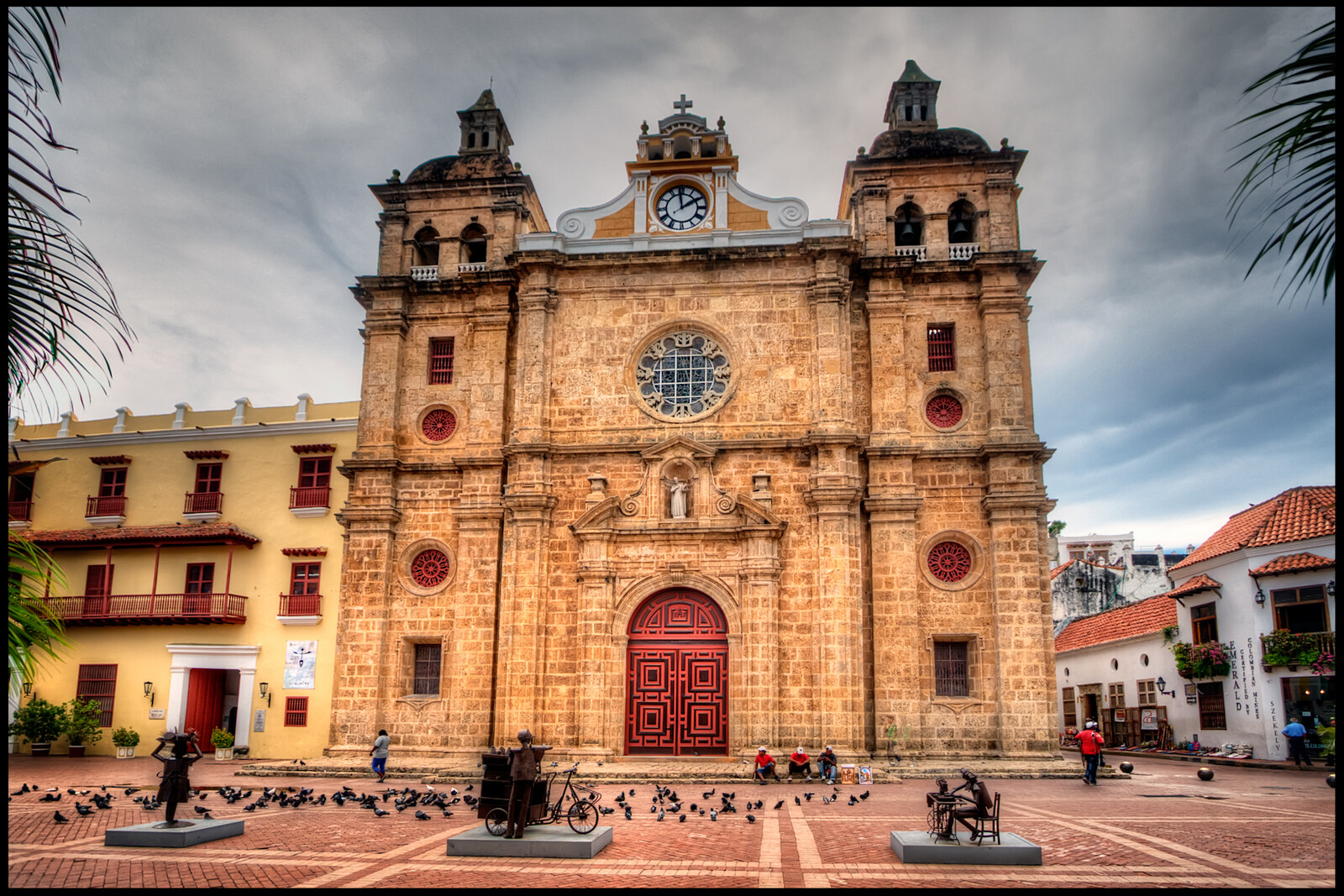
Look around first
What to notice
- The bronze pair without a pedestal
- The church facade
- The entrance to the former Jesuit college
- The college cloister
The story of the place
The church facade and the entrance to the former Jesuit college outline the monastic quarter right beside the port. The college was established here because its gates were not far from the piers; the small church that once stood nearby is gone. The inner courtyard—the cloister—has survived, and a museum-shrine now operates in the old building.
The bronze priest at the center of the square walks beside an African man. The sculptor Enrique Grau placed both figures directly on the pavement, without a pedestal. The priest is Pedro Claver, a Spanish Jesuit who for nearly forty years met captives brought from Africa to Cartagena. The square and the church are named after him.
The Jesuit college was built here because of its proximity to the port. From its gates, it was not far to the piers where slave ships arrived. Captives were kept in Cartagena for only a few days: they were then sold and sent onward. Pedro Claver wanted to have enough time to help and baptize them.
When word came of a new ship, Claver gathered donated food, water, and medicines, took bandages, and went to the pier. He went down into the holds, washed wounds, cared for the sick, and, after disembarkation, received people at the gates of the college and in the small Jesuit church that stood here before the present church. In sixteen twenty-two, he signed his final religious vows with the words: “Pedro Claver, slave of Africans forever.”
But Claver did not know the languages of the arriving people. Without an interpreter, he could neither ask a sick person what had happened to them nor explain why the priest intended to baptize them. This work was done by enslaved Africans owned by the Jesuit college itself.
One of them was named Francisco Jolofó. The college bought him specifically to work with Claver. Other interpreters knew the languages of Angola, Congo, Guinea, and the coast of West Africa. They found out where each new group had arrived from, conveyed the requests of the sick, and translated the priest's instructions. Through them, Claver could speak with people whom traders counted as cargo.
The interpreters remained the property of the college. In sixteen twenty-eight, the leaders of the order ordered that the eight or nine Africans working with Claver not be sold or exchanged: without them, his mission would come to a halt. The order kept these people at the college, but did not give them freedom.
Claver and the interpreters had time to feed the arrivals, treat their wounds, and prepare many for baptism. Church tradition attributes about three hundred thousand baptisms to him. After several days in the port, the newly baptized were nevertheless taken away to buyers, to mines, plantations, and city homes. Baptism did not cancel the transaction, and the interpreters who explained to other people their new Christian names themselves continued to be listed as Jesuit property.
In sixteen fifty-four, Claver died in his room in this college. The present large church was built only after his death; the small church where he received the arrivals no longer exists. The cloister where Claver lived and died has survived, and his remains were placed in the church altar. After Claver's canonization in eighteen eighty-eight, the church received his name, and then the square did as well.
A museum-shrine now operates in the former college. In the square, the bronze Claver still walks beside an unnamed African man. In the college records, the name of one such man has survived: Francisco Jolofó.
Useful on site
The whole story can be read from the square. Enter the church or museum only after checking access separately, and without disrupting services.