 Guide On Map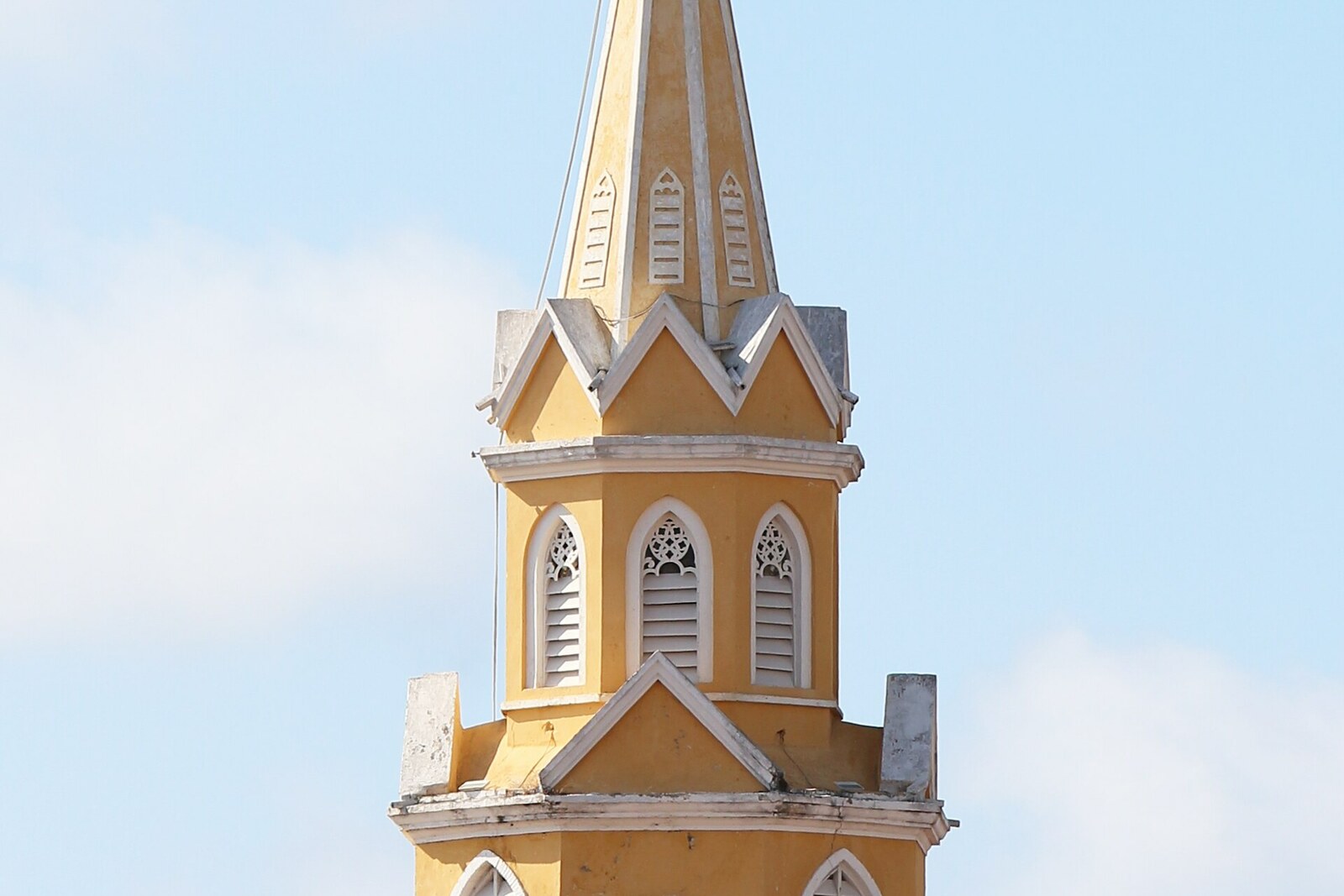
Look around first
What to notice
- Yellow clock tower
- Central arch of the gate
- Side passages
- Triangular square
The story of the place
The yellow clock tower rises above three arches in the fortress wall, and beyond them opens the triangle of Plaza de los Coches. The side arches were opened later than the main passage so that traffic could pass through, and the clock above received its current Swiss mechanism in nineteen thirty-seven. The square's name remains from the carriages: coachmen waited for passengers along its edge, taking advantage of the steady flow at the city entrance.
The triangular square beyond the gate emerged at the main land entrance to fortified Cartagena. Before the San Anastasio Canal was filled in, a drawbridge led here from the suburb of Getsemaní. The gate, completed around sixteen thirty-one, closed off this bridge. People and cargo passed through the central arch; the side chambers held the guard, provisions, and military equipment.
In fifteen ninety-five, the Spanish Crown assigned Cartagena the role of the principal authorized port for the slave trade in Spanish South America. Portuguese merchants brought captives here from Upper Guinea, Angola, and other regions of West and Central Africa. Officials checked ship documents, counted those who had survived the crossing of the Atlantic, and determined which shipment should be charged a duty. Then traders led the people out for sale.
The city council set aside the square immediately beyond the gate for this purpose. Buyers did not have to search for sellers through the streets: everyone entering from the bridge arrived in a single open space. People were inspected, and their age, state of health, and assigned origin were entered into records, after which bargaining began. A buyer raised the price, and with the price it was decided whether a person would remain in Cartagena or be resold farther on—into the interior of New Granada, through Panama to Pacific ports, to Quito, or to Peru.
Some were forced to work in city houses, workshops, the port, and construction sites. Others were sent to mines and estates. Relatives could be bought by different people, and then a single transaction separated them forever. The square received a direct name—Slave Square. Nothing remains here of the trading arrangement: there is no inspection area, no pens, and no clerks' tables. What remain are the square's triangular shape and its location immediately beyond the former drawbridge.
Its current name appeared much later. At the end of the nineteenth century, the city council allowed coachmen to park their carriages along one edge of the square. For them, a place at the main entrance meant a steady stream of passengers, and townspeople began calling it Plaza de los Coches. In nineteen nineteen, the council tried to rename it Ecuador Square in honor of the border treaty between Colombia and Ecuador. The new name did not catch on: people continued arranging to meet “by the carriages.”
The yellow tower above the gate is younger than both the square and the fortress wall. In eighteen seventy-four, a public clock brought from the United States was installed here. Fourteen years later, the Cartagena architect Luis Felipe Jaspe added two octagonal tiers above the old passage so that the clock face could be seen from afar. In nineteen thirty-seven, the American mechanism was replaced with a Swiss one—it is still behind the current clock faces.
The San Anastasio Canal and the drawbridge have disappeared. Of today's three arches, the central one served as the original passage; the side arches were opened later for through traffic, and the third was opened only in nineteen oh five. Beyond them, the same triangular square still begins.
Useful on site
First look at the gate from outside, then pass beneath the arches and listen in the square without obstructing carriage traffic.