 Guide On Map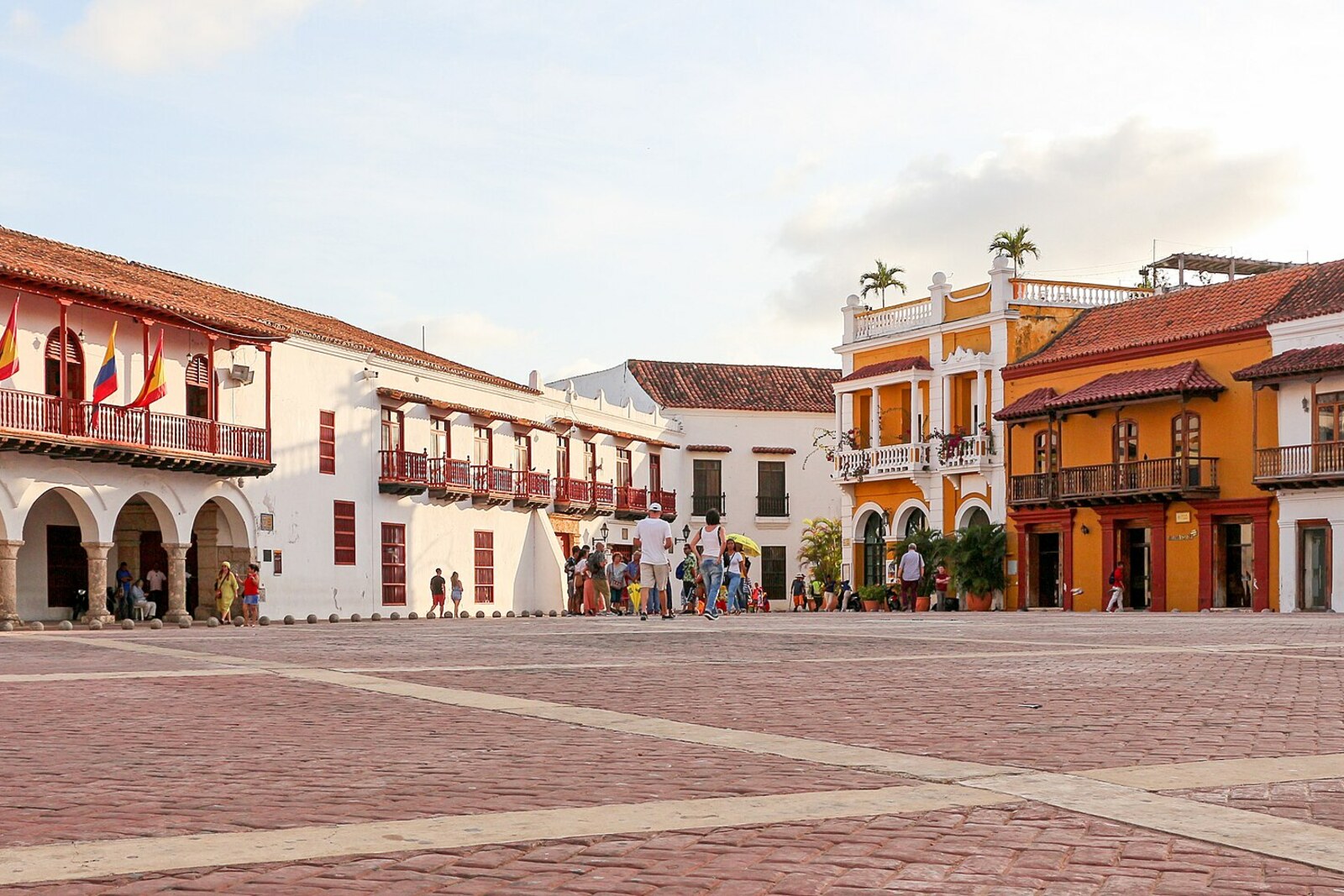
Look around first
What to notice
- The long facade of the former customs office
- The facade of the former Artillery Armory
The story of the place
The long facade of the former customs office stretches along the square, and the facade of the Artillery Armory remains beside it. Today, both buildings are part of the Cartagena City Hall complex. There have long been no weapons inside, but in the state register the buildings are still listed as the customs office and the artillery armory. These old names show that the state needed both a service for maritime trade and supplies for the port's defense.
The square took its name from the institution that occupied its long side. When the city's first wharf stood here, merchants unloaded goods, while royal officials processed maritime transactions and collected duties. At the end of the eighteenth century, the building housed the Royal Customs Office. Nearby, the artillery corps kept the Artillery Armory—a storehouse of rifles, pikes, and ammunition for the defense of the port.
On November eleventh, eighteen eleven, this storehouse was needed by people who were preparing to defend the city from the Spanish Crown. They were led by Pedro Romero, a master blacksmith and contractor for the Naval Arsenal. He directed craftsmen, knew how to make and repair weapons, and his annual contract was worth eighty thousand reales. Romero had much to lose: his home, workshop, and lucrative post. At the same time, colonial documents classified him as a mulatto; for his son to be allowed to study law, Romero had to petition the king for a special exemption from this classification.
A year earlier, Cartagena's residents had expelled the Spanish governor and created the Cartagena Junta, a temporary city council. The council governed independently but continued to recognize King Ferdinand VII. Cartagena Junta member Germán Gutiérrez de Piñeres pressed for a complete break with Spain. The council's chairman, José María García de Toledo, considered such a step premature, and the discussion was postponed several times.
When a decision again failed to materialize, Romero brought to the square a militia from Getsemaní—craftsmen, Black people, and mulattoes known as the Getsemaní Lancers. Here they had the chance to back up their demand with weapons. They seized the Artillery Armory, took pikes and rifles, occupied the city's main fortifications, and then burst into the building where the Cartagena Junta was meeting. After threats and a clash with opponents of separation, the council signed the act of full independence. Cartagena declared itself a sovereign state.
The following year, Romero joined the constituent assembly drafting the constitution of the new state. The Republic of Cartagena held out until December eighteen fifteen, when Spanish troops retook the city after a siege. Romero fled to Haiti and died there the following year. García de Toledo, whom Romero had forced to agree to the break with Spain, remained a supporter of the republic; a Spanish military court sentenced him to death in eighteen sixteen.
There are no weapons in the old premises anymore. The complex is occupied by Cartagena City Hall, and in the state heritage register the building still carries two former names: the former Artillery Armory and the former Royal Customs Office.
Useful on site
Walk around the monument to view the composition from different sides; you do not need to enter the buildings to understand the history.