 Guide On Map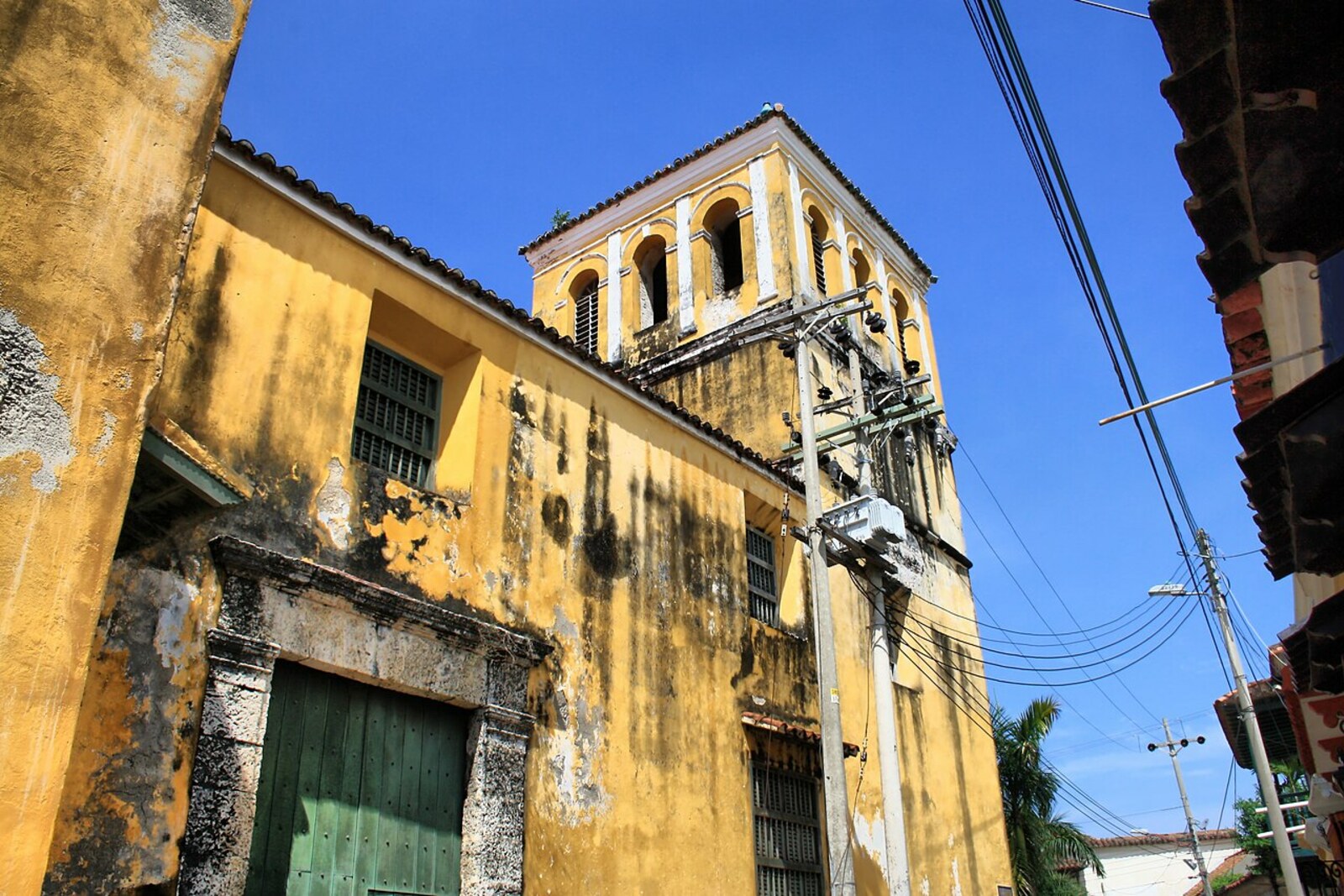
Look around first
What to notice
- Main façade
- Central nave
- Two side naves
- Columns and semicircular arches
The story of the place
Behind the main façade, the space opens into three naves: a broad central one and two side naves. Columns and semicircular arches hold this composition together, following the model of Cartagena Cathedral. Since the early nineteenth century, the church has existed as an independent parish, and masses, baptisms, weddings, confessions, and communion still take place here. The name of the Holy Trinity first became attached to the church and then gave its name to the square.
In July sixteen twenty, Bishop Diego de Torres Altamirano called the residents of Getsemaní “the most scandalous people in the city.” This was the judgment of a colonial clergyman who had arrived in Cartagena only very recently. In the same letter, he asked the Spanish king to establish here a church dependent on Cartagena Cathedral. The bishop sought to have baptisms, weddings, confessions, and communion performed in Getsemaní itself.
At that time, Cartagena Cathedral remained Cartagena’s only parish church. Getsemaní lay beyond the main fortified quarter, on a separate island. Priests had to cross a bridge more than two hundred paces long. Altamirano wrote that because of the distance and the heat, the sacraments could not be performed in time. For someone ill or dying, the delay could decide everything.
The request was supported by Captain Julio Evangelista, a resident of Getsemaní, a member of the city council, and a local landowner. A census from that same year records part of his property: he rented four roofed huts behind a wooden fence to Black tenants. Evangelista offered a site for the church, money for its construction, a house for the priest and sacristan, the first church vestments, and utensils.
The donation came at a price. The captain demanded the right to choose the parish priest himself and, after his death, to pass that right on to his heirs. This was how he intended to pay for the church and leave its administration to his family.
The reply was delayed for twenty-two years. King Philip III and Bishop Altamirano both died the following year. Evangelista, too, did not live to see permission granted. In sixteen forty-two, Philip IV ordered the governor to report again how many people lived in Getsemaní, how far it was from Cartagena Cathedral, and whether a new church was truly needed. After the reply, construction was authorized. Evangelista’s site was accepted, and the cathedral chapter and neighbors added money. Work began in sixteen forty-three, and the church is already shown on a city map from sixteen eighty-eight.
Evangelista did not receive the hereditary right to choose the priest. Getsemaní received its own church, built on the model of Cartagena Cathedral: behind the present façade are a central nave and two side naves, divided by columns and semicircular arches. The church became an independent parish in eighteen oh eight.
It was dedicated to the Holy Trinity—the Father, the Son, and the Holy Spirit, the three persons of the one God in Christian teaching. From the church, the name passed to the square. Masses are still celebrated here, along with the very sacraments for which Altamirano had asked to spare the residents of Getsemaní the journey across the bridge to Cartagena Cathedral.
Useful on site
Active church; access to the interior depends on services, holidays, and the current arrangements on site.
Checked: June 30, 2026. Check the official source before visiting.Entry is not guaranteed: during a service, listen to the account outside; inside, keep quiet and do not use flash.