 Guide On Map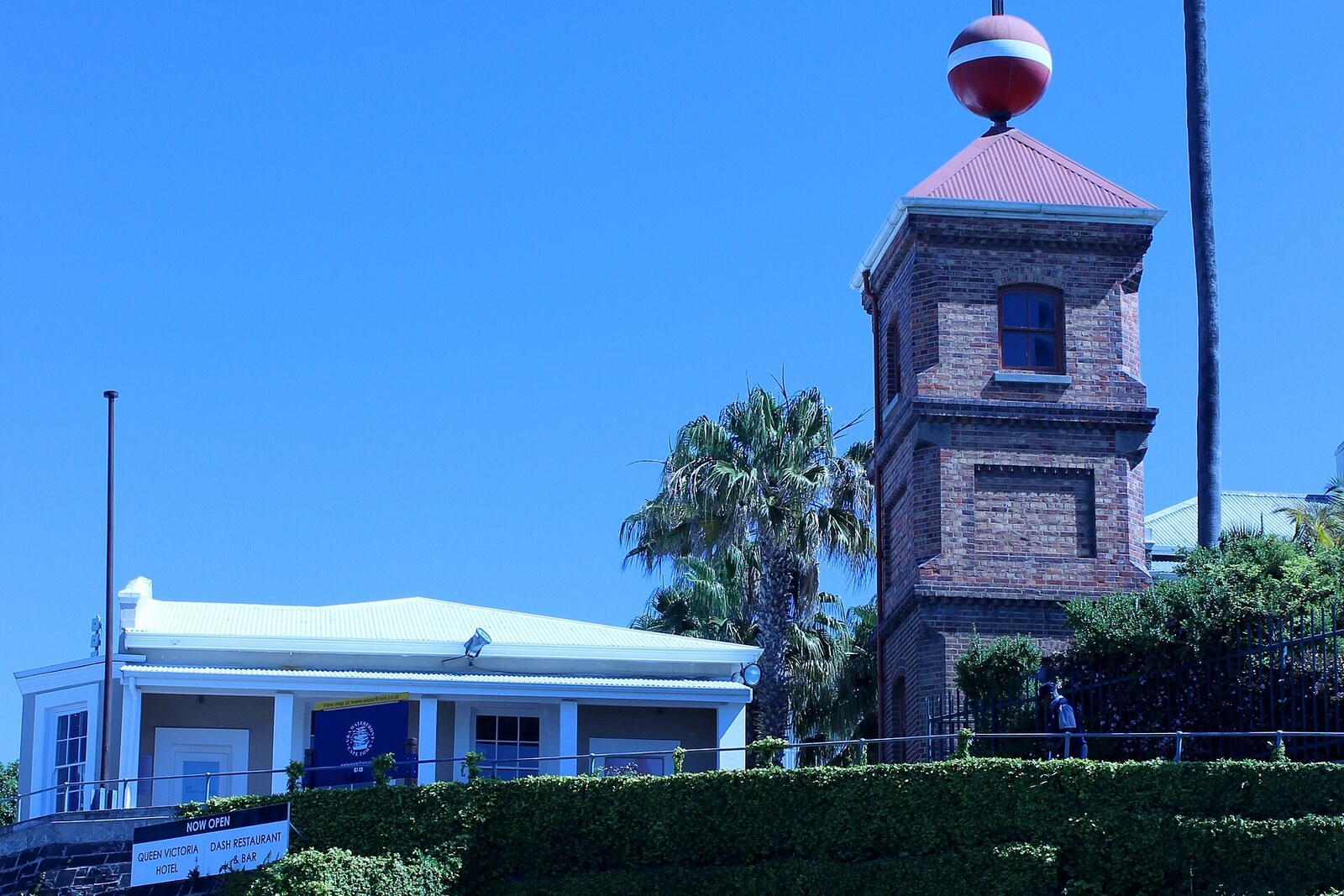
Look around first
What to notice
- Brick tower
- Red-and-white ball
- Vertical rod
- Lifting mechanism
The story of the place
Port engineers chose the elevated ground of Portswood above the wharves so that the top of this tower would remain visible from ships' masts throughout the harbor. New buildings and trees hid the old observatory signal from part of the bay, and dock staff needed a high point of their own. The vertical rod and lifting mechanism are visible in the brickwork: dock staff raised the signal along it and sent the observatory a reply confirming that the mechanism had worked. When sailors switched to radio signals, the daily raisings stopped, and the steel ball was removed.
The red-and-white ball above the brick tower was a command for ships' navigators. They watched it from the decks of ships in Table Bay and waited for one movement—the beginning of its fall.
Precision was a navigator's craft: by the navigator's calculations, the captain plotted the course, and an error put the ship, cargo, and people at risk. Mechanical marine chronometers were expensive, yet they still gradually gained or lost time. A warship might keep several such timepieces so that a single failure would not leave the crew without reliable time.
At sea, the navigator determined local noon by the sun and compared it with the time on the chronometer. This was how the navigator calculated longitude. An error of four minutes on the dial shifted the calculation by a full degree. So, before a new passage, the navigator needed to learn the correction to the timepieces in a port with precisely known coordinates.
Astronomers at the Royal Observatory, Cape of Good Hope determined time from the passage of stars across the meridian. Since eighteen thirty-six, their signal had been displayed by a ball on the observatory's own grounds. Then Cape Town and the docks grew, and buildings and trees hid it from part of the bay. Navigators could no longer rely on a signal that was not visible from a ship.
In eighteen ninety-four, port engineers installed a new ball here, on the elevated ground of Portswood above the wharves. The tower was soon raised still higher. The site was chosen for a direct line of sight between the mast and the vessels in the harbor.
Before the appointed time, an employee raised the ball along the rod. In the early years, the employee released the mechanism by hand on a signal from the observatory. The navigator noted the chronometer reading at the moment the ball began to fall and recorded the correction. Contacts in the tower sent the observatory two return signals: the first at the beginning of the movement, the second at the bottom. This was how the astronomers knew that the command had arrived and that the mechanism had actually worked. From nineteen oh three onward, an electrical impulse itself released the ball.
That is where the name Time Ball Tower comes from—the tower of the time ball. What mattered was the top position and the first movement downward; waiting until the ball reached the base was too late.
In nineteen thirty-four, sailors switched to radio time signals received directly on board. Port staff stopped the daily raisings, and the steel ball was removed.
Above the tower now is another sphere—a red-and-white fiberglass structure weighing about one thousand two hundred kilograms. After the restoration of two thousand twenty-five, it has again been raised periodically before one p.m. At exactly one p.m., the ball is released; the signal is still considered to be the very beginning of its fall.
Useful on site
Available for exterior viewing daily 09:00–21:00. The ball is raised at 12:55 and dropped at 13:00 on Mondays and Thursdays.
Checked: June 28, 2026. Check the official source before visiting.Choose a spot with an unobstructed view of the top of the mast. The ball is not dropped all the time, so do not expect to see it without checking the current demonstration.