 Guide On Map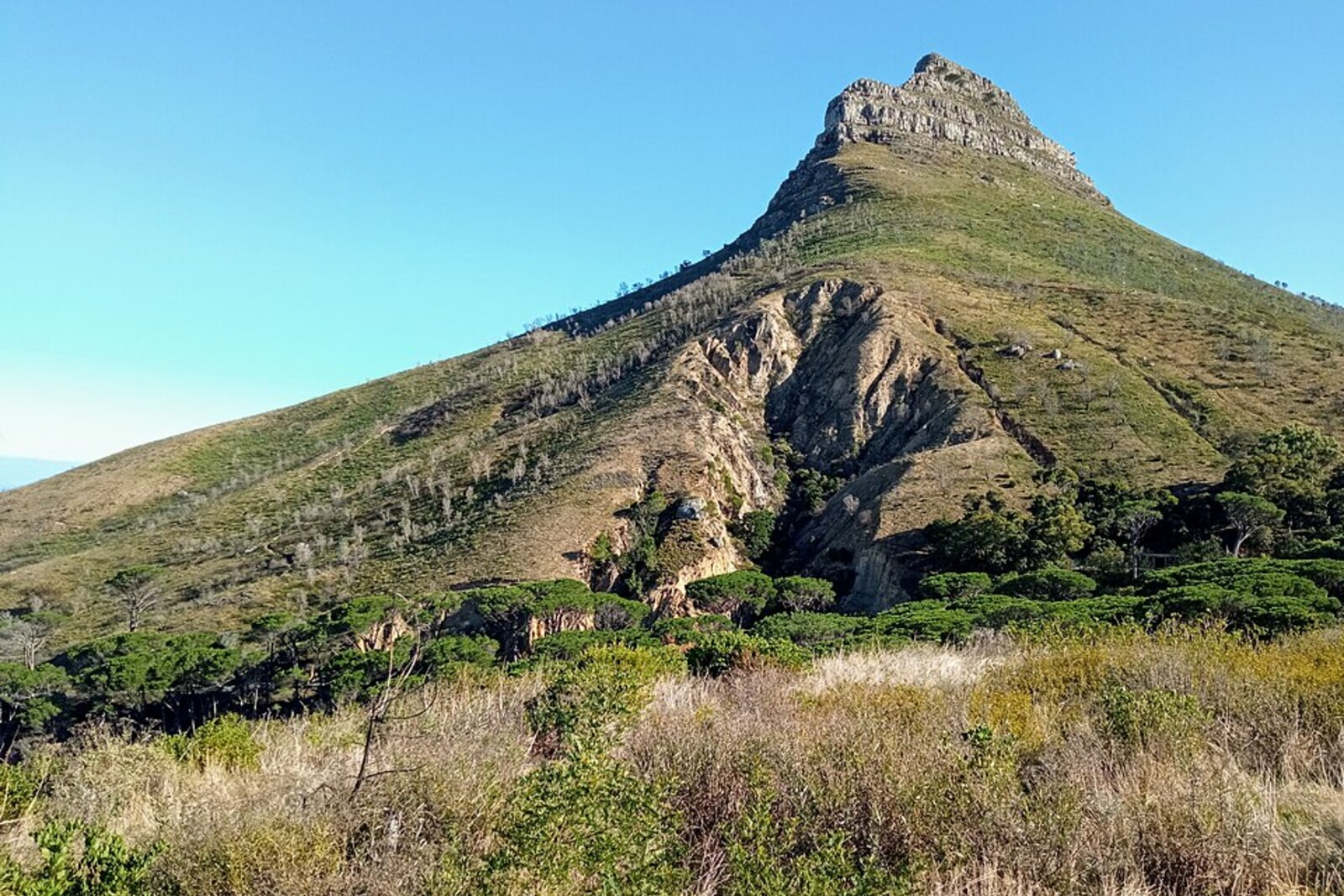
Look around first
What to notice
- Slangolie Ravine
- Old tunnel portal
- Cast-iron pipe
- Fractured rock
The story of the place
An abandoned stone portal emerges from the fissure in the slope, with a cast-iron pipe stretching beside it, covered in reddish-brown rust. They remain from the old water tunnel through which water crossed the mountain on its way to the city. Inside, smooth rock alternated with stone vaults: the masonry supported sections where the rock was crumbling away. After further collapses, the water was sent through another passage farther north, and this outlet remained among the cracks.
In the late eighteen eighties, city engineer Thomas Cairncross was tasked with bringing water from the other side of Table Mountain to Cape Town. The Disa River flowed from there toward Hout Bay, while the growing city no longer had enough water from its former sources. Cairncross chose the shortest line: a seven-hundred-meter tunnel through the Apostles ridge was to emerge in Slangolie Ravine. From here, the water could be sent through a cast-iron pipe along the slope to Kloof Nek and then on to the city’s Molteno Reservoir.
For the excavation, they hired people who made their living breaking through hard rock: Cornish miners from the Millwood gold workings and the De Beers diamond mines. From the Disa Ravine side, they advanced through solid quartzitic sandstone. At Slangolie, Cairncross’s calculations ran into something that could not be seen from the surface. The ravine itself lies in a zone of intersecting faults; the rock here is cracked and shattered deep inside the mountain.
The rock began to collapse. Several tunnel workers were caught beneath the debris, and two died. At dangerous sections, Scottish stonemasons built vaults of local sandstone, holding back the crumbling walls and ceiling. That is why bare rock alternates inside the tunnel with carefully fitted masonry: it was built where the rock could no longer be left unsupported.
In eighteen ninety-one, the remaining tunnel workers completed the tunnel. The workers gave a stone commemorative plaque to Robert Esdon, the engineer in charge of the construction. The tunnel itself was named Woodhead Tunnel, after John Woodhead, a Cape Town mayor and businessman who promoted the city’s water projects. Water began flowing to Cape Town through the pipe laid beside it, and the service path along the pipe became today’s Pipe Track.
The shattered rock continued to move after the work was completed. Collapses at Slangolie disrupted sections of the pipeline, and the slope gradually crept toward the tunnel outlet. By the nineteen fifties, engineers had judged this approach dangerous, and in the following decade they drove a new Apostles Tunnel farther north. Woodhead Tunnel was disconnected.
Water still passes through Table Mountain to the Kloof Nek treatment works, but it now emerges north of Slangolie. What remains here are the old portal without its iron gates and a cast-iron pipe eaten away by corrosion—a channel from which people diverted the flow when the shortest route through the mountain proved to be the least stable.
Useful on site
An open mountain trail beside a steep gully; do not leave the main route.
Checked: June 28, 2026. Check the official source before visiting.The tunnel remains part of the water system, so do not expect to be able to go inside. The ravine is unstable after rockfalls and is not a safe shortcut along the route.