 Guide On Map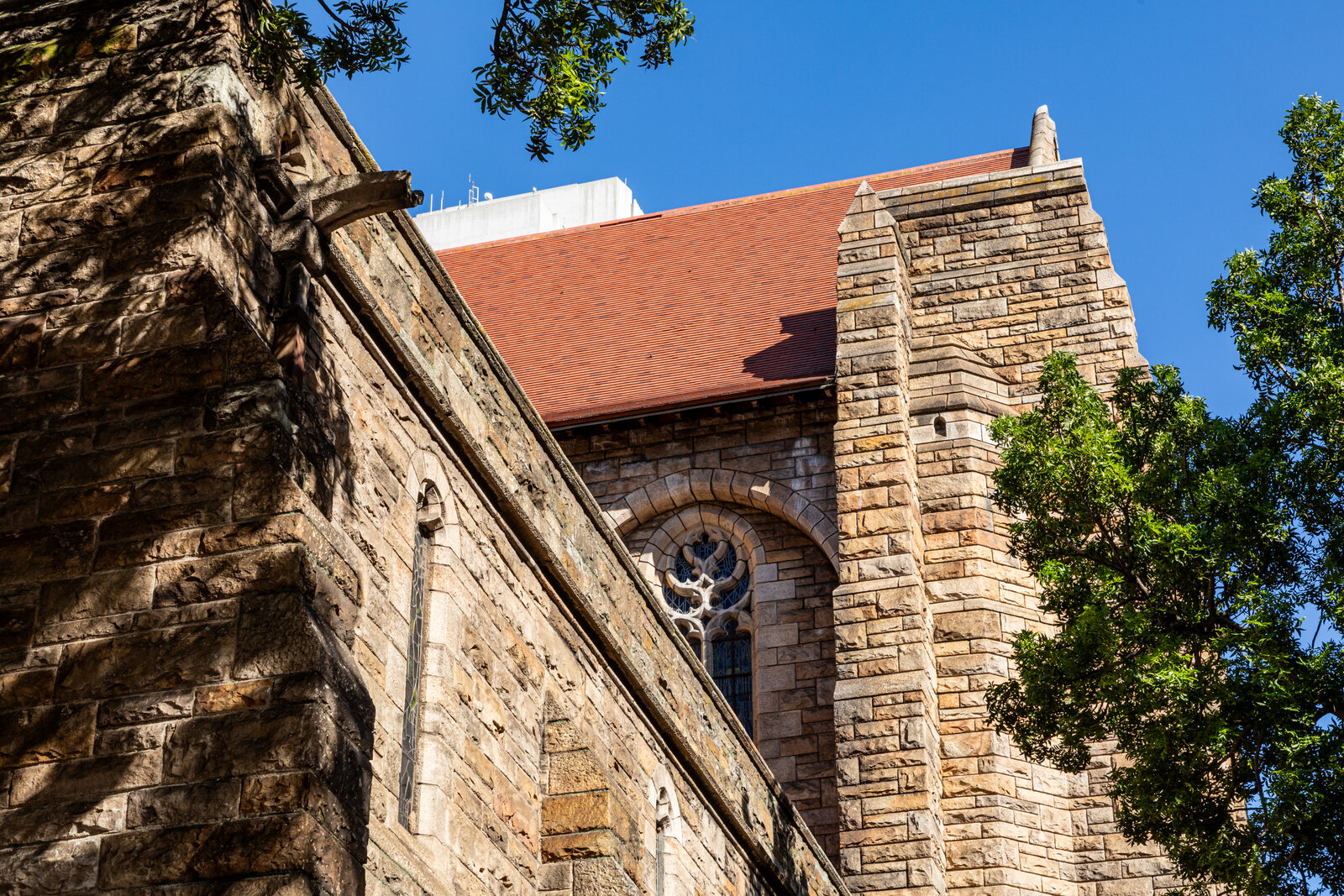
Look around first
What to notice
- Six trees on the cathedral steps
- Stone facade
- Main nave
- Slab in front of the high altar
The story of the place
Six trees on the cathedral steps mark the places where the columns of the former St George's Church stood. It opened by Christmas of eighteen thirty-four and was later replaced by the present stone building. Today, services are held here, bishops are ordained, and decisions of the Anglican Church of Southern Africa are made: this is its principal church and the seat of the Archbishop of Cape Town.
Saint George in the official name is an early Christian martyr of the early fourth century. Reliable information about him is scarce: tradition called him a Roman soldier, while the story of his victory over a dragon appeared later. For Anglicans, Saint George was above all the patron saint of England. The first stone of the old Cape Town church was laid on his feast day, April twenty-third, eighteen thirty, and its name passed to the present cathedral.
For Desmond Tutu, this church was a workplace. In nineteen eighty-six, he was enthroned here as the first Black Anglican Archbishop of Cape Town. He campaigned for the abolition of apartheid during the state of emergency, when many organizations were banned and public marches were broken up. A church service remained a rare opportunity to gather people under one roof, but Tutu’s office did not make him immune. On August thirty-first, nineteen eighty-nine, he left the cathedral with his wife Leah and church activists to demand accountability for the beating of clergy. Police blocked their way and took away all thirty-six people.
Two days later, participants in another banned demonstration tried to walk from here to the nearby Parliament of South Africa. Police beat people with batons, used tear gas, and sprayed the crowd with purple dye from a water cannon so that dyed participants could later be identified. About one and a half thousand people took shelter in the cathedral, where the injured were treated. Police trucks and armored vehicles took up positions outside. Tutu, human-rights defender Dullah Omar, and priest Colin Jones went out to negotiate. They secured an agreement that those gathered would not be detained en masse: people were released in small groups.
On September sixth, more than twenty people were killed in clashes around the elections in Cape Town. At a memorial service, Tutu called on city residents to join a peaceful march a week later. Gordon Oliver, who had just taken office as mayor of Cape Town, joined him. The mayor’s participation turned the march from the cathedral into an open challenge to the emergency bans: Oliver intended to lead the column, although his colleagues warned him that he would be breaking the law.
The government initially promised to stop the march. The day before, F. W. de Klerk, appointed president, backed down and ordered that participants not be obstructed. On September thirteenth, about thirty thousand Cape Town residents of different races set out from the cathedral steps. Tutu, Oliver, and religious leaders walked at the front, while police, for the first time in years of such demonstrations, did not break up the column. After Cape Town, peaceful marches involving thousands took place in other cities across the country.
After these events, the cathedral came to be called the People’s Cathedral. In January two thousand twenty-two, Desmond Tutu’s ashes were placed beneath a slab in front of the high altar. From it to the steps where the march began is one cathedral nave.
Useful on site
The exterior can be viewed while passing along the street; interior access depends on services, events, and arrangements. The official website recommends asking about tours in advance.
Checked: July 1, 2026. Check the official source before visiting.The cathedral functions as a church: access to the interior may be restricted by a service, and photographs should be taken only where permitted. If the doors are closed, remain at the threshold from which the processions began.