 Guide On Map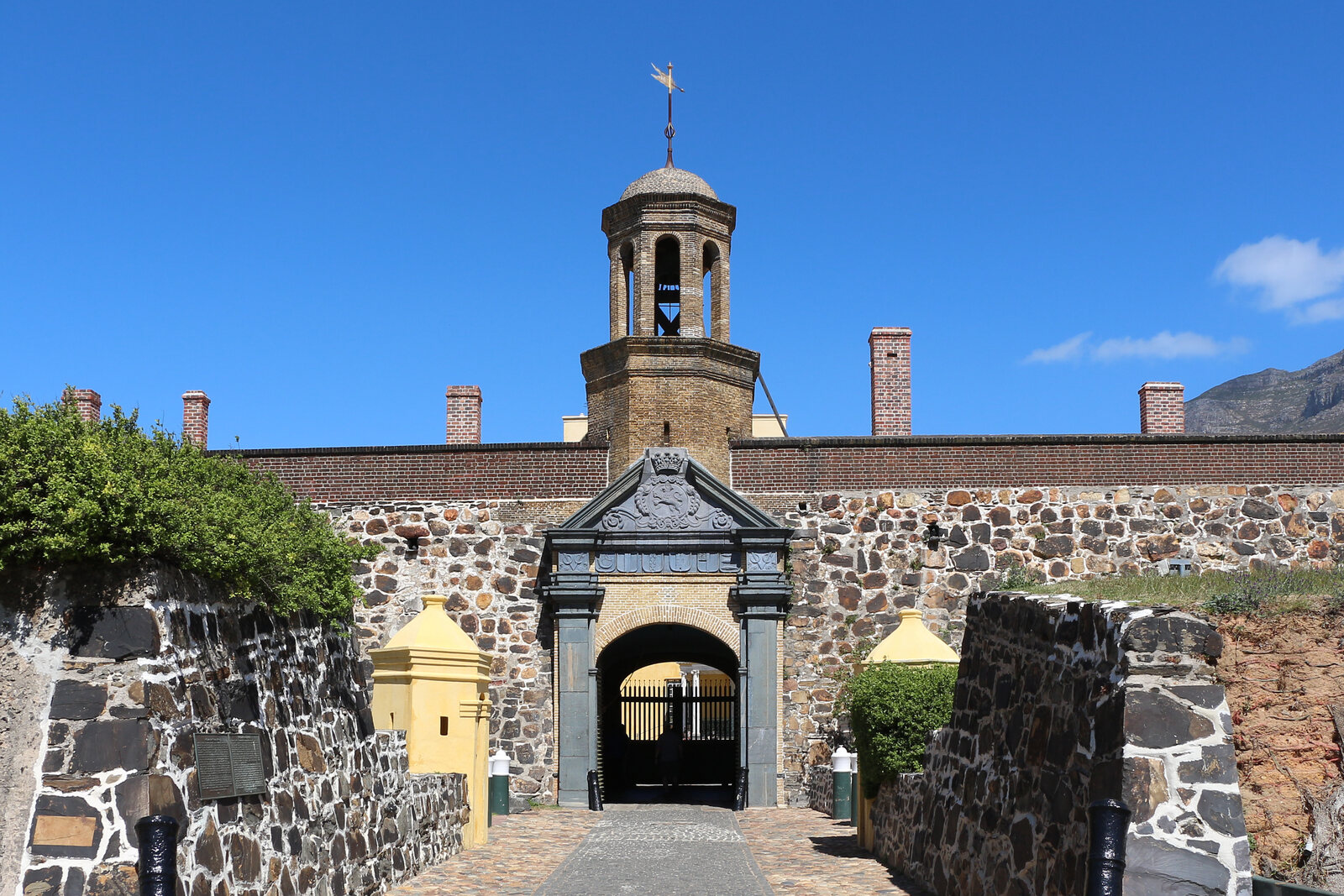
Look around first
What to notice
- The castle's stone walls
- The five-sided outline of the fortification
- The Old Recruitment Building
- The prison rooms
The story of the place
Ships traveling between Europe and Asia called at Table Bay for water and provisions, while both soldiers and company officials were responsible for this station. The stone walls surrounding the five-sided fortification replaced the earlier earthen fort and enclosed an entire colonial apparatus: the governor's quarters, the council, the court, the garrison, and the cells. The old premises now contain a military museum and historical exhibitions; among them is the Old Recruitment Building, where the interrogation room and dungeon were located.
On February twenty-eighth, seventeen oh six, the farmer Adam Tas was taken from his home near Stellenbosch and brought here in chains. Tas was the secretary of a group of settlers who were no longer in the service of the Dutch East India Company and lived from their farms. Through marriage to a wealthy widow, he himself acquired land and income from a farm. Now he was seeking to make the governor and senior company officials stop using their offices in the interests of their own trade.
He was brought here specifically because, at the beginning of the eighteenth century, everything involved in the colonial administration of the Cape was housed behind these walls: the governor's residence, the council chamber, the court, the garrison, and the prison. The Castle stood right on the shore of Table Bay and protected the station where ships traveling between Europe and Asia replenished their supplies. In sixteen sixty-four, the company's leaders feared a war with England and ordered the earlier earthen Fort of Good Hope to be replaced with a stone pentagon. Construction continued from sixteen sixty-six to sixteen seventy-nine. The name of the former Fort of Good Hope was repeated in the name of the new castle; the fort itself had been named after the Cape of Good Hope.
To supply the ships, the company allowed some former employees to establish farms. Then Governor Willem Adriaan van der Stel and other officials acquired large farms themselves while remaining in charge of trade. The farmers depended on people who were at once their competitors and their judges. Tas drew up a complaint signed by sixty-three settlers out of about five hundred fifty. They intended to send it secretly to Heeren XVII—the directors who ran the company from the Netherlands—bypassing the governor. The demand concerned the trading rights of free settlers; it did not change the position of enslaved people or the Cape's Indigenous inhabitants.
Van der Stel learned of the complaint. A draft and the names of those who had signed were found among Tas's papers. The farmer's diary ends with an entry dated February twenty-seventh: he was arrested the following night. His sealed writing desk was delivered to the governor at the Castle. Here, officials copied excerpts from the diary and questioned Tas about his own records. The original later disappeared; two incomplete copies survive.
Tas was kept under round-the-clock guard by two soldiers with drawn swords. The chimney of his cell was bricked up, his food was inspected, and paper, pen, and ink were forbidden. His wife was allowed to see him only rarely. The man who had drawn up the complaint and recorded events every day spent thirteen months and seventeen days here without being able to write.
A copy of the complaint nevertheless reached the directors. On April sixteenth, seventeen oh seven, their order arrived in Cape Town: Van der Stel and several senior officials were removed from office, the rights of the prisoners were restored, and company employees were forbidden to own farms or engage in trade. Tas and his companions were released that same day. He returned to his farm. Van der Stel left for the Netherlands, and his Vergelegen estate was divided up and sold.
The Castle now houses the Military Museum and historical exhibitions, and the prison rooms are open to visitors. Tas is usually associated with the cell called Donker Gat—“the Dark Hole.” However, researchers have established that the room long thought to be this dungeon most likely served as a munitions store and later as a coal store. The original interrogation room and dungeon were in two rooms of the Old Recruitment Building. It is now impossible to identify the exact door behind which Tas spent thirteen months and seventeen days.
Useful on site
Official website: 09:00 to 16:00 daily. The site's pages give conflicting information about the last ticket sales and holiday closures; check on the day of your visit.
Checked: July 1, 2026. Check the official source before visiting.The walls and defensive form are clearly visible from outside; the courtyards and museum rooms require a separate visit. Inside, bear in mind that this is not only an architectural monument but also a former place of imprisonment.