 Guide On Map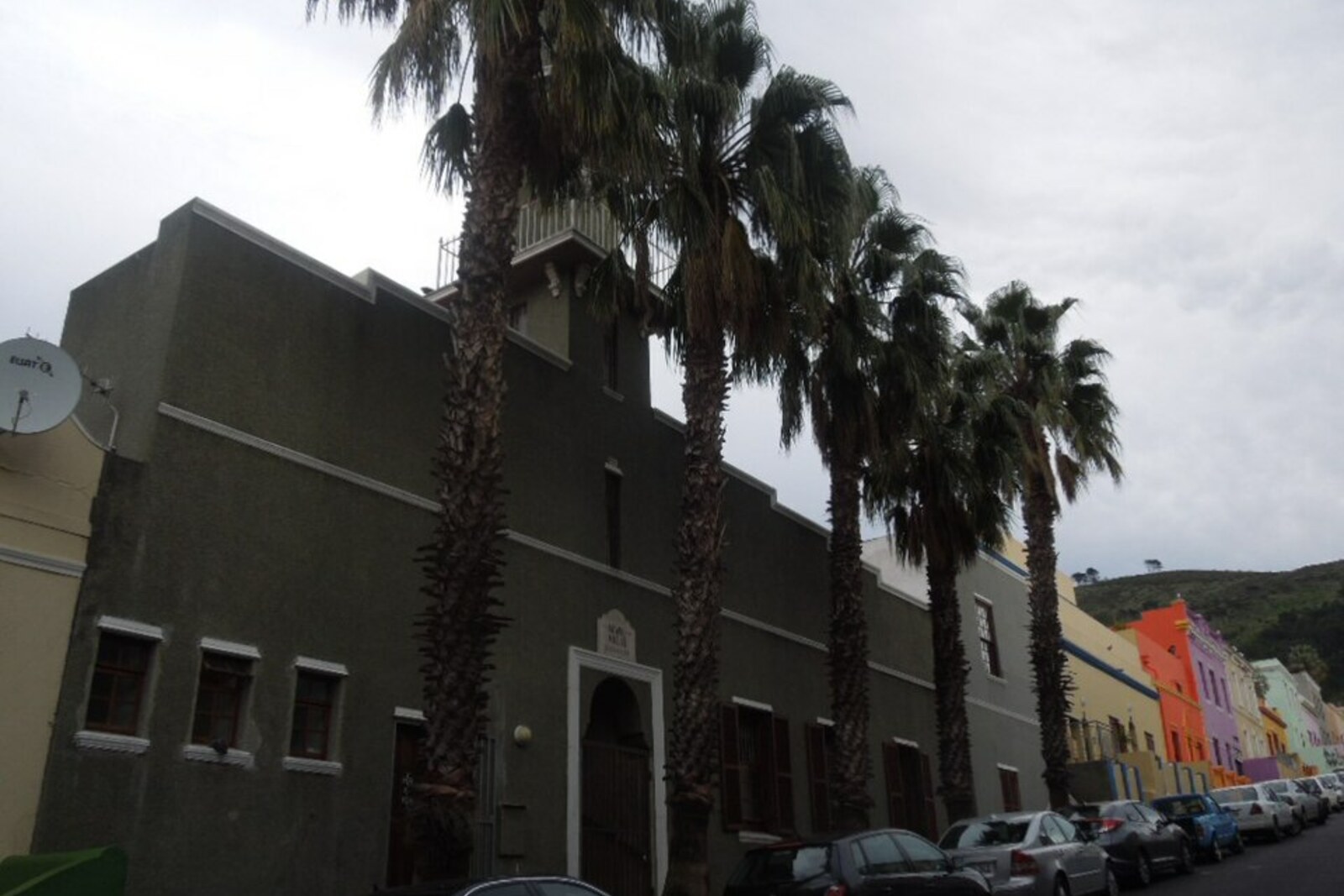
Look around first
What to notice
- Light-colored façade
- Minaret
- Inscription with the date 1794 above the entrance
The story of the place
The light-colored façade wall and minaret mark a small mosque that grew out of an outbuilding on two adjacent plots. A mihrab was made in the wall so that worshippers could keep the direction of Mecca, although Muslims in colonial Cape Town had previously not been allowed to have their own house of worship or gather for communal Friday prayer. Almost none of the first walls remain after later alterations, but above the entrance the date when the community began, seventeen ninety-four, has been preserved. Inside is kept a Qur'an written from memory, and the plot is still registered to the woman thanks to whom this place remained with the community.
In seventeen ninety-three, the Muslim scholar Tuan Guru (Abdullah Kadi Abdus Salaam) began looking in Cape Town for a place where he could teach children and gather the community for prayer. He was about eighty. The Dutch East India Company had exiled him from Tidore for an alleged conspiracy with the British, forbidden him to return home, and held him on Robben Island as a state prisoner.
In prison, Abdullah wrote the Qur'an from memory and compiled a six-hundred-page work on faith and religious law. The paper manuscripts replaced the library that did not exist on the island. After his release, it was these texts that allowed him to begin teaching.
A space was found here, on Dorp Street. Coridon of Ceylon, a man who had previously been enslaved, acquired two adjacent plots and gave Abdullah a storeroom beside his house. A madrasa, a Muslim school, opened in the storeroom. Enslaved and free residents learned together to read the Qur'an and write in Arabic script. By eighteen oh seven, there were already three hundred seventy-two pupils. It was for this work that Abdullah was called Tuan Guru—Malay for “master teacher.”
The colonial administration had previously not allowed Muslims to build their own houses of worship or gather for public Friday prayer. Tuan Guru petitioned for land for a mosque, was refused, and for some time held communal prayer in an abandoned quarry. Religious gatherings on Coridon's plot can be traced from seventeen ninety-four. The storeroom was then adapted for prayer: a mihrab, a niche indicating the direction of Mecca, was made in the wall. This is how the country's first mosque came into being. Auwal means “first” in Arabic.
Coridon's daughter, Saartjie van de Kaap, helped preserve this function for the building. She was born into slavery, but in eighteen oh nine she bought the family property for three thousand guilders—for a married Muslim woman, such a transaction was exceptionally rare in Cape Town at the time. Between eighteen oh nine and eighteen fourteen, a separate mosque building was erected here. In her will, Saartjie directed that the plot be used for a Muslim house of worship as long as Islam was permitted in the colony. After her death, the property did not become an ordinary inheritance: prayers continued here, and the community's right to the premises was preserved.
The façade and minaret were altered repeatedly; a particularly major reconstruction took place in nineteen thirty-six, so little remains of the first walls. Above the entrance is the date when the community began—seventeen ninety-four. The mosque keeps one of the Qur'ans that Tuan Guru wrote from memory, and the plot is still registered in Saartjie van de Kaap's name.
Useful on site
Active mosque; exterior viewing is possible during the day. Interior tourist access has not been confirmed by an official current source.
Checked: July 1, 2026. Check the official source before visiting.This is an active place of prayer, not an ordinary museum stop. View it from outside; entry requires permission, appropriate clothing, and readiness to step away immediately if a service is taking place.