 Guide On Map
Bo-Kaap: Houses, Faith, and Family Stories
From Buitengracht Street through Dorp Street and Wale Street to a spice shop

Guide On Map on your phone
Open the walk like a regular app
It takes about 10 seconds to install. No app store needed.
The whole path
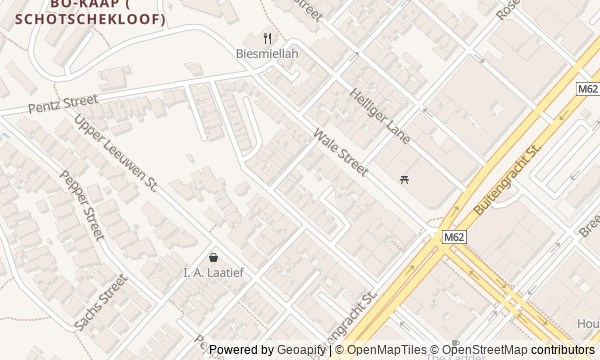
Route map
About the walk
You will begin on broad Buitengracht Street, where Bo-Kaap's low houses meet the high-rises of the city center. Then you will climb to the country's first mosque, an old house on Wale Street, stepped rows of homes, and a hidden stone quarry. You will finish among sacks of rice and spices in a family-run shop.
The bright facades will remain in the background. What matters are the decisions after which some houses were preserved, some residents were allowed to remain, and others were evicted. You will learn why the mosque site is still tied to the name of a woman born into slavery, and how a museum could spend decades telling the story of the wrong family. The answers will not come all at once: first there will be a will, an old plaque, a stone bench by a door, and a goods lift.
The story will compare familiar names with documents and calmly separate what is established from what is disputed. After the walk, you will see Bo-Kaap not as a row of colorful backdrops, but as a residential neighborhood where a preserved facade does not necessarily mean a preserved family.
Why this order
The route begins on Buitengracht Street: only from the outer boundary can you see the contradiction between preserved houses and the right to live in them being taken away. From here, the way leads to Auwal Mosque, because after the state designation, you need to see the community that took shape long before it and secured its place through a private house. The next move to the museum shows what happens when a house is preserved but the memory of its residents is replaced with a convenient version. Leaving one house on Wale Street, you will see the whole rental neighborhood: the stoops explain how dense development created close-knit neighbors. Behind the facades on the next section of Chiappini Street lies Prayer Quarry—a place of communal prayer before a mosque was permitted. Returning to Wale Street and Atlas Trading ends the route not with a monument, but with a family shop: here, preservation continues through everyday work.
Those who want to understand Bo-Kaap beyond its colorful facades People drawn to urban history, family archives, and living religious sites Those who value a dense documentary story without ceremonial rhetoric
Those mainly looking for panoramas and Cape Town's major sights Those who dislike climbing uphill streets Those who prefer light stories without themes of eviction and slavery
Before you go
Choose daylight hours and wear shoes suitable for climbs, uneven paving, and steps. Bo-Kaap remains a residential neighborhood: do not occupy doorsteps or stoops, look into windows, block the way, or photograph people without asking permission. Contact the museum separately in advance and check its visiting conditions. Auwal Mosque is active: plan primarily to view it from outside, dress modestly, and enter only with clear permission, without disturbing prayer.
When to go
For the walk itself, without visiting interiors, it makes sense to allow about an hour. If you plan to visit the museum, linger at stops, and shop at the end, allow up to 2 hours and check access with these places in advance.
Backup plan
If the museum is unavailable, view the house from the street only: its white facade, green shutters, and veranda are enough to compare its neat appearance today with the story of crowding, alterations, and evictions. If you cannot enter the mosque, do not wait at the door or try to join the congregation—listen to its story from a respectful distance. If the shop is closed, finish the route outside, looking at the commercial building and recalling how storage spaces, a family business, and local shopping habits tied this place to the neighborhood.
Route conditions
Surface. Paved — 657 m (data covers 81% of the route)
Elevation. Ascent — 4 m; descent — 14 m
OpenStreetMap extract of June 18, 2026: database data, not a check on the ground. Data © OpenStreetMap contributors, ODbL licence
Walk plan
Open in maps ↗- 1
The Boundary on Buitengracht
This stop sets up the central conflict: the neighborhood's architectural preservation would become linked to the forced removal of its residents. - 2
Auwal Mosque
Here, a private house, a school, and a will come together in the story of how a community secured its right to its place. - 3
Bo-Kaap Museum
This stop will show how the official display displaced the memory of the real residents and how documents helped restore it. - 4
Wale Street and Stoeps
Here, the origin of rental development will be connected to everyday life at the boundary between home and street. - 5
Chiappini Street
This stop returns to a time when communal prayer was a public risk and no authorized mosque yet existed. - 6
Atlas Trading
The finale will shift the conversation about preservation from museums and monuments to an ongoing family business.
Route features
Everything you need stays in the browser
Progress, saves and your trip plan are stored on this device.
Add Guide On Map to your home screen so the walk opens outside the browser.
How we handle sources, maps and corrections: our editorial standards