 Guide On Map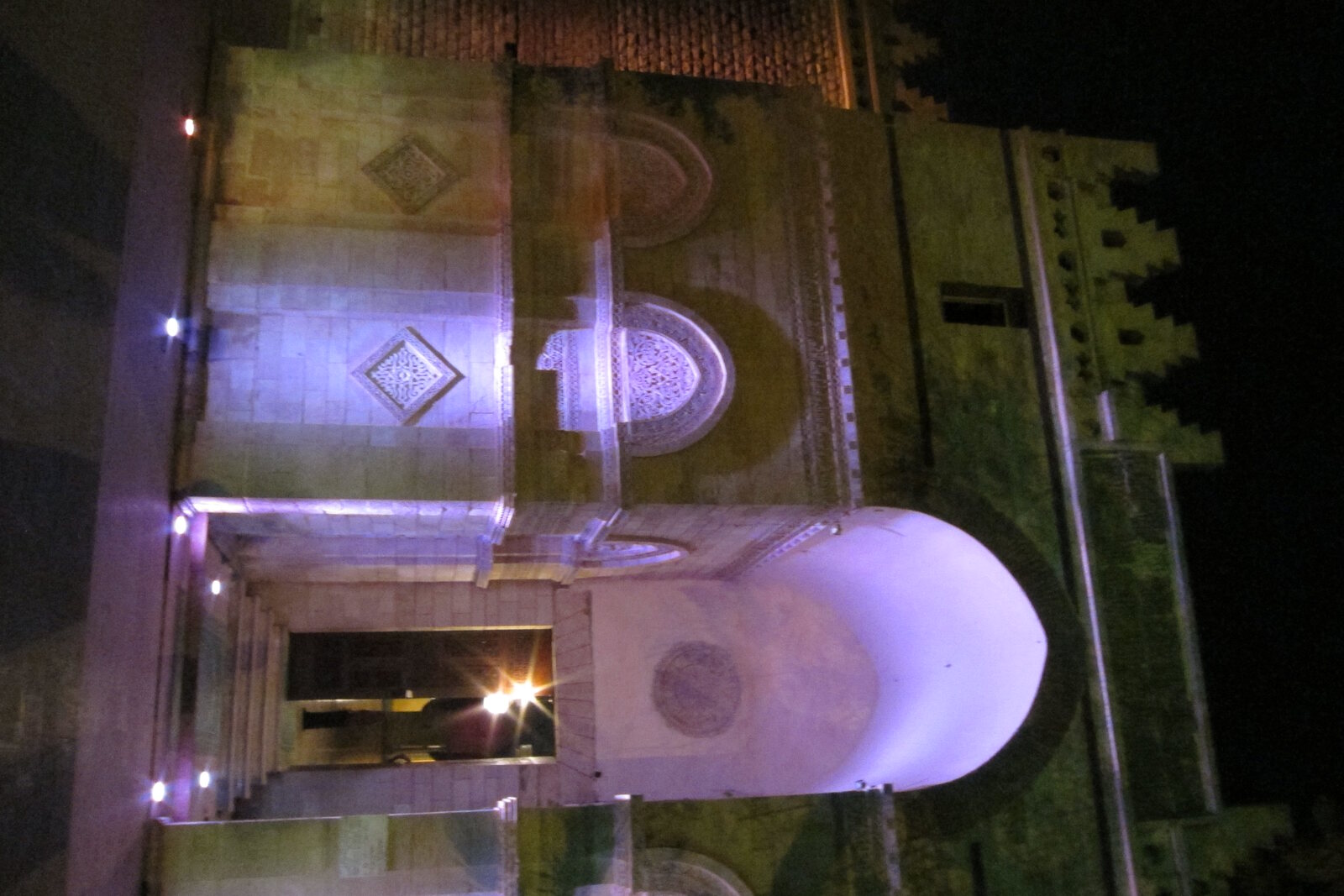
Look around first
What to notice
- Projecting stone portal
- Towers at the bases of the minarets
- Courtyard arcades
- White marble of the prayer hall
The story of the place
Cairo's residents came here for the main Friday prayer without needing to cross the closed palace city. The mosque was built beside Bab al-Futuh, outside the northern city wall of that time; later, the city's boundary shifted farther out, and the mosque's own northern wall became part of the fortifications. That is why there are not only minarets at the entrance: their bases are hidden inside heavy towers, and the stone portal projects outward from the wall. Behind it, a courtyard with arcades leads into the prayer hall.
At the end of the nineteen seventies, behind the ancient stone portal stood a partly ruined mosque occupied by a boys' school. School buildings stood directly in the courtyard, and the open space served as a sports ground. Rows of arches had disappeared, and most of the halls had no roof. Prayer had long ceased to define the life of the building.
Mohammed Burhanuddin, the spiritual leader of Dawoodi Bohra, sought to return the mosque to worship. Dawoodi Bohra are Ismailis who live mainly in India and Pakistan. They trace their religious lineage to the Fatimid imams who ruled medieval Egypt. To them, the man whose name the mosque bears remained one of those imams.
al-Hakim bi-Amr Allah—"Ruler by God's Command"—was the throne name of a Fatimid caliph. His father, the caliph al-Aziz, began construction in nine hundred ninety: he needed a large congregational mosque where many people could gather for Friday prayer. The site was chosen beyond Cairo's former northern wall, near Bab al-Futuh. People could come here without entering the palace city. After his father's death, al-Hakim ordered the building completed, came here for Friday sermons, and opened the finished mosque in one thousand thirteen. At first it was called al-Anwar—"the Radiant One"—but Cairo's residents gradually attached to it the name of the caliph who brought the work to completion. Later, Badr al-Jamali extended the city wall and incorporated the mosque into Cairo: the building's northern wall became part of the line of fortifications.
Almost a thousand years later, Burhanuddin first had to clear the school out of this courtyard. He offered to pay for a new building for it if the city provided a site. Once a place had been found, the school premises inside the mosque were demolished. Members of the community brought money and specialists and worked here alongside Egyptian craftsmen: clearing the courtyard, raising supports, and passing bricks and marble slabs.
Their aim was to restore a complete Fatimid plan and fill it with worshippers again. They rebuilt the lost arcades, roofed the prayer hall, laid marble, and made a new mihrab—a niche indicating the direction of prayer. To create an open façade, they dismantled the Mamluk tomb that stood in front of the entrance and moved it to the Northern Cemetery. Monument restorers disputed this decision: new concrete structures, white marble, and gilding reproduced an assumed medieval appearance while also removing traces of later centuries.
In November nineteen eighty, people began praying here again. For Dawoodi Bohra, the opening marked the start of a whole series of projects involving Fatimid monuments in different countries. Today the mosque is active, and members of the community come here to a structure belonging to one of their imams.
The projecting stone portal and the bases of the minarets inside massive towers date back to al-Hakim's construction. The even courtyard arcades, white marble, and gold decoration of the prayer hall show what Mohammed Burhanuddin and his community decided to return to worship in nineteen eighty.
Useful on site
Active mosque; exterior viewing is unrestricted, but entry inside may vary because of prayer, Fridays, and local rules. Checked 2026-06-25.
Checked: date not specified. Check the official source before visiting.This is an active religious space: entry may depend on prayer and local rules. Modest clothing is required, and a full exterior view is available without visiting the courtyard.