 Guide On Map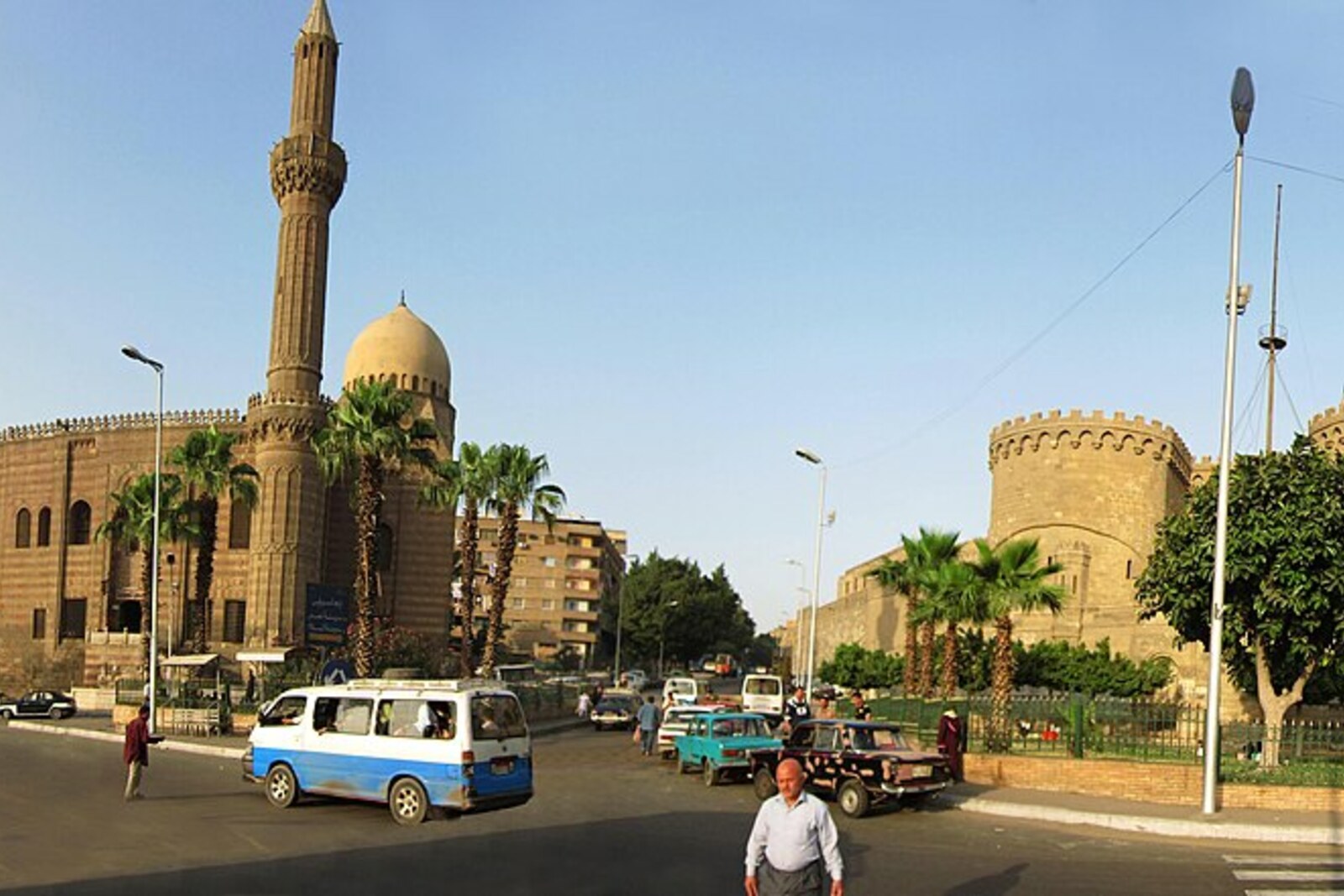
Look around first
What to notice
- Citadel wall
- Bab al-Azab
- The square's open space
- Facade of the Mosque-Madrasa of Sultan Hassan
The story of the place
Between the Citadel wall and the Mosque-Madrasa of Sultan Hassan, a broad gap remains, now occupied by roads and a roundabout. Today this is Salah al-Din Square, named after the man who began building the Citadel above it. In medieval chronicles, it appears as Rumayla—the Sandy Square.
This open space was needed after Egypt's rulers settled in the Citadel. In twelve thirteen, Sultan al-Kamil established a horse market at the foot of the walls. Later, al-Nasir Muhammad cleared and enlarged the ground for playing polo with his emirs. Troops assembled here, ambassadors were received, and festival prayers were held. The Citadel gates opened directly onto this field: every ceremonial arrival before the sultan began below, in full view of the townspeople.
In March fourteen fifty-three, a very different procession crossed the square. A few weeks earlier, Sultan Jaqmaq had died, leaving the throne to his eighteen-year-old son, Uthman. The senior Mamluks refused to recognize the young heir. Mamluks were warriors purchased into slavery in their youth and trained for military service; many of them later became commanders and took the throne themselves.
The rebellion was led by seventy-three-year-old Inal, the commander-in-chief of the army. He sought Uthman's removal and his own proclamation as sultan. The young sultan had more soldiers, but he did not occupy the Mosque-Madrasa of Sultan Hassan opposite the Citadel. Inal's men breached an opening in its wall, raised throwing engines onto the roof, and began bombarding the sultan's stables beyond the Citadel gates. Below, detachments from both sides met at Rumayla.
The fiercest clash unfolded near Sabil al-Mu'mini, a building with a drinking-water source on the square's southern side. Inal's fighters advanced beneath mobile wooden canopies that shielded them from arrows and stones. One contemporary claimed that an unknown rider rode out ahead: armor covered him and his horse almost completely, and the tip of his spear was coated with an incendiary mixture. With it, the rider set fire to the roof of the sabil. The chronicler did not record his name, but stated the consequence precisely: smoke drifted toward the Citadel wall, the defenders withdrew, Inal's engineers dismantled part of the barrier, and the rebels burst inside.
Uthman's supporters began going over to the other side. The young sultan hid in the palace women's quarters beside his mother, but he was found and arrested. A few days later, he was led out of the Citadel in chains, put on a horse, and sent down the Nile to an Alexandrian prison. His reign lasted around a month and a half. Inal took the Citadel and remained sultan for another eight years.
Sabil al-Mu'mini and the old Bab al-Silsila gate have not survived; on the Citadel side, the later Bab al-Azab now stands. But the distance between the wall and the mosque remains. It was this distance that Inal's men crossed when, in one week, a ground for cavalry parades became the road to the sultan's throne.
Useful on site
Open urban space accessible around the clock; admission is free, but traffic around the square is heavy.
Checked: June 27, 2026. Check the official source before visiting.The main view opens from outside, so the interior is not essential for this stop. Because of the traffic, choose a safe spot at the edge of the square and cross streets only at permitted places.