 Guide On Map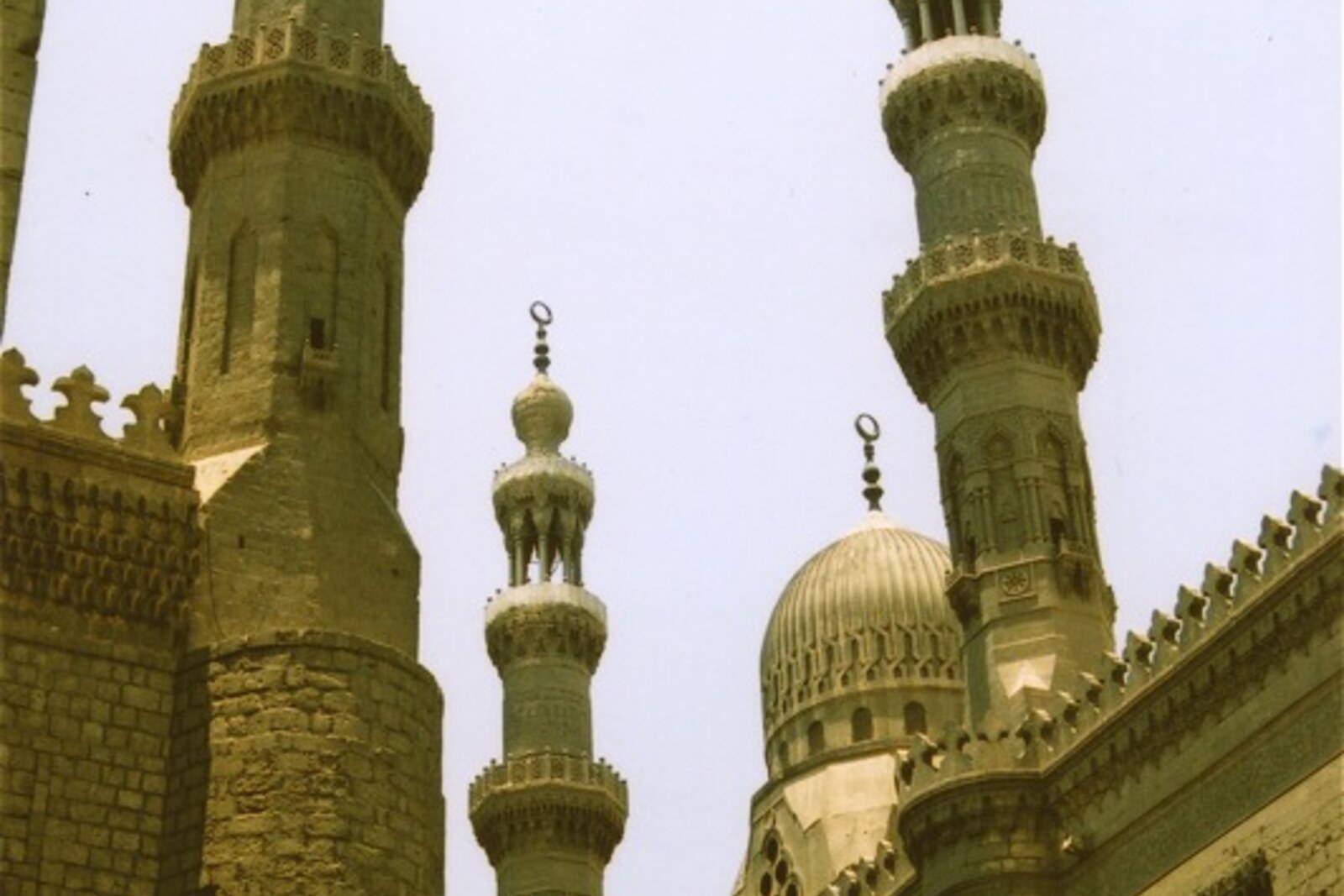
Look around first
What to notice
- Tall entrance portal
- Central courtyard
- Four iwans
- Mihrab and mausoleum wall
The story of the place
Sultan Hassan ordered his own tomb to be built beyond the wall of the main prayer hall. When people faced Mecca, the patron's future grave lay behind the mihrab, in the same direction. But Hassan himself was never in it.
This is a mosque, an educational institution, and a mausoleum brought together in one complex. On the sides of the courtyard are four open vaulted halls—iwans—and around them were the schools of the four Sunni legal traditions. Here, they taught interpretation of the Quran, hadiths, and law; they housed students and orphans; the main iwan served as the hall for the communal Friday prayer.
Construction began in thirteen fifty-six on the site of an emir's palace by the horse market at Salah al-Din Square, directly below the Cairo Citadel. Hassan, the young sultan of Egypt, tried to rule without the guardianship of the senior emirs. He was first placed on the throne as a teenager, and when he began making decisions himself, he was deposed and held in custody for about three years. After his return, Hassan removed the former administrators and began promoting Mamluks personally loyal to him. The complex by the road to the Cairo Citadel was meant to feed hundreds of students, gather city residents for prayer, and preserve the name of its founder after his death.
One of the people promoted by Hassan was Yalbugha al-Umari, his Mamluk and trusted military commander. The sultan gave him the highest military rank, rich land revenues, and a fortified palace above Cairo. Yalbugha spent these resources on his own large retinue. Hassan saw that the man he had raised as a support against the old emirs could now do without him.
In March thirteen sixty-one, the sultan attempted to arrest Yalbugha al-Umari. Yalbugha al-Umari had prepared in advance. His men defeated Hassan's detachment outside Cairo, surrounded the sultan in the Cairo Citadel, and, after a failed attempt to escape, took him to the victor's house.
After that, the reliable sequence of events breaks off. The chroniclers agree on one point: no one ever saw Hassan again, and his body was not found. Al-Maqrizi, writing later, claimed that Yalbugha al-Umari ordered the captive to be tortured and killed, then had the body hidden beneath a stone platform by his house, from which he mounted his horse. There is no known grave there, so this is a chronicler's account, not a confirmed burial place.
Together with the senior emirs, Yalbugha al-Umari installed a new young sultan and took the post of commander in chief. He also received his former master's house: soon afterward, Yalbugha al-Umari married Hassan's widow. For Hassan himself, the outcome was disappearance and a tomb to which there was no one to carry.
Work on the complex was continued by the court official Bashir al-Jamdar. Later, two of Hassan's sons—Ahmad and Ismail, Sultan Hassan's Son—were buried in the mausoleum. Beyond the wall with the mihrab remained the burial chamber prepared for the sultan; his children lie in it, while the place of his own burial is unknown.
Useful on site
Daily 09:00–17:00; a combined ticket with the Al-Rifa'i Mosque is valid. The MoTA page as of 27.06.2026 lists 220 EGP for adult foreign visitors and 110 EGP for students.
Checked: June 27, 2026. Check the official source before visiting.Check the conditions for visiting the interior separately from the Cairo Citadel. Inside, speak quietly and do not enter closed areas; outside, step back far enough to see the scale of the complex and its proximity to the Cairo Citadel.