 Guide On Map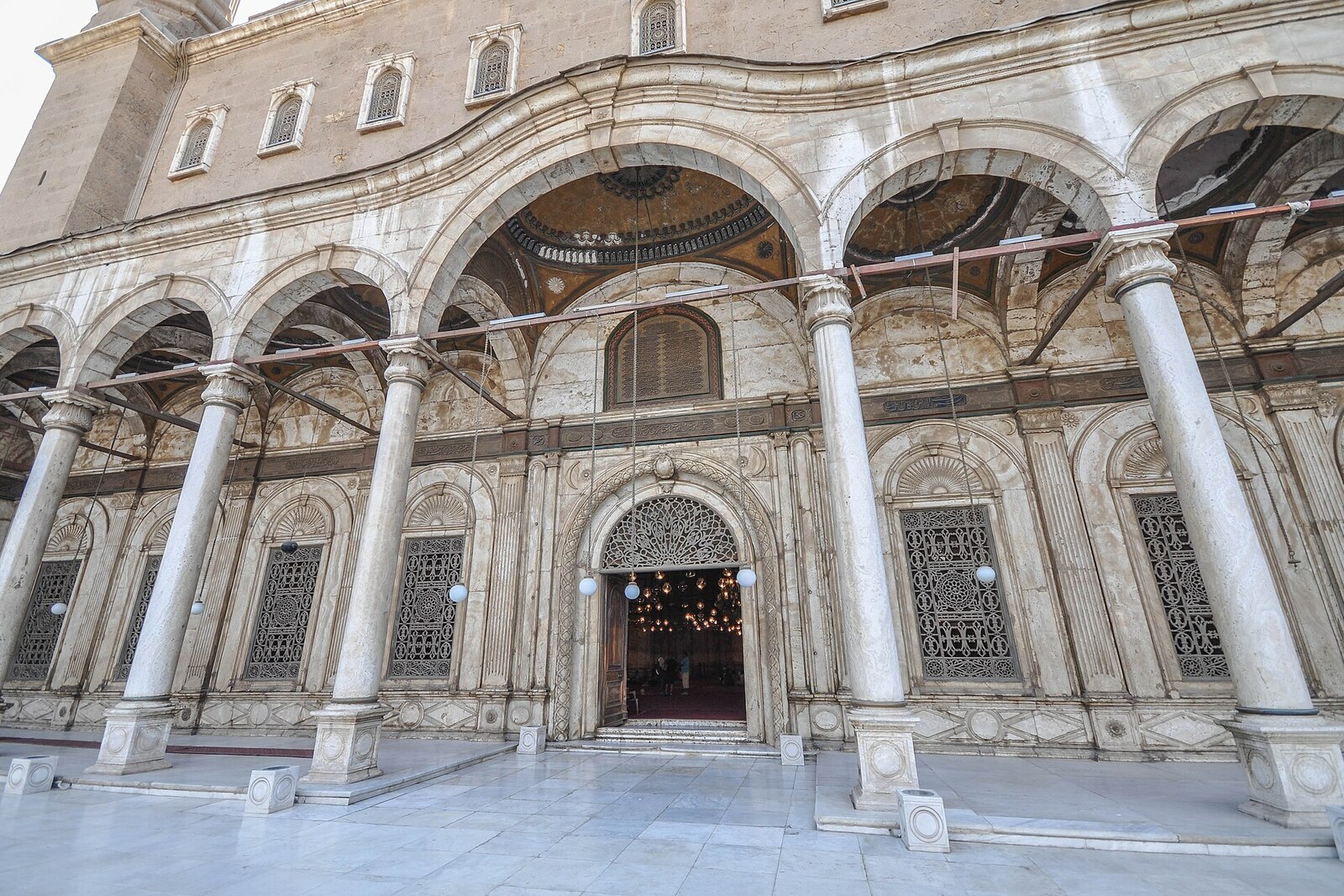
Look around first
What to notice
- Central dome
- Cascade of half-domes
- Two slender minarets
- White marble tomb behind a bronze grille
The story of the place
The mosque bears the name of its patron. Muhammad Ali was the Ottoman governor of Egypt, whom the sultan could remove from office. He collected taxes, commanded the army he had created, and pursued one main goal: that Egypt after him should pass to his sons.
For his mosque, he chose the summit of the citadel, from which the Mamluk beys had formerly ruled the country—the military elite with whom the Ottoman governor had to share power. In eighteen eleven, Muhammad Ali ordered that they be killed in the citadel. The builders then cleared away the remains of their palace complex, including Qasr al-Ablaq. In eighteen thirty, they began building a huge prayer hall beneath a central dome on this site.
Muhammad Ali did not take his model from Cairo. He ordered the mosque to be built in the likeness of Istanbul's imperial mosques: with a cascade of half-domes and two slender minarets. In Ottoman tradition, several minarets usually distinguished the mosques of the ruling family. Formally, Muhammad Ali remained an official of the sultan, but he commissioned a mosque of the same rank as those of his sovereigns.
A year after construction began, his son and commander in chief, Ibrahim Pasha, led the Egyptian army into Syria. He defeated the sultan's troops, occupied Syria, crossed into Anatolia, and approached the empire's capital. Muhammad Ali hoped to obtain for his family the possessions that he was already holding by force of arms.
The sultan was saved by the intervention of the European powers. In eighteen forty, they forced Muhammad Ali to withdraw his troops from Syria and limit his army. Yet the following year, the sultan recognized Egypt as a hereditary possession of Muhammad Ali's family. Muhammad Ali lost the conquered lands, but his descendants really did succeed one another at the head of Egypt for more than a century.
He himself did not live to see the mosque fully finished and died in eighteen forty-nine. His son Said Pasha completed the work in eighteen fifty-seven. To the right of the entrance to the prayer hall, behind a bronze grille, stands the white marble tomb of Muhammad Ali. The dome of the new dynasty also became the tomb of its founder.
Useful on site
Daily 08:00–16:00; admission is included in the citadel ticket. As an active mosque, it may close to visitors during prayers.
Checked: June 27, 2026. Check the official source before visiting.Inside, follow the rules of an active mosque and do not walk in front of people at prayer. If entry is restricted, the silhouette, the Ottoman composition, and the clock are clearly visible from the courtyard and the open sections of the citadel.