 Guide On Map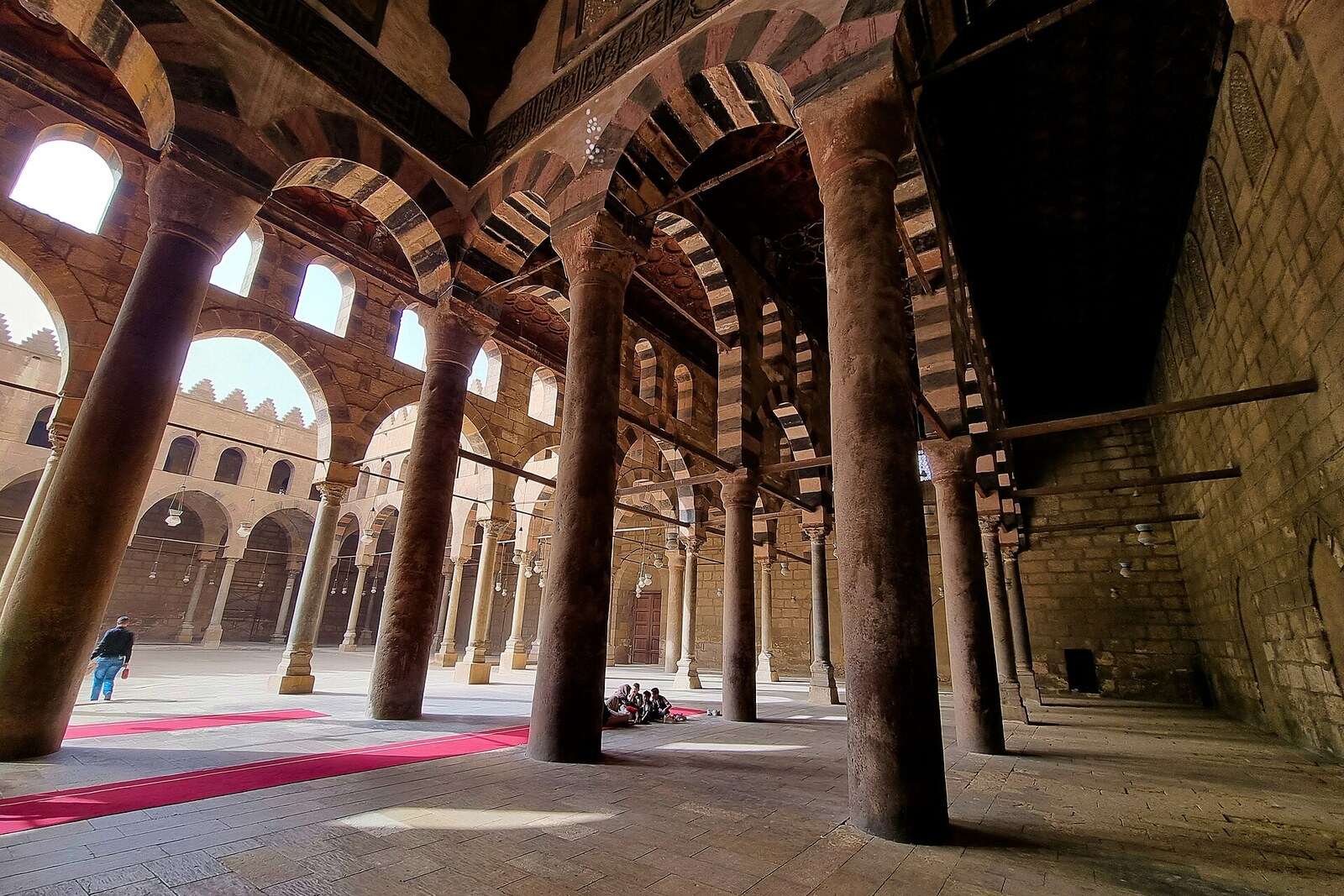
Look around first
What to notice
- Open inner courtyard
- Mihrab
- Site of the former maqsurah
- Two minarets
The story of the place
Inside the Citadel stands a mosque built where an old fortress prayer hall once stood. An open courtyard connects it to the hall, and two minarets face the former palace and military quarters. The wooden screen by the mihrab has disappeared, as have the neighboring palaces; the Mosque of Muhammad Ali now rises nearby.
On Fridays, the open courtyard at the center of the mosque brought together those who on other days were divided by the Citadel's walls: residents of the sultan's palaces, officials, Mamluk soldiers, and inhabitants of the surrounding quarters. The ruler prayed beneath the dome, in front of the mihrab—a niche indicating the direction of Mecca. A maqsurah, a screened-off section of the prayer hall, was arranged there for him and his retinue. One minaret carried the call toward the palaces, the other toward the military quarter.
The patron of the Mosque of al-Nasir Muhammad, the young Mamluk sultan, sought the ability to control the court, army, and treasury himself. He first received the throne as a nine-year-old boy. During his second reign, two emirs—senior military commanders at court—kept the title for him but made the decisions themselves. The governor Salar and Baybars al-Jashankir, who managed the sultan's household, even restricted al-Nasir Muhammad's spending and movements. He did not have enough money to maintain his own household, although his sultan's name was pronounced in the Friday sermon.
In thirteen oh nine, al-Nasir Muhammad announced that he was leaving on pilgrimage, departed Cairo, and turned toward al-Karak—a fortress in what is now Jordan. From there, he announced his abdication. If the calculation failed, he would lose the throne and probably his life. Baybars immediately took his place.
From al-Karak, al-Nasir Muhammad began negotiating with Syrian governors and Egyptian emirs whom he trusted. Some of the commanders refused to support Baybars. Already in thirteen ten, Baybars fled Cairo, then fell into al-Nasir Muhammad's hands and was executed. Salar ended up in prison and died there. Al-Nasir Muhammad returned to the throne for the third time and no longer appointed his former guardians over himself.
Eight years after his return, he ordered the old fortress mosque demolished and this one built in its place. Here the sultan appeared before the courtiers and garrison every week, now in his own place beneath the dome. He recruited reciters, imams, and muezzins, and the two minarets made it possible to summon both parts of the Citadel to a single prayer. In thirteen thirty-five, al-Nasir Muhammad enlarged the mosque, raised the roof, and rebuilt the dome over the maqsurah. Inside the dome, his name, titles, and the date of the reconstruction were placed. After his death, subsequent Mamluk sultans continued to come here for Friday prayer.
The palaces from which al-Nasir Muhammad emerged into this courtyard were later dismantled; the Mosque of Muhammad Ali now stands nearby. The wooden screen of the maqsurah has also disappeared. What remains are the open courtyard, the sultan's place in front of the mihrab, and the two minarets facing the former palace and military quarters. Here, the title that had once been left to al-Nasir Muhammad instead of money and decisions was heard every Friday in the presence of people gathered on both sides of the Citadel.
Useful on site
Daily 09:00–16:00; admission is included in the Citadel ticket. Access to the prayer hall may be restricted during prayers.
Checked: June 27, 2026. Check the official source before visiting.View the ancient fragments as parts of a working building, without touching the masonry or columns. The colored details are high up—step back and view them from a distance.