 Guide On Map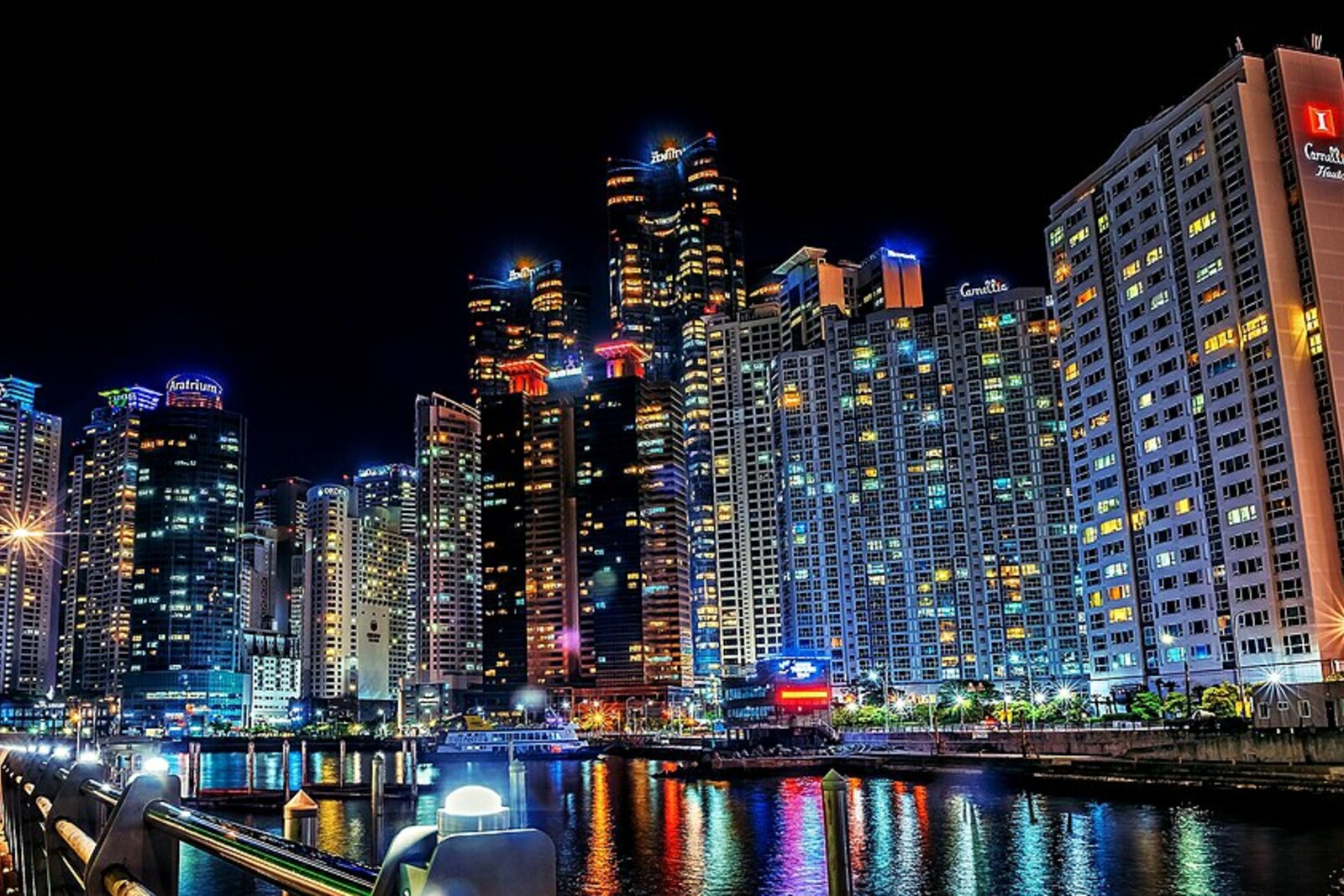
Look around first
What to notice
- Two-story clubhouse
- Floating piers
- Open waterfront plaza
- Marine City towers
The story of the place
Restaurants, a gallery, and an open waterfront plaza are gathered around the low two-story clubhouse. Behind it operates the marina at Unchon Port, with floating piers for sixty-one vessels. The protection regime around Dongbaekseom Island kept this stretch of shore low-rise, although the towers of Marine City already rise nearby. The piers receive yachts, while people come from shore to the plaza and the clubhouse.
In twenty eleven, a halted construction site stood at the entrance to Dongbaekseom Island. The previous developer had begun work a year earlier, ran into financial trouble, and put the rights to the project up for auction. They were bought by Park Ji-man, a restaurateur from a family of Busan builders, who envisioned a yacht base open to everyone. He needed visitors who had never owned a yacht of their own. So Park turned the clubhouse over to restaurants, a gallery, and open terraces: people were meant to come first to eat or take photographs, then become interested in trips at sea.
Before that, the site had been a concrete parking lot. Earlier still, it was Unchon Port, where boats took shelter in the bay between the Haeundae shore and Dongbaekseom Island. Park took the word “Bay” from the old port—the bay. He explained the number “one hundred one” differently: he wanted to make the yacht base one hundred percent, then add one more. Because of the protection regime around Dongbaekseom Island, tall construction was not allowed, so a two-story clubhouse with a large waterfront plaza appeared opposite the towers of Marine City.
The choice of the bay seemed justified. A study commissioned by the district as early as two thousand five called this water relatively calm: waves no higher than fifty centimeters were expected. But four-meter waves arrived the day before the opening. They smashed two of the three floating piers and damaged four vessels. The next day, May thirteenth, two thousand fourteen, the complex opened nevertheless. The restaurants filled at once, while the marine section was left with damaged decks and bare supporting columns. The owners had to receive guests and at the same time decide again how to keep yachts by the shore.
The piers were restored. In a city study from twenty twenty-five, The Bay 101 is listed as an operating marina at Unchon Port with sixty-one berths on the water. Food, the open plaza, and photographs against a backdrop of high-rises still bring far more people here than the yachts themselves—just as Park Ji-man intended to accustom the city to trips at sea.
The word “Bay” also recalls another activity on this water. Fishermen lived in old Unchon; for coastal families, fishing was their main source of income. From spring through autumn, they went out for anchovies, and on the neighboring shore of Seoundae they laid stone enclosures. At low tide, the water receded, the fish remained inside, and the catch could be gathered without a boat.
In nineteen eighty-three, builders began filling in this part of the bay for a yacht center for the Asian Games and the Olympics. By the end of nineteen eighty-seven, the shore of Seoundae, together with its stone traps, had disappeared. Fishing families lost their working edge of the sea, and the new land was called the Suyeong Reclamation for another twenty years. It was given the name Marine City only in two thousand seven. The low The Bay 101 stands by the former Unchon Port, and beyond its sixty-one berths rise towers on the site of the old fishing enclosures.
Useful on site
The waterfront is always open; the restaurants and yacht club operate on their own schedules
Checked: June 28, 2026. Check the official source before visiting.In heavy surf, do not linger at the very edge and follow the requirements of temporary barriers. Reflections require a calm bay; wind easily ruins the mirror-like image.