 Guide On Map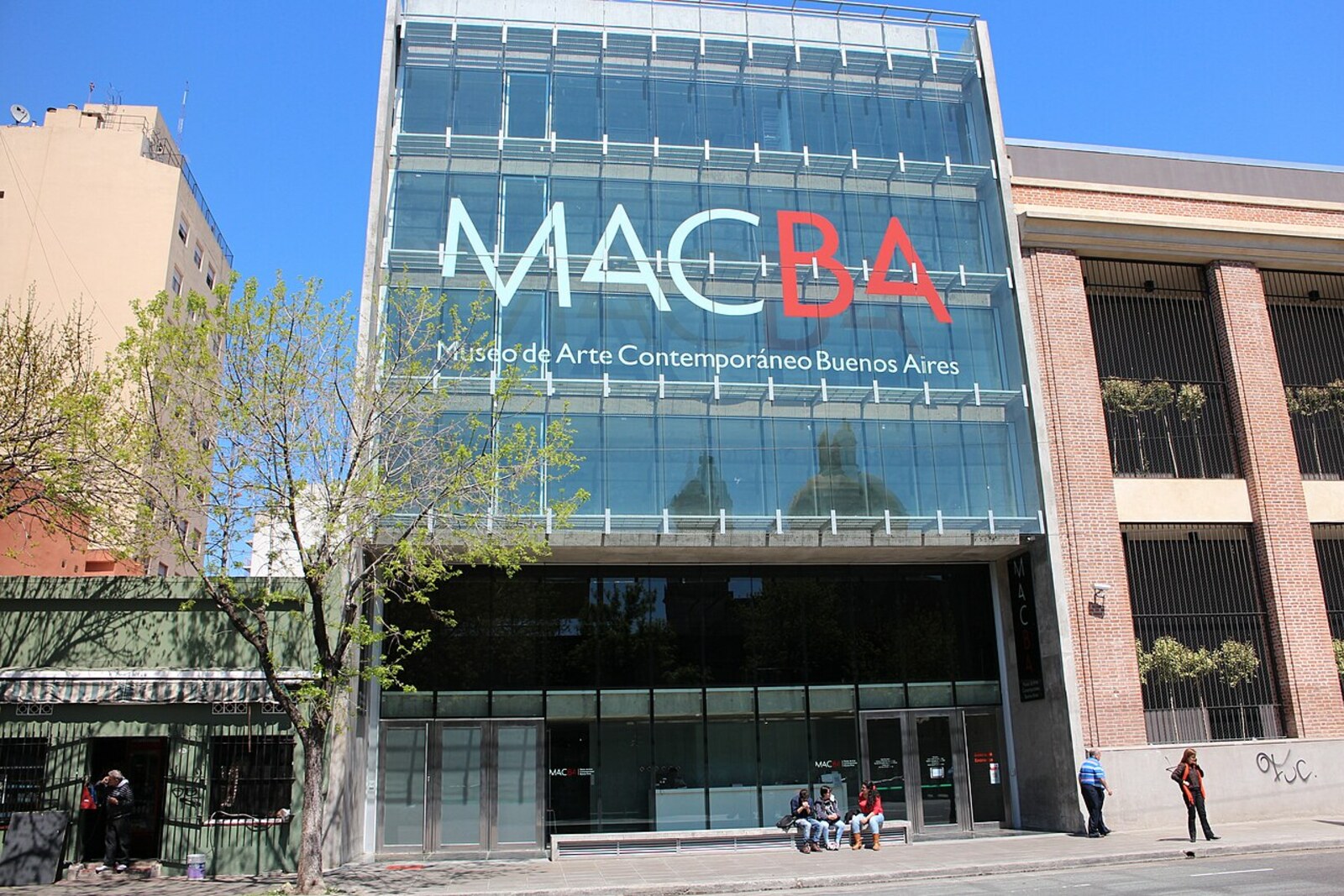
Look around first
What to notice
- Museum entrance
- Ground-floor galleries
- Temporary exhibition
The story of the place
The heavy red-brick facade conceals museum galleries that follow the rhythm of temporary exhibitions. Displays are assembled on the lower level, then dismantled to clear space for the next one. At the entrance begins a route through the museum, where artworks and exhibition structures may remain in the city briefly before moving on.
In nineteen fifteen, on the ground floor of a former tobacco warehouse, museum staff attempted to reconstruct an artwork that had not existed for half a century. Curator Sofía Durron wanted to bring back “La Menesunda,” a work known from photographs, newspaper articles, and the recollections of those who had managed to be inside it.
Its name means confusion in Buenos Aires slang. In nineteen sixty-five, artists Marta Minujín and Rubén Santantonín built this labyrinth at the Torcuato Di Tella Institute on Florida Street. Visitors were admitted one at a time. They passed through a pink opening shaped like a human figure, climbed a steep staircase, saw themselves on screens in a closed-circuit television system, found themselves beside actors lying in bed, and entered an enormous woman’s head, where a makeup artist and a masseuse were at work. Eleven rooms turned the viewer into a participant. After fifteen days, the structure was dismantled; it disappeared completely.
It had to be reconstructed without plans. Santantonín had already died in nineteen sixty-nine, so only his archive could correct other people’s memories. In one photograph, the artists stood in front of a tiny diagram. Durron and her colleagues enlarged this drawing and obtained the basis for the route. They calculated the rooms’ dimensions from parquet strips caught in the frame: their standard width provided the scale. Then they searched for old televisions, refrigerator doors, cosmetic packaging, and materials resembling Argentine plastics and fabrics from the nineteen sixties. Marta Minujín took part in checking every stage.
The staff had to decide where reconstruction ended and a new work began. The original staircase was narrow, electrical appliances stood beside visitors, and the entire structure had been assembled for two weeks and was not intended to be preserved. These risks could not be brought into the museum along with its appearance. Engineers reinforced the frame, took modern safety requirements into account, and divided the labyrinth into independent modules that could be dismantled, packed, and installed again.
Across four hundred square meters of the ground floor, “La Menesunda” opened fifty years after its first showing. Over several months, more than sixty-five thousand people passed through it. The museum thus returned to the history of Argentine art a work of which only film, photographs, and participants’ accounts had previously remained. The modules created here were then shown in New York and prepared for a European tour.
The labyrinth itself is not currently behind the red-brick facade. The restored neon tunnel, old signs, television panels, lamps, refrigerator doors, and record player created here travel from Buenos Aires; temporary exhibitions are once again installed on the ground floor of the former tobacco warehouse.
Useful on site
Daily 12:00–19:00; entry until 30 minutes before closing. Hours updated from the museum website.
Checked: July 1, 2026. Check the official source before visiting.If you go inside, give your eyes time to adjust to the optical works and vary your distance from them. Outside, it is most useful to compare the building with the brick shell of the neighboring museum.