 Guide On Map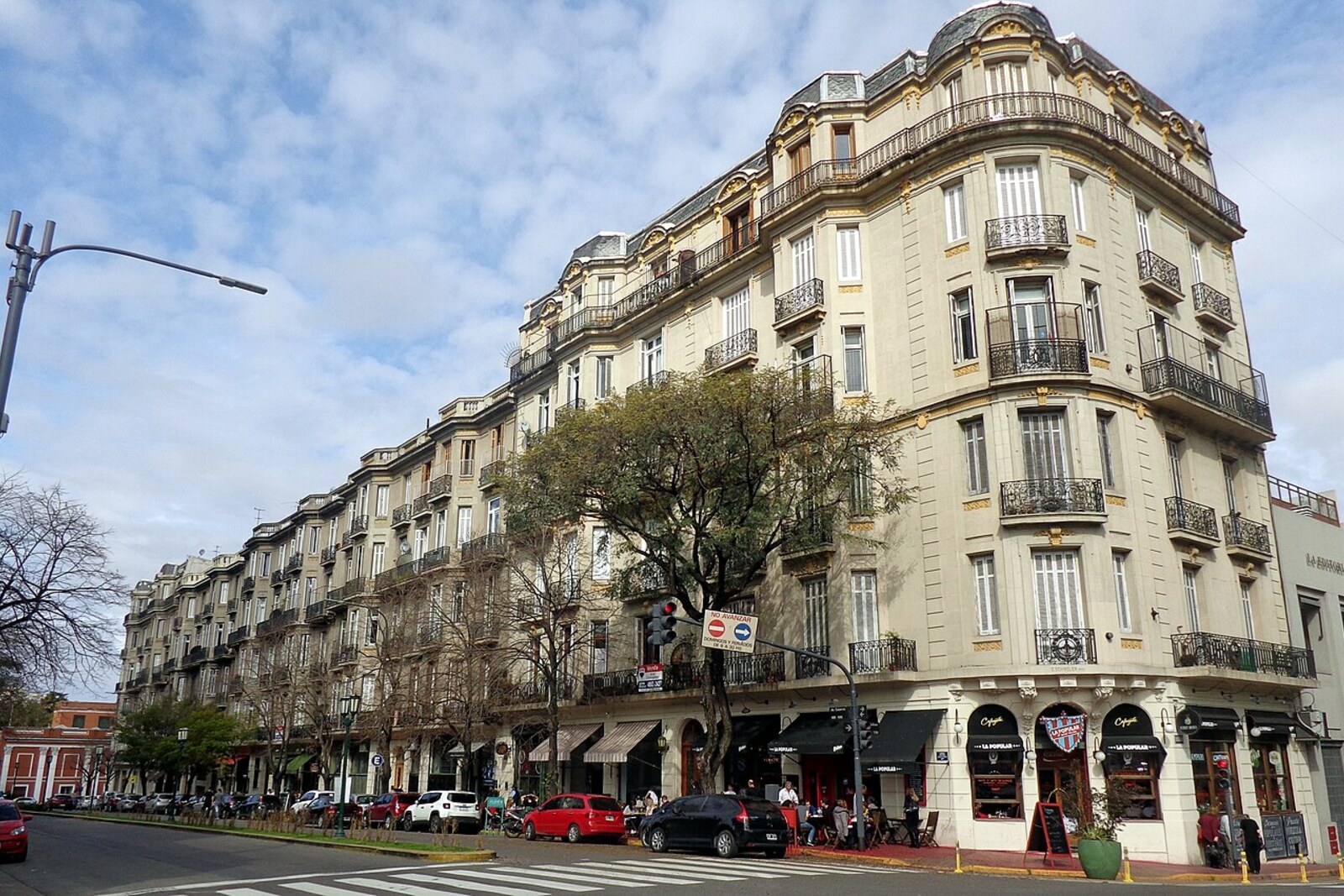
Look around first
What to notice
- Five oak doors
- Bay windows
- Attic apartments
- Broken balcony lines
The story of the place
For almost one hundred twenty meters along Caseros Avenue, the building has a shared facade, although inside it is divided into five separate parts. The oak leaves of the five entrances open onto different stairwells; there are forty-four apartments in all, and the corner sections rise with extra floors and attic apartments. Bay windows project above the sidewalk, and the balconies change direction with the slope of the avenue. Workshops once operated on the ground floor; cafes and restaurants have now replaced them.
At the beginning of the twentieth century, Alberto Anchorena, who owned five adjoining plots opposite Lezama Park, combined them into one large apartment building. The investment was meant to pay for itself through residential and commercial rents, so the commission was designed for specific tenants: British managers and employees of the Southern Railway.
Their workplace was a few blocks from here. The British company operated a network whose lines converged at Constitución Station. Anchorena hired the Swiss architect Christian Schindler to house the railway workers near this terminus. Between nineteen ten and nineteen twelve, Schindler brought five separate residential blocks together behind a single facade about one hundred twenty meters long.
The unified palace exists only on the outside. Behind the five oak doors are separate entrances, and the building contains forty-four apartments in all. The corner blocks were given extra floors and attic apartments, bay windows projected above the sidewalk, and the balcony lines had to change direction to follow the slope of the avenue. On the ground floor, space was left for premises that brought in separate rent: workshops occupied them at first, while cafes and restaurants now take up most of them.
Anchorena's plan worked. British railway workers moved into the building, and neighborhood residents nicknamed it the English Conventillo. In Buenos Aires, conventillos were multifamily apartment buildings; here the word sounded unusual because of the well-off tenants, separate apartments, marble staircases, and cage elevators. After the law on condominium ownership was passed in nineteen forty-eight, the apartments began to be sold to different owners. The former single owner and the original group of tenants were gone, but the name English Conventillo outlived them.
The avenue itself received its name before this building did. Caseros is the name of a battle that took place on February third, eighteen fifty-two, far to the northwest of here. Juan Manuel de Rosas, governor of Buenos Aires, handled the foreign affairs of the Argentine Confederation, kept the customs revenues of the capital's port, and postponed convening a general constitutional congress. Justo José de Urquiza, governor and major cattle rancher from Entre Ríos Province, sought free river trade and a new agreement among the provinces. He broke his alliance with Rosas and led the Great Army against him, made up of troops from Entre Ríos Province, Corrientes Province, Uruguay, and Brazil.
Urquiza won. Rosas signed his resignation and left for England, while the victor assembled the governors and began a process that ended with the adoption of the constitution of eighteen fifty-three. Buenos Aires refused to join it at the time and separated from the confederation. It was during this period, on August twenty-fifth, eighteen fifty-seven, that the street was given the name Caseros.
Today the name appears on the street signs, and between Defensa Street and Bolívar, five oak doors still follow one another—five parts of the apartment building that Anchorena built for employees of the British railway.
Useful on site
Open city street; businesses on the ground floors keep their own hours.
Checked: July 1, 2026. Check the official source before visiting.These are residential buildings, so view them from the street and do not enter the interior spaces without an invitation. For a complete view, move to the opposite side of the avenue.