 Guide On Map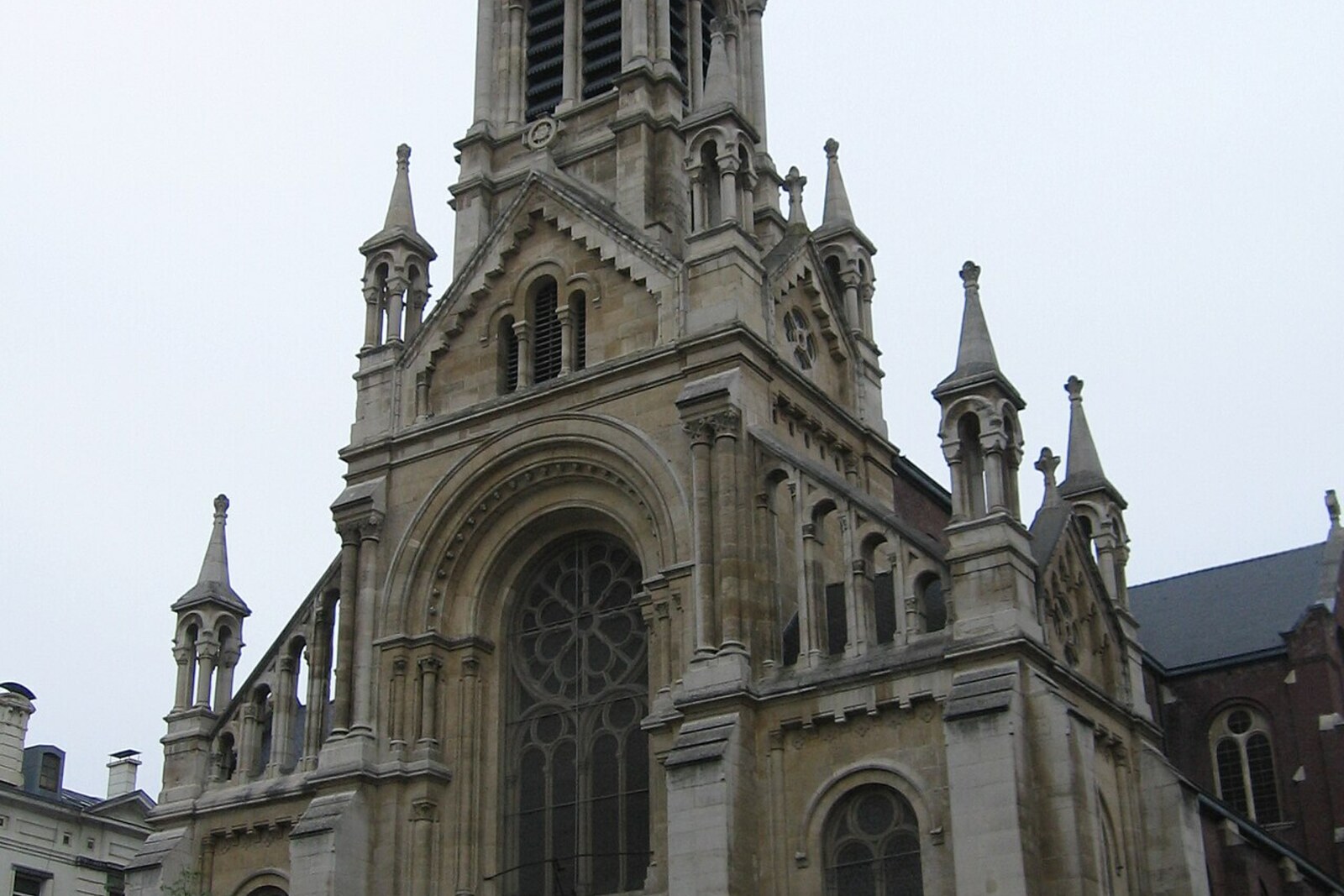
Look around first
What to notice
- The church's main portal
- Relief of the hermit and the doe
- Steps before the entrance
- The curving square
The story of the place
The steps lead to the main entrance of the third church on this site. It was built to a design by Victor Besme and completed in eighteen seventy-eight; its altar faces west, although those of the two earlier churches faced east. The space by the steps curves because it was laid out over the beginning of the demolished Rue Jourdan. Where the square meets the steps, parishioners were once buried.
In front of the Church of St. Gilles, a market is set up several days a week; at other times, café tables occupy the square. The word “parvis” itself means the space in front of a church entrance. But the church appeared here before the square, and the saint's name passed from it to the whole Brussels district.
In twelve sixteen, Obbrussel—as Upper Brussels was then called—belonged to the parish of Forest. At the request of Henry I, Duke of Brabant, the residents received their own parish, church, baptismal font, and cemetery. They could now baptize children and bury the dead locally. The first houses of the future Saint-Gilles gathered around the church site.
The parish was dedicated to Saint Giles, an early medieval hermit. He was venerated as the patron saint of the disabled, the poor, and blacksmiths, and was asked for healing; a leprosarium stood within the new parish. On the portal of the present church is a depiction of the legend of Saint Giles: during a royal hunt, a doe hid beside the hermit, and the arrow meant for it pierced his hand. This is a legend, not a confirmed episode in his biography.
The first church stood here for more than three and a half centuries. In fifteen seventy-eight, Spanish troops besieged Brussels. The church stood outside the city walls and could have served as an observation point for the besieging forces. The residents of Obbrussel dismantled their own parish church to prevent this.
They destroyed the building where they baptized children and buried relatives, and had to wait seventeen years for a replacement. Construction of the second church began on the same site in fifteen ninety-five. Five years later, its choir was consecrated, but the roof over the nave was not completed until seventeen fifty-six. This building also disappeared: in the nineteenth century, Saint-Gilles's population grew so much that parishioners no longer fit inside.
The present church is the third. Victor Besme designed it in eighteen sixty-two, and construction was completed in eighteen seventy-eight. The altars of the two earlier churches faced east; the present church's altar faces west, while its main entrance faces the Chaussée de Waterloo. No visible parts remain beneath the present church from the churches for which residents once sacrificed the first building.
The market occupied the cramped space by the church entrance in eighteen sixty-five. Vegetables, fruit, and dairy products were sold here. By the end of the century, traders no longer had enough room. In nineteen hundred, the municipal council approved a plan by the architect Edmond Quétin: the Municipality of Saint-Gilles bought and demolished the beginning of Rue Jourdan, together with village houses, an enameling works, a hardware factory, and the old inn À la Cour Royale. A long square was laid out on the cleared land, widening as it approaches the church.
At the steps, where stalls and tables now appear, the parish cemetery once lay. The elongated, curving section of Parvis de Saint-Gilles occupies the vanished stretch of Rue Jourdan—the very site cleared for the market.
Useful on site
An active church; interior access depends on services and parish events. The Parvis de Saint-Gilles market operates on its own schedule.
Checked: June 28, 2026. Check the official source before visiting.This is an active public space, not museum scenery: go around the market stalls, do not disturb parishioners, and keep in mind that the market is not always present. For the finale, find a quiet place with a view of the church and square.