 Guide On Map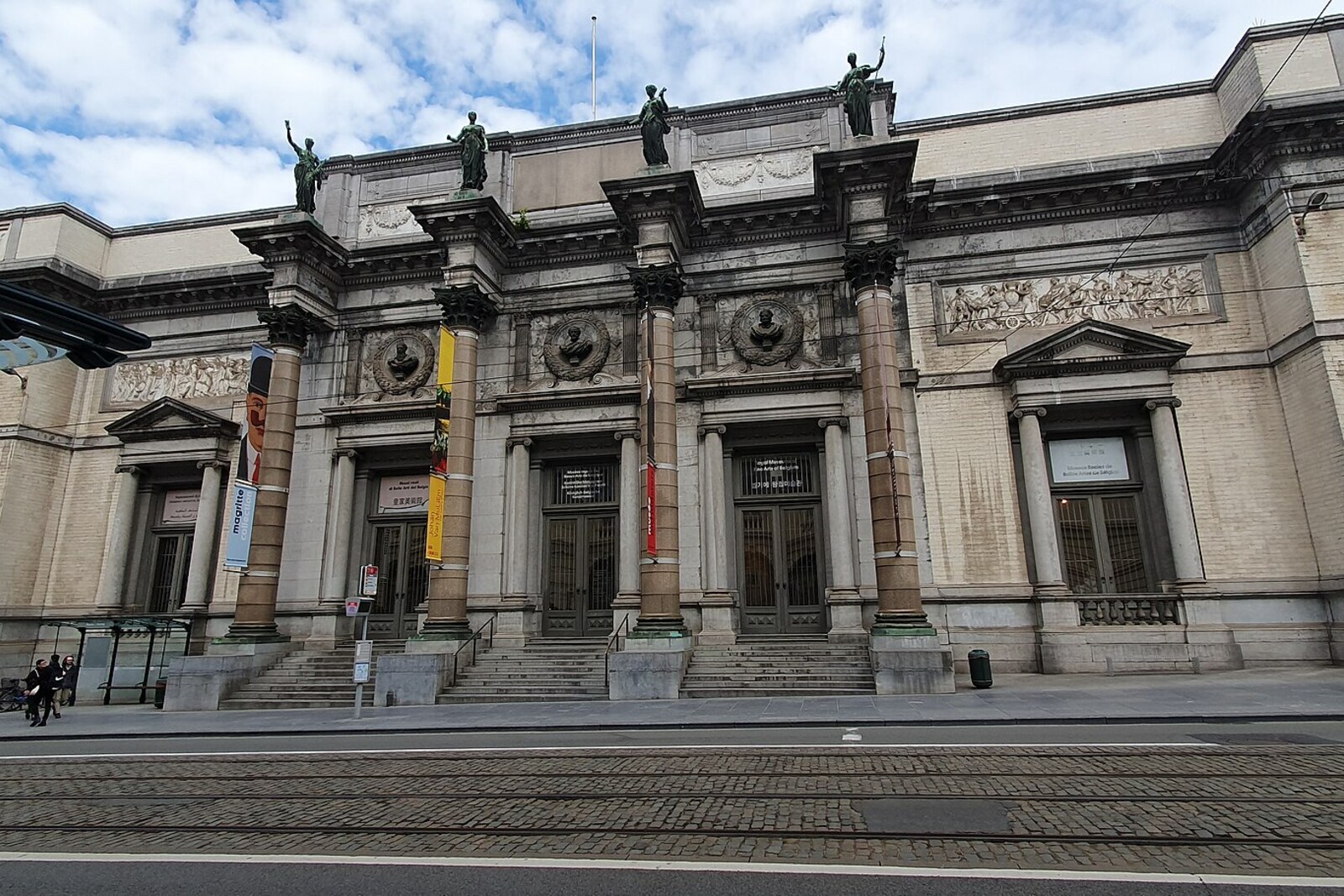
Look around first
What to notice
- The façade on Rue de la Régence
- “The Coronation of the Virgin”
- “The Assumption of the Virgin”
- The plaster bust of the first curator
The story of the place
Along Rue de la Régence runs the façade behind which separate galleries for the Old Masters were set aside in the late nineteenth century. Here, the word “Royal” refers to the institution’s state status under the Belgian monarchy, not to a ruler’s private collection. The Antoine Wiertz Museum was added to it later, which is why the name is plural. The collection includes paintings by Rubens and a plaster bust of the first curator.
Guillaume Bosschaert was appointed curator of a museum the public had not yet seen. In seventeen ninety-eight, his workplace became the overcrowded storerooms of the Old Court—the name given to the former Palace of Charles of Lorraine on this same museum site.
Four years earlier, the French army had occupied the Austrian Netherlands. Commissioners then went through churches, abbeys, and private collections: the finest paintings were sent to the Louvre in Paris, the property of closed monasteries was declared national, and everything else was brought to Brussels. About one thousand five hundred works accumulated in the palace, stacked and laid one atop another. The commission set aside around one hundred for the future museum.
By then Bosschaert headed the Academy of Painting, Sculpture and Architecture of Brussels and served as an expert on paintings. The museum extended his profession: he wanted to give his students original works by Old Masters. After the requisitions, no publicly accessible works by Rubens or Van Dyck remained in the city, and the administration would not allow even a small sum to be spent on maintaining the collected paintings.
In eighteen oh one, First Consul Napoleon Bonaparte established fifteen provincial museums, including the one in Brussels. Paintings from Paris, however, did not arrive, and the opening was postponed. Bosschaert traveled to the capital four times and wrote to officials and to Bonaparte himself. He asked for at least a dozen good paintings for the academy.
The Paris administrators decided to divide the paintings among fifteen cities in equal lots, effectively by lottery. Bosschaert objected: Brussels had been placed on the same level as cities from which no one had removed the finest works. The allotment assigned to him proved weak. The curator declared that he would not leave without the promised Rubenses, and won the right to make an exchange. He traded several secondary paintings for four works by Rubens and two by Van Dyck. In a letter to the mayor of Brussels, Bosschaert reported that, after all the obstacles, the paintings were finally being packed.
In the summer of eighteen oh three, the museum opened. The catalogue listed two hundred fifty-one works, although only half had been hung. The public was admitted on Thursdays and Saturdays; on the other days, artists worked in the galleries. So the institution’s purpose was established at once: paintings were displayed here and artists were taught from them at the same time.
Bosschaert continued to demand new shipments. In eighteen eleven, he received another thirty-one paintings from the Louvre. After Napoleon’s fall, France began returning the works it had removed. On November twentieth, eighteen fifteen, six crates intended for Brussels were placed in the museum courtyard. Permission was required to open them, and the correspondence dragged on for five weeks. On December fourteenth, Bosschaert died without ever seeing the crates’ contents. His successor unpacked them in January; several paintings had been damaged by damp.
The collection gradually ceased to fit in the Old Court. The Belgian state took over the city museum in eighteen forty-two, and the Old Masters were moved behind the present façade on Rue de la Régence in eighteen eighty-seven. The word “Royal” denotes the status of a state institution under the Belgian monarchy: these galleries were not the monarch’s private collection. The plural form appeared after the Antoine Wiertz Museum was incorporated in eighteen sixty-eight; the final current name was established in nineteen twenty-seven.
The collection still includes The Coronation of the Virgin by Rubens and his workshop, from the shipment Bosschaert negotiated in eighteen oh two. It also holds The Assumption of the Virgin, returned in eighteen fifteen, and a plaster bust of the first curator, made by Gilles-Lambert Godecharle in the year Bosschaert died.
Useful on site
Old Masters/Magritte: Tue-Fri 10:00-17:00, Sat-Sun 11:00-18:00; Mon closed.
Checked: June 28, 2026. Check the official source before visiting.The paintings are inside, so viewing them requires a separate museum visit; choose the works you want to see in advance.