 Guide On Map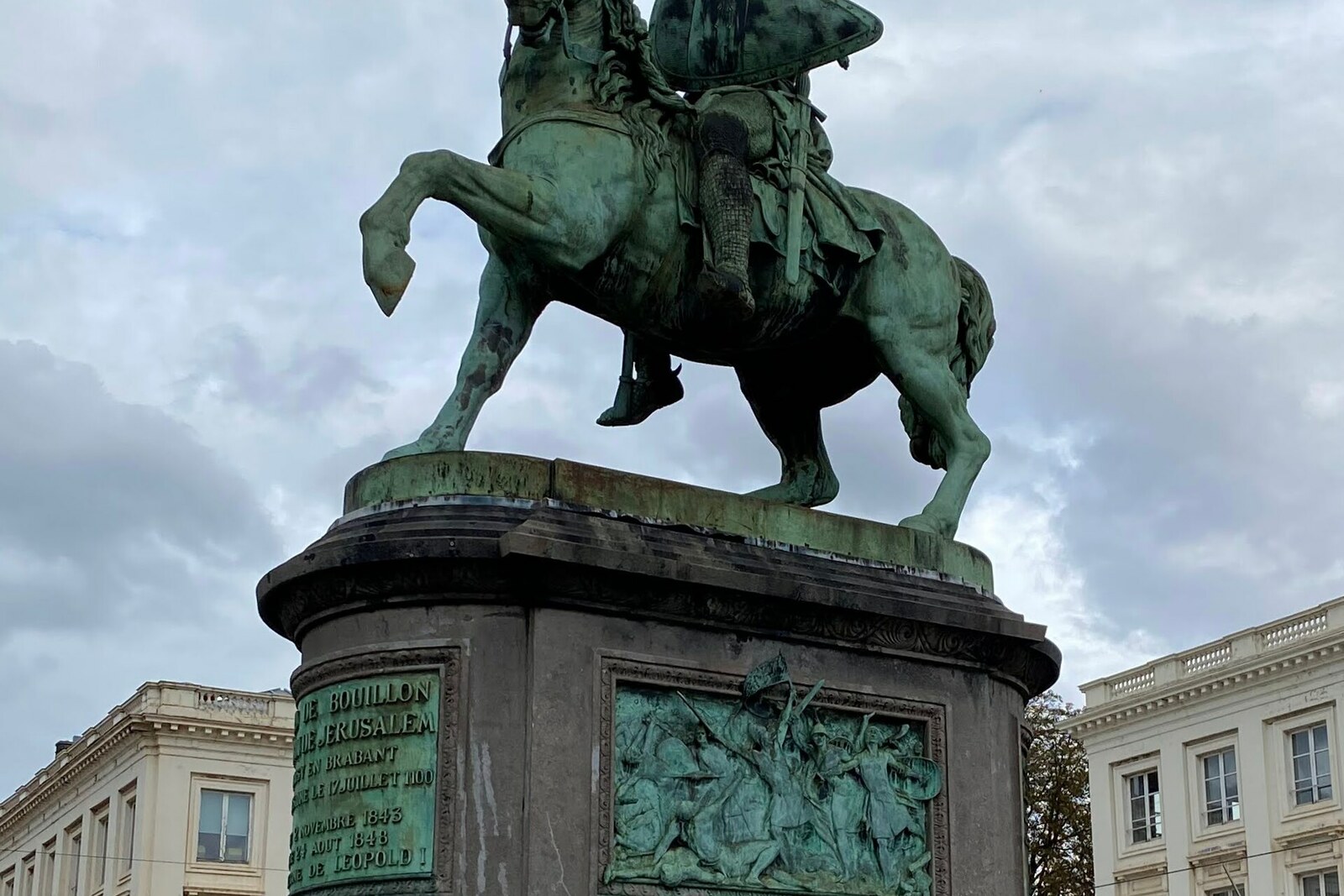
Look around first
What to notice
- Equestrian statue of Gottfried of Bouillon
- Façade of the Church of St. Jacques-sur-Coudenberg
- Inscription on the pedestal
The story of the place
At the center of Place Royale, Gottfried of Bouillon raises a banner above his head. Yet on the square’s main day, the bronze horseman was not here yet. On July twenty-first, eighteen thirty-one, a temporary gallery with columns was erected in front of the Church of St. Jacques-sur-Coudenberg. A throne was placed beneath a white-and-gold canopy, and the chair bore the words: “Unity gives strength.” The deputies of the National Congress of Belgium waited for a man who was still a foreign prince.
After the revolution, Belgium declared independence from the United Kingdom of the Netherlands and adopted a constitution. The new state did not yet have a king, and Willem I had no intention of recognizing the loss of the southern provinces. Congress elected Leopold of Saxe-Coburg, a forty-year-old German prince living in England. He was the widower of the British heiress Princess Charlotte; his English home, household, and obligations were supported by a life annuity granted by Parliament after the marriage.
Leopold hesitated. The Belgian constitution left the king less independence than he wanted, the country’s borders were disputed, and the army was still being formed from former units and volunteers. Before leaving, he announced that, after accepting the Belgian throne, he would not use the British annuity for himself. It could be used to settle debts, maintain the Claremont estate, pay pensions to his employees, and continue the late Charlotte’s charitable payments; the remainder was to be returned to the British Treasury. He traveled to Brussels from a secure English life to take up a position whose existence depended on several lines spoken aloud.
Leopold entered the square on horseback, wearing the uniform of a Belgian general. He dismounted by the gallery. The regent, Surlet de Chokier, who was temporarily performing the duties of head of state, relinquished his powers before Congress. Leopold then swore to observe the constitution and laws of the Belgian people, preserve the country’s independence and the integrity of its territory. He was not crowned here. He became King of the Belgians after this oath to the country’s representatives.
The square was not chosen because it offered a convenient empty space. It was built between seventeen seventy-six and seventeen eighty-two on the site of the dismantled ruins of Coudenberg Palace. On the cleared site, the States of Brabant decided to erect a monument to their governor, Charles of Lorraine. Hence the name Place Royale: it followed the French model of ceremonial squares intended for statues of sovereigns, formal entries, and oaths. In eighteen fifteen, Willem I had already taken his oath here. Sixteen years later, Belgian deputies put up a new temporary gallery in front of the same church and made the new monarch pledge fidelity to the constitution they had written.
Twelve days after the ceremony, the Dutch army invaded Belgium. Belgian forces retreated, and Leopold appealed to the French king for military aid. The French army crossed the border; Willem I withdrew his troops to avoid a major war. Final recognition was delayed until eighteen thirty-nine. The Netherlands then recognized independent Belgium, while the Belgians had to cede part of Limburg and Luxembourg. Leopold kept the throne and remained king until his death.
Gottfried of Bouillon occupied the center of the square only in eighteen forty-eight. He was Duke of Lower Lorraine and one of the leaders of the First Crusade. After the capture of Jerusalem in ten ninety-nine, accompanied by the mass slaughter of its inhabitants, the Crusaders elected him ruler of the city. The inscription on the pedestal calls Gottfried the first king of Jerusalem, although he did not accept the royal title; the first crowned king was his brother Baldwin.
The Belgian state paid for the monument. Catholic politicians saw Gottfried as a defender of the faith, liberals as a figure in shared Christian history; several successive cabinets supported the commission. The young country needed a hero from the past of the lands it now united. They chose the square where Leopold had already taken his oath and founded a new dynasty.
The temporary gallery was dismantled. All subsequent Belgian kings took their oaths in Parliament. Of Leopold’s ceremony, the square retains the church façade before which the throne stood, and a date: since eighteen ninety, the twenty-first of July has been observed as Belgian National Day.
Useful on site
Open city square; check traffic, trams, and works on site.
Checked: June 28, 2026. Check the official source before visiting.Walk around the center of the square and view the ensemble from several sides; traffic around it requires attention.