 Guide On Map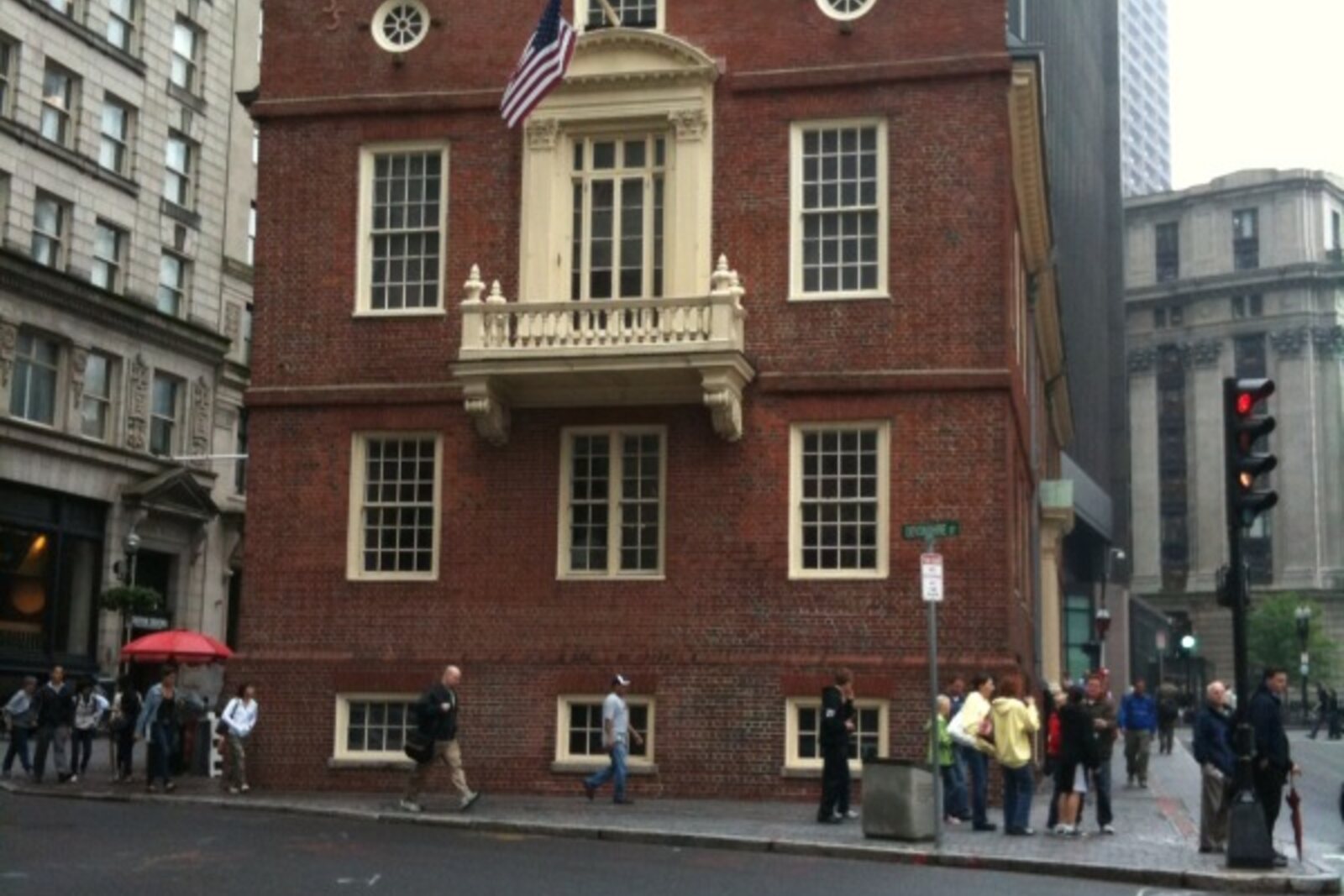
Look around first
What to notice
- Granite circle
- Bronze ring
- Date in the pavement
The story of the place
Beneath the Old State House balcony, a granite circle edged in bronze is set into the pavement; a date is left at its center. A customs house once stood at this corner, where officials collected duties and kept a sentry at the entrance. The building itself disappeared long ago, King Street became State Street, and toward the end of the nineteenth century townspeople first marked this corner with a memorial sign. The circle in the pavement has preserved the address of the institution over which the city's relations with British authority became especially tense.
On the evening of March fifth, seventeen seventy, Edward Garrick, a barber's apprentice, finished work and saw the British officer John Goldfinch on King Street—now State Street. Garrick shouted that Goldfinch owed his master's shop for hair care. To the apprentice, it was a matter of the trade by which he made his living. But the bill had already been paid, and Goldfinch walked on.
Private Hugh White stepped in for the officer. He was standing guard here at the entrance to the customs house and was supposed to protect the duties collected there. White traded insults with Garrick, left his post, and struck him below the ear with his musket. The boy cried out, and his companions began cursing the sentry. Within minutes, an argument over a barber's bill had drawn in the whole street.
The customs house explains why the clash happened right here. After disputes over duties and attacks on customs officers, the British government sent two regiments into Boston. The soldiers lived among townspeople who considered the new levies illegal. White was guarding the door of the institution for which the troops had come to the city.
When bells began to ring, people thought there was a fire somewhere and ran toward King Street. Among those who arrived was Crispus Attucks, a sailor of mixed African and Indigenous descent who earned his living on seagoing voyages. In Boston, he was waiting for another voyage; after his death, newspapers reported that his ship was preparing to sail for North Carolina. Attucks came forward at the head of a group of sailors, some carrying wooden clubs.
British Captain Thomas Preston brought seven soldiers to get the surrounded sentry out and hold his men together. They formed a semicircle by the customs house, loaded their muskets, and fixed their bayonets. Snowballs, chunks of ice, and sticks flew from the crowd; witnesses later disagreed both over the number of attackers and over who struck whom first. A stick hit Private Hugh Montgomery. He lost his balance, got up, and fired. The other shots followed the first, although the court was never able to prove that Preston had ordered his men to fire.
Two bullets struck Attucks in the chest. He died on the spot. In all, the soldiers mortally wounded five people and wounded six more. Preston and his men were arrested that same night.
Boston lawyer John Adams agreed to defend the soldiers when other lawyers refused: he wanted to make sure that hatred of the accused did not replace a trial. The decision could have ruined his reputation. More than forty witnesses gave contradictory testimony. Some heard an order to fire; others saw Preston standing in front of the muzzles and said there had been no order. The captain was acquitted. Of the eight soldiers, six were released, and two were convicted of manslaughter. The old benefit of clergy for literate first-time offenders saved them from the gallows: both men were branded on the thumb and released as well.
Opponents of the troops' presence fixed the name “Boston Massacre” on the event. The engraver Paul Revere, seeking to spread their version of what had happened, depicted a coordinated soldiers' volley and an officer giving the order. Court testimony did not support that picture, but the print spread through the colonies before the proceedings were over.
The customs house where White stood has not survived. In eighteen eighty-two, townspeople marked the site for the first time with a commemorative medallion. The present circle of granite paving stones with its bronze ring lies by the intersection beneath the Old State House balcony: King Street became State Street, the customs-house door disappeared, but the date in the pavement remained.
Useful on site
Street-side stop by the Old State House; access depends on traffic and events.
Checked: June 28, 2026. Check the official source before visiting.This is an open stop in a busy passageway: listen at the edge of the square, without blocking the flow of people or stepping into the roadway.