 Guide On Map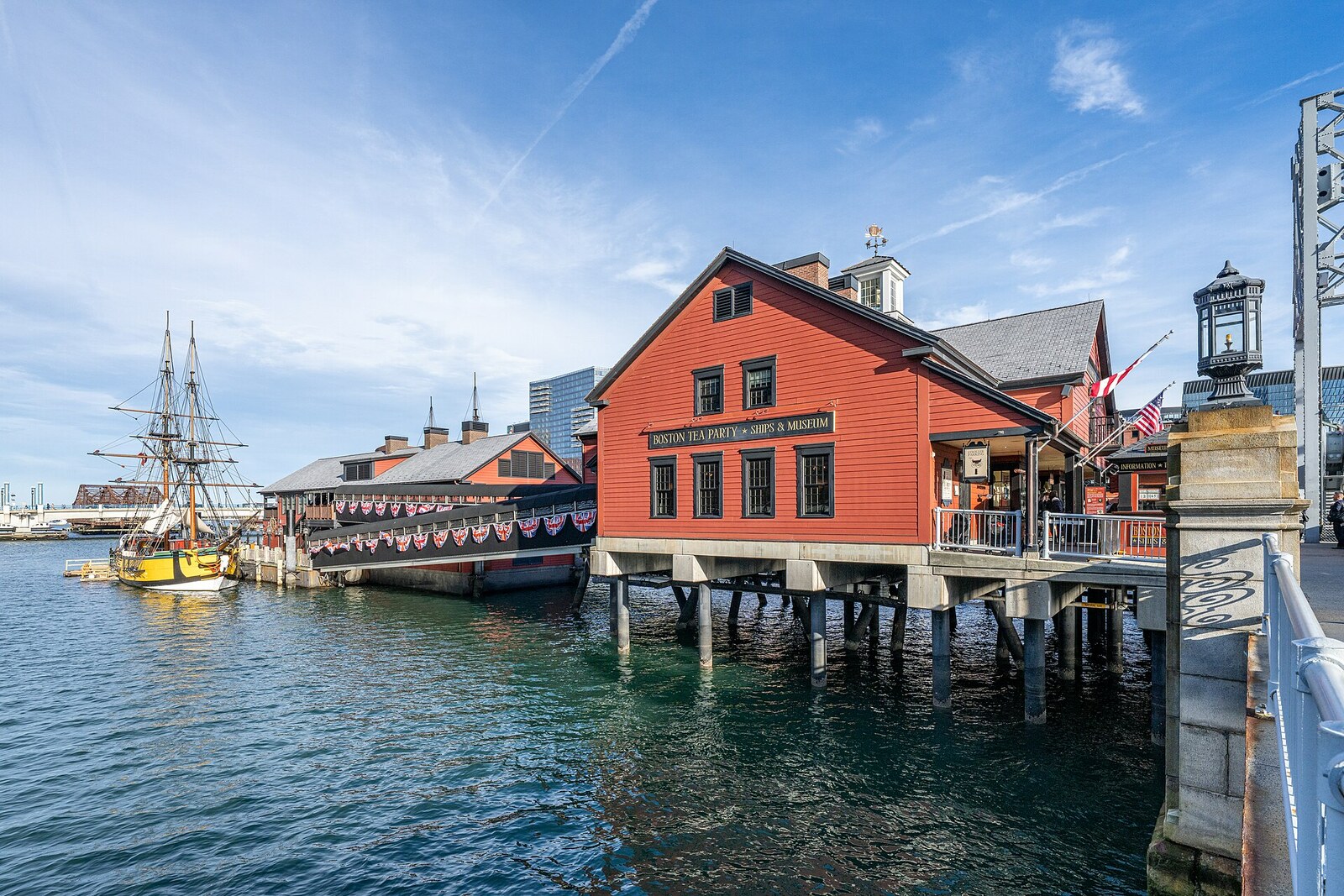
Look around first
What to notice
- Two moored sailing ships
- Wooden model chests
- The museum pavilion above the water
The story of the place
The museum pavilion stands on Congress Street Bridge above the waters of Fort Point Channel. The present shoreline runs over the old Griffin's Wharf, whose likely location is associated with the area closer to InterContinental Boston. Reconstructions of the Beaver and the Eleanor are moored at the museum wharf; there is no reconstruction of the Dartmouth here. On the tour, each visitor receives the name of a real participant and a model chest.
On the evening of December sixteenth, seventeen seventy-three, thirty-one-year-old Boston shoemaker George Robert Twelves Hewes came to Griffin's Wharf to destroy someone else's cargo. He smeared his face and hands with coal dust, and his clothes were meant to resemble those of a Mohawk. Hewes made his living repairing shoes and could not afford to take open part in a crime that the British Crown might regard as treason.
The dispute did not arise because tea had become more expensive. Parliament allowed the loss-making British East India Company to import it directly into the colonies. The price fell, but the duty imposed without the consent of assemblies elected by the colonists remained, and only intermediaries appointed by the company could sell the tea. Buying it would have meant that Bostonians accepted both the duty and the monopoly.
The Dartmouth arrived here first, carrying one hundred fourteen chests of tea. The law allowed twenty days for unloading and paying the duty; after that, customs officers could seize the vessel and the cargo. The organizers of the resistance made sure that the Dartmouth, followed by the Eleanor and the Beaver, were moored together at Griffin's Wharf under the guard of the townspeople.
The young merchant Francis Rotch was responsible for the Dartmouth. He tried to save the family vessel, return the tea to England, and avoid being at fault before either customs officers or the gathering of several thousand Bostonians. On the final day of the deadline, about five thousand people sent him to ask Thomas Hutchinson—the royal governor of Massachusetts, who was seeking enforcement of the law—for permission to leave Boston Harbor. Hutchinson refused. When Rotch returned with that answer, no legal way out remained.
About one hundred fifty disguised men moved toward Griffin's Wharf. At the wharf, they split into three parties and boarded the ships at the same time. Hewes was appointed boatswain—the person who passes on orders and organizes deck work. In old age, he recalled demanding the hatch keys and candles from the captain. The captain handed them over, asking them not to damage the ship or its rigging.
Some participants hauled the chests out of the holds, others broke them open with axes, and still others threw the tea overboard. In three hours, they destroyed all three hundred forty-two chests. They left the ships, the crew's belongings, and the other goods intact. When one participant, O'Connor, tried to carry off tea in his pockets and in the lining of his coat, Hewes grabbed him by the coat tail and tore it off. Even stealing part of the doomed cargo would have turned a collective action into ordinary robbery. The participants later replaced the only lock that had been broken by accident.
After the unloading, Hewes returned home without learning the names of the people in the neighboring parties. Each person had to keep his own secret and answer for the consequences himself. There were almost no personal confessions, but all of Boston was punished. In seventeen seventy-four, Parliament closed the port until the value of the tea was repaid, restricted Massachusetts's self-government, and sent troops into the city. Delegates from twelve colonies gathered at the First Continental Congress to work out a common response. In the spring of the following year, the clashes at Lexington and Concord began the war. Hewes escaped from Boston and served on privateer vessels and in the militia; after the war, he again earned his living by his trade and lived modestly.
Griffin's Wharf itself no longer exists. Later filling of the shoreline concealed the wharf, and its most likely location is closer to today's InterContinental Boston. The museum stands on Congress Street Bridge above the same waters of Fort Point Channel. The Beaver and the Eleanor moored here are reconstructions of two vessels; the Dartmouth is not among them. On the museum tour, visitors are given the names of real participants and invited to throw a model chest overboard—to repeat the work for which the shoemaker Hewes needed coal dust, hatch keys, and someone else's candle.
Useful on site
Ticketed tours daily from 10:00 to 17:00; the tearoom and shop are available without a museum ticket.
Checked: June 30, 2026. Check the official source before visiting.You can view the ships and the wharf from outside; the museum program takes place separately and requires its own ticket.