 Guide On Map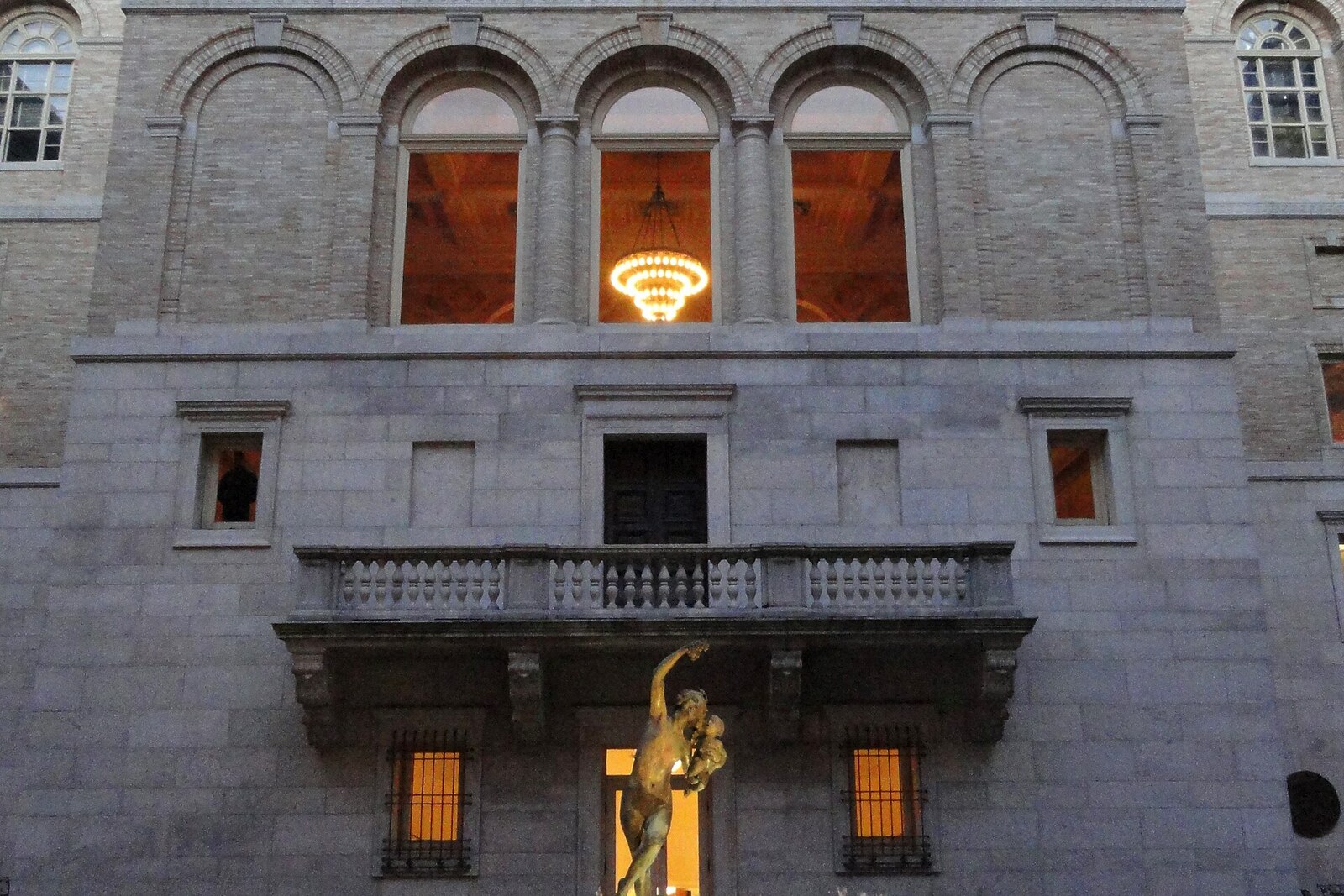
Look around first
What to notice
- The inscription “Free to All”
- The courtyard
- The fountain
- The bronze bacchante
The story of the place
On the site of the recently filled Back Bay, the state gave the city land for a new Boston Public Library building. More than four thousand wooden piles were driven beneath it: the previous building had become too small, while the current one houses research and special collections and contains reading rooms. Book circulation and public programs take place in the neighboring building. Deep inside the building is a courtyard with a fountain.
Carved above the central entrance to the Boston Public Library are the words: “Free to All.” Joshua Bates proposed them—a native of the Boston area who grew up without a public library, educated himself, and then made his fortune as a London banker. In eighteen fifty-two, he gave the city fifty thousand dollars for books. Bates required the reading room to be warm, well lit, capable of holding at least one hundred fifty people, and free. The long room with a barrel vault on the second floor bears his name.
The library was established as early as eighteen forty-eight, but its previous building quickly became too cramped. The state of Massachusetts gave the city a site in the recently filled Back Bay. More than four thousand wooden piles had to be driven for the future palace of books. Architect Charles Follen McKim opened this building in eighteen ninety-five. It now houses research and special collections and contains reading rooms; the neighboring building handles book circulation and public programs.
McKim’s most personal idea is in the courtyard. In eighteen eighty-seven, his wife, Julia Emory Appleton McKim, died in childbirth; the child did not survive either. The architect decided to create a fountain in the center of the courtyard in her memory. For it, he chose a bronze by his friend Frederick MacMonnies, a young sculptor whom he had previously helped with money and commissions. MacMonnies gave McKim the first cast of the statue in gratitude for that support.
A nude woman stands on one leg, holding an infant and raising a bunch of grapes above him. She is a bacchante—a companion of Bacchus, the ancient god of wine—and the child is depicted as an infant faun. The sculptor conceived it as a dance and a sharp movement of the body. Some Bostonians saw a drunken mother putting her child in danger.
The Woman's Christian Temperance Union, the Young Men's Christian Association, the New England Watch and Ward Society, and several religious associations began collecting signatures against the statue. At first, the city art commission rejected it. The library trustees secured the temporary installation of the bronze in the fountain so that invited specialists could judge it on site. Seven experts voted to accept it and two against; afterward, the commission also approved the gift by four votes to one.
The petitions and newspaper controversy continued throughout the winter and spring. In April eighteen ninety-seven, McKim himself withdrew the gift to end the pressure on the library. The trustees agreed. The architect sent the statue to the Metropolitan Museum of Art in New York City, where it was accepted and displayed. The scandal brought MacMonnies many buyers for smaller casts, but the memorial to his wife that McKim had envisioned disappeared from the courtyard he had created.
The Museum of Fine Arts, Boston later acquired another cast of Bacchante and Infant Faun. During the library’s restoration in the nineteen nineties, another bronze copy was made from it for the fountain. McKim’s original remains in New York City; the library courtyard holds a copy made from the Boston copy.
Useful on site
Check Central Library opening hours on the BPL website before entering.
Checked: June 28, 2026. Check the official source before visiting.This is a working library: keep quiet and do not occupy workspaces for photographs. Access to particular rooms, murals, and the courtyard may depend on current work in the building.