 Guide On Map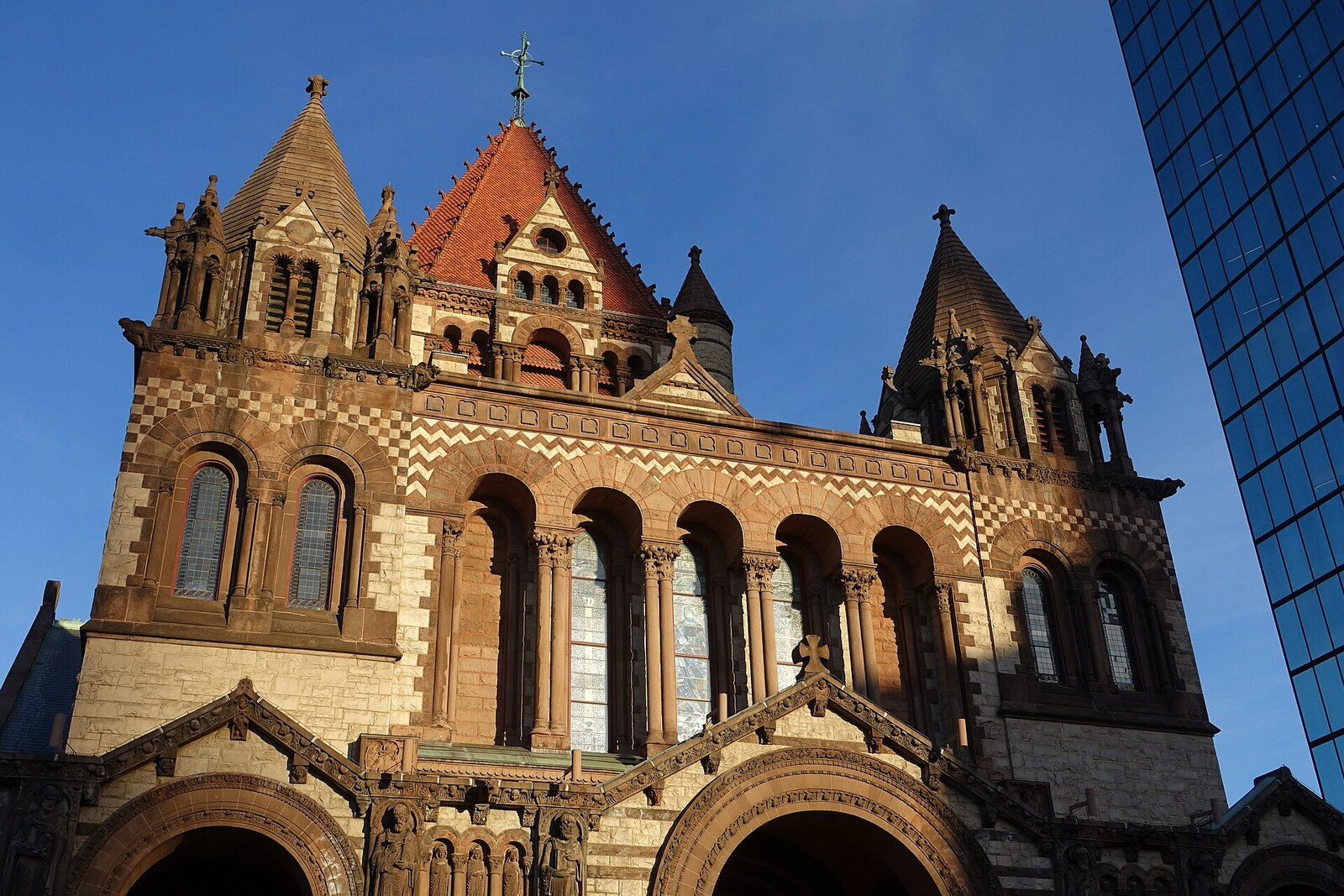
Look around first
What to notice
- Bronze figure of the preacher
- Figure of Christ
- Stone arches
- Balcony
The story of the place
Trinity’s heavy masonry and broad arches stand out on the square: the church is organized around a central tower, and its short wings form an almost equal-armed cross. The parish of the Holy Trinity began in old Boston as early as seventeen thirty-three, but over time its former church ended up among warehouses, offices, and shops. The congregation moved to recently filled Back Bay; about four thousand five hundred wooden piles were driven through the fill beneath the building to a damp layer, and services have continued here since eighteen seventy-seven.
At the church’s north wall stands a bronze Phillips Brooks—the priest whom parishioners called to Boston to save a fading parish. Behind him, the sculptor placed a figure of Christ with a hand on the preacher’s shoulder. Before the statue stands Brooks’s main achievement: a church arranged so that both wealthy owners of pews and people without money for a place of their own could hear him.
Trinity is an active parish of The Episcopal Church, the American branch of the Anglican tradition. Its name means the Holy Trinity—the Father, the Son, and the Holy Spirit. The parish was founded in old Boston as early as seventeen thirty-three, but by the time Brooks arrived, the former church on Summer Street stood among warehouses, offices, and shops. Parishioners’ families were moving to residential Back Bay, and the number of people in the congregation was shrinking.
Brooks lived for preaching in the most literal sense: he served as rector, meaning that he led the parish, and people came to hear him speak without a written text or prompts. In eighteen sixty-nine, he took over a church with rows growing empty and quickly filled it again. He then persuaded parish leaders to follow the people to Back Bay. The site on recently filled land was bought even before the Great Boston Fire of 1872 destroyed the old building. The fire accelerated the move that Brooks had already prepared.
The commission went to Henry Hobson Richardson, a young architect seeking a major project. He won the competition over five better-known firms. Brooks needed a spacious place for preaching and services where listeners would not be far from the priest. So Richardson organized the church around an almost equal-armed cross: short arms meet beneath the central tower, and rows surround the preaching place on three sides. Brooks himself usually spoke from a broad step in front of the chancel, close to the parishioners.
In those years, church pews were bought or rented, and those payments supported the parish. Brooks insisted that seats in the balcony remain free for those who could not pay. The lower rows still belonged to wealthy families; upstairs, people could hear the same preacher without charge. Even the building plan served that decision: the balcony offered a direct view of the central space.
For such a church, the parishioners paid more than twice the original estimate. Its enormous stone mass had to be set on about four thousand five hundred wooden piles, driven through the fill to a permanently damp layer. In eighteen seventy-seven, services began here. This commission made Richardson one of America’s leading architects, and heavy arches and rough-cut stone began to be copied across the country.
Brooks preached at Trinity until eighteen ninety-one, when he became Bishop of Massachusetts. He died two years later. The monument at the north wall was unveiled in nineteen ten and depicted Brooks specifically as a preacher, not as a builder. The paid pews downstairs were not abolished until nineteen fifty-two. The balcony that Brooks had once reserved for listeners without a place of their own remains inside the active church.
Useful on site
Tours usually Tue-Sat 10:00-16:30; in summer also Sun 11:00-15:30, changes are possible.
Checked: June 28, 2026. Check the official source before visiting.The exterior is easy to take in from the square. Check separately about visiting the interior: services and events may limit access, and sightseeing should not disturb parishioners.