 Guide On Map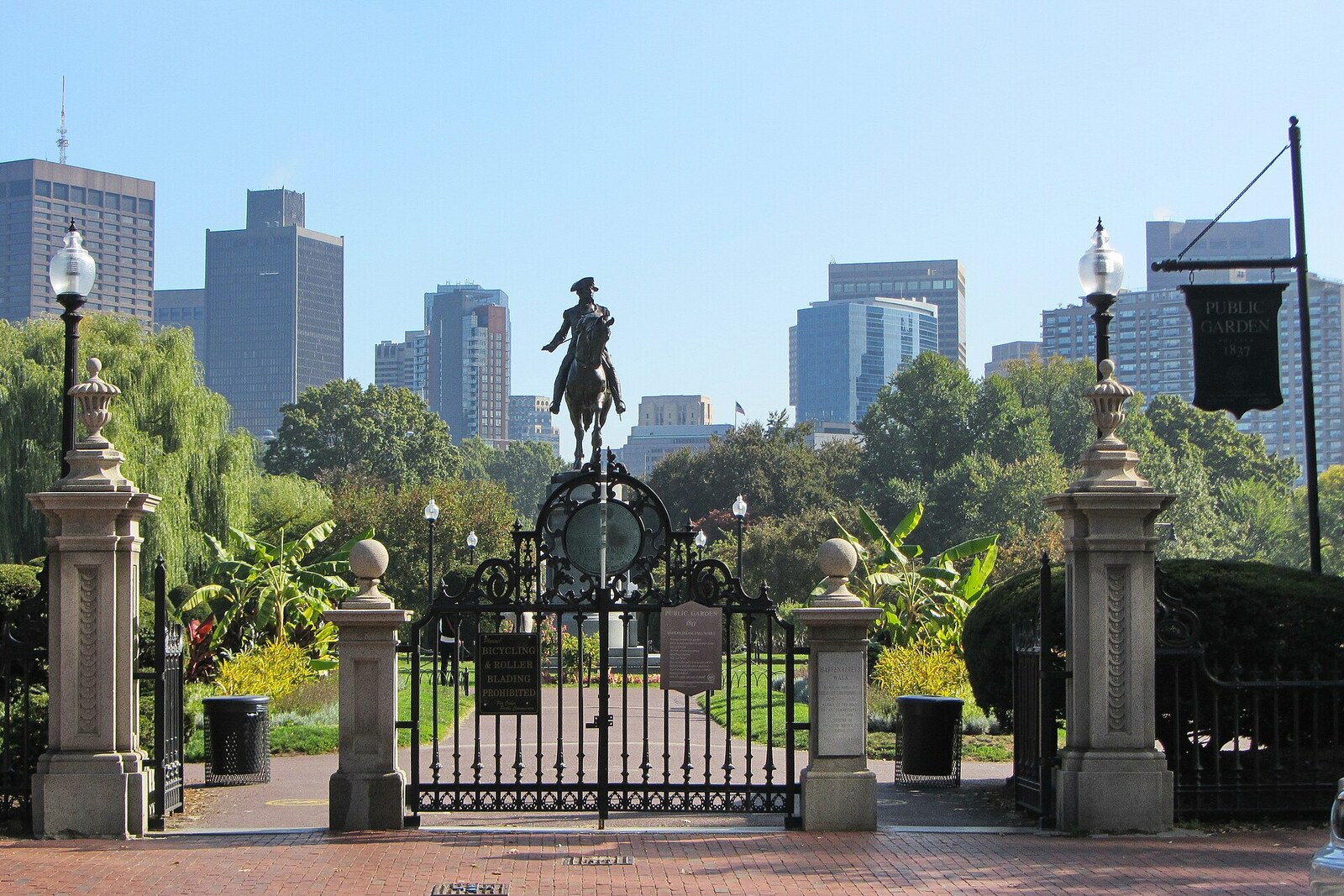
Look around first
What to notice
- Lagoon
- Swan Boats
- Winding paths
- Seasonal flowerbeds
The story of the place
Where today’s lawns and flowerbeds lie, there was once a tidal lowland by the Charles River. After a dam was built, the water stagnated here, and Bostonians decided to fill in the marshy shore while keeping the land for public use. In eighteen thirty-seven, the wealthy merchant and keen gardener Horace Gray gathered another sixteen townspeople and secured permission to create a botanical garden here, open to the public. This gave the name “Boston Public Garden” a literal meaning: the plants were meant not simply to grow on their own, but to form a collection.
Gray managed to build a greenhouse and plant ornamental trees. In eighteen forty-seven, he lost his fortune through unsuccessful investments, and the private enterprise came to a halt. The land was again considered for development, but civic groups advocated preserving the garden. In eighteen fifty-nine, Boston residents approved that decision by a margin of about sixty to one. George F. Meacham, an architect and participant in the competition to design the garden, placed a winding lagoon at its center and surrounded it with walking paths and flowerbeds. Their outlines have largely survived to this day. City gardeners still grow plants for seasonal flowerbeds in municipal greenhouses.
The lagoon soon gave one craftsman a chance to earn a living from a new urban pastime. Robert Paget, an Irish immigrant and boat builder, received a license to rent rowboats. In eighteen seventy-seven, he placed passenger benches on two pontoons, connected pedals to a paddle wheel, and enclosed the boatman and the mechanism inside the tall body of a swan.
Robert and his wife Julia, admirers of the opera Lohengrin, came up with the image. In it, a knight arrives by river in a boat pulled by a swan. Paget adapted the theatrical image to an entirely practical task: the mechanism remained hidden, passengers sat facing forward, and one boatman turned the paddle wheel with his feet.
Robert saw only the first season of his invention. In eighteen seventy-eight, he died at the age of forty-two. Julia was left with four children and a business on which the family’s income depended. A woman running a boat-rental business on her own was rare at the time. To keep operating, for many years she had to collect signatures from business owners in nearby Back Bay confirming that she could be entrusted with a city license. Julia ran the boats for more than thirty years—decades before American women gained nationwide voting rights—while also raising her children.
In nineteen fourteen, the business was taken over by her youngest son John and his wife Ella. They enlarged the boats to five rows of benches, and their children spent summer seasons here before passing the rental business on to the next generation. It is now run by Robert and Julia’s great-granddaughter Lyn Paget and her cousin Phil Paget.
The current fleet has six boats; the oldest was built in nineteen ten. A paddle wheel is still hidden beneath a copper or fiberglass swan, the pontoons have oak frames and copper cladding, and a fully loaded three-ton boat is propelled by one person pressing the pedals.
Useful on site
Park 6:30-23:00; pedestrian access 24/7.
Checked: June 28, 2026. Check the official source before visiting.The sculptures are outdoors; boat operation depends on the season. On the paths, yield to other visitors and do not block the way near the ducklings.