 Guide On Map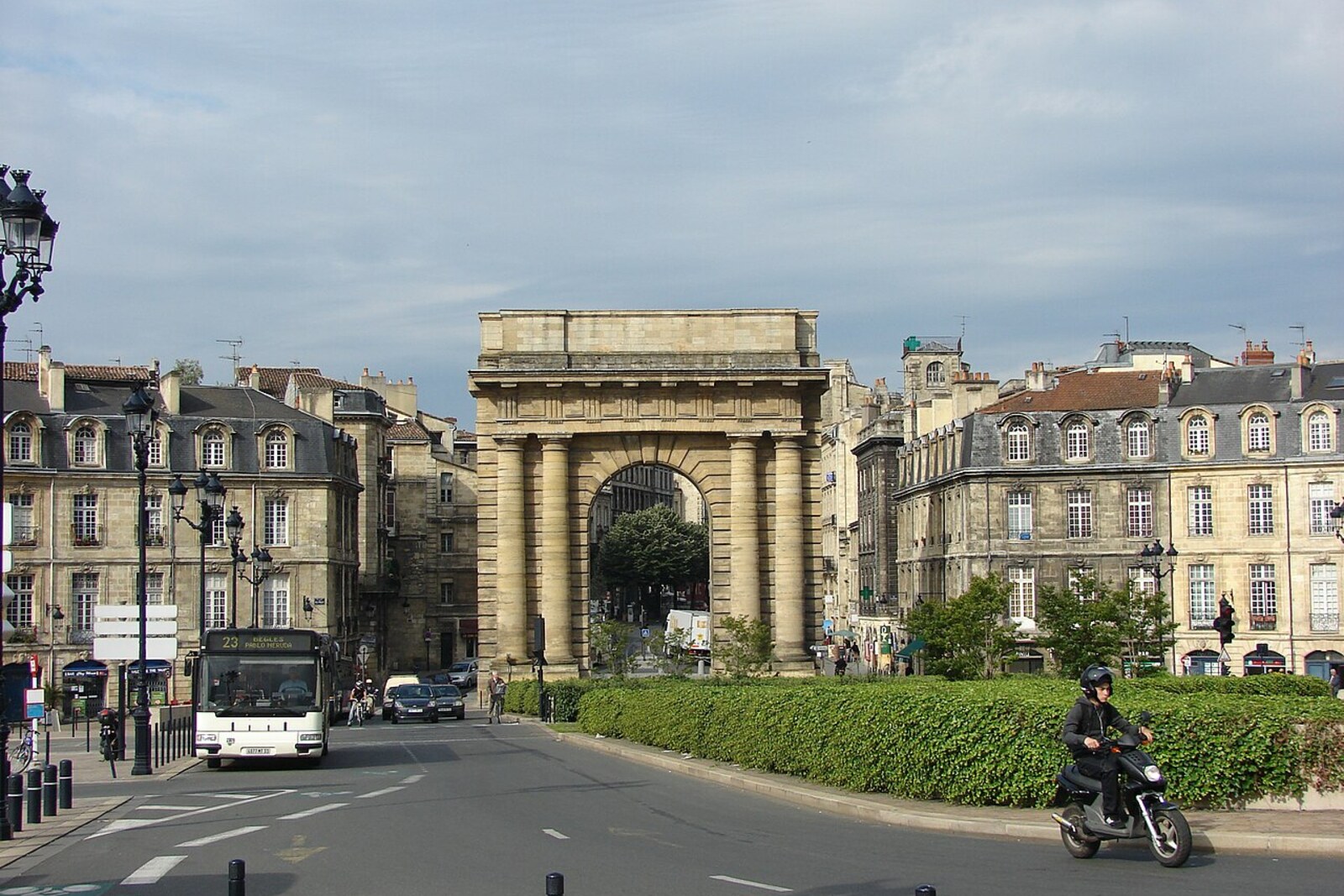
Look around first
What to notice
- Central arch
- Empty spaces on either side
- Pont de Pierre gate leaf
The story of the place
In late December eighteen hundred seven, municipal workers began tearing down the two side passages of the Porte de Bourgogne. The large arch did not yet stand alone: smaller gates for pedestrians stood on either side, and the matching façades of the square continued beyond them. This complex was the way into the city, and it was also where the movement of people and goods was controlled. The city council destroyed working passages for the ceremonial arrival of a man who did not yet know he would come to Bordeaux.
In the middle of the eighteenth century, the royal intendant Louis-Urbain Aubert de Tourny ordered the old moats filled in and the medieval Porte des Salinières replaced. The medieval Porte des Salinières connected the trading district with the river port associated with the salt trade. The new arch retained the location of the former entrance but was given a courtly name. It was dedicated to Louis-Joseph-Xavier, the young grandson of Louis XV, who bore the title Duke of Burgundy. That is where Burgundy in the name comes from.
Six days after Napoleon was proclaimed emperor, in May eighteen hundred four, Bordeaux’s city council resolved to erect a triumphal arch in his honor. The prefect suggested saving money: rather than build a new structure, they would remodel the Porte de Bourgogne. At the same time, they could demolish dilapidated houses and open a connection between neighboring districts.
The major commission went to the Lyon sculptor Joseph Chinard. He planned a colossal bust of Napoleon above the gate, carried aloft by an eagle; lions were to recline above the side passages, and two reliefs were to appear on the façade. The council approved the project. There was no money to carry it out. Chinard used the prepared model in Lyon, and only one terracotta relief survives from the Bordeaux design.
When the emperor’s visit became a reality, the city organizers chose a cheaper solution. The side stone passages were dismantled, and the central arch was covered with temporary decoration. Wood was painted to look like bronze, military trophies were depicted on canvases, and Napoleon’s victories were listed on shields. By the end of February eighteen hundred eight, the former city gateway had become a lone Arc Napoléon.
The emperor was traveling to Bayonne to intervene in a dispute within the Spanish royal family. Bordeaux was preparing a reception, but on the evening of April fourth, Napoleon arrived without an entourage and went unnoticed to the prefecture. After the fall of the Empire, the wooden eagles, the canvases, and the name Arc Napoléon disappeared. The gate was rededicated to the Duke of Burgundy. The side passages were not rebuilt: the empty spaces on either side of the arch are the only part of the Napoleonic project carried out in stone.
Useful on site
The monument can be viewed from outside around the clock; crossings and traffic arrangements around the square may change during work on the bridge.
Checked: June 30, 2026. Check the official source before visiting.It is best to view the gate from a short distance, without lingering in the roadway. The sculptures planned for the top were never installed, so there is no need to look for their remains in the stone.