 Guide On Map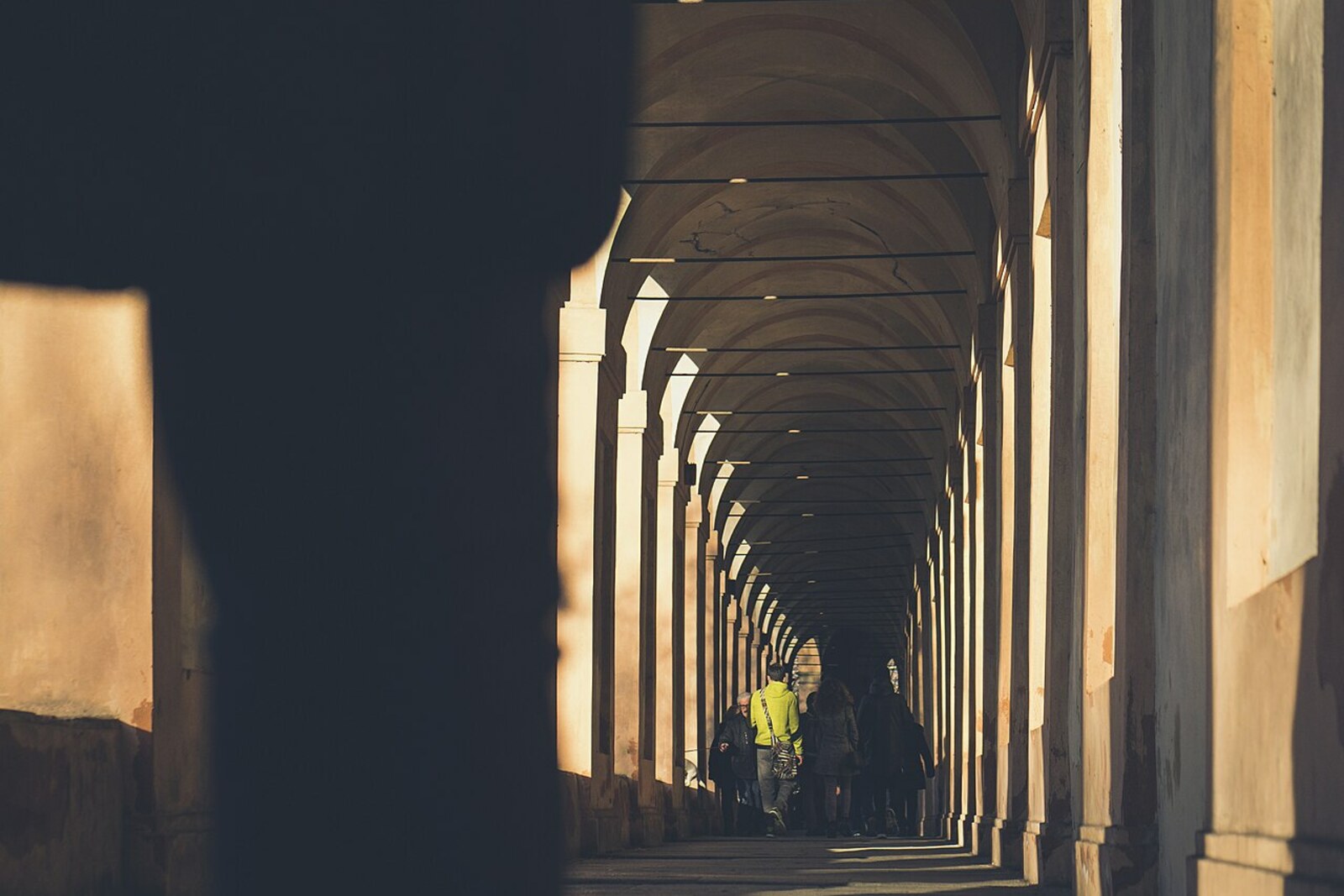
Look around first
What to notice
- Upper loggia
- Broad passage beneath the arch
- Curved side galleries
- Copper coat of arms above the central opening
The story of the place
Arco del Meloncello stands across Via Saragozza: a broad passage has been left below, while the upper loggia runs above it, approached on both sides by curved, asymmetrical galleries of the portico. Construction was completed in seventeen thirty-two. Above the central opening, you can see the copper coat of arms of the Monti Bendini family, which paid for a significant part of the work. The name Meloncello itself is older than the arch: since the tenth century, it has referred to the local stream and valley, although the origin of the word remains disputed.
In seventeen fourteen, several Bolognese architects were asked to connect two sections of the portico that had already been built here. The level gallery approached from the city, while the other descended from the hill. Via Saragozza lay between them. The conditions were strict: pilgrims and the annual procession with the Madonna di San Luca had to remain under cover, while carts had to pass through without stopping. Carlo Francesco Dotti then made his living as a capomastro, a construction foreman: he supervised small building projects and repairs. He was already over forty, but had not yet received a major independent commission. Of all the participants, he alone proposed separating the traffic by height. Pilgrims would cross the road above, and carts would pass beneath them. Dotti assigned the side rooms as carriage sheds: wealthy Bolognese could leave their carriages here and walk the final stretch. It was precisely for this practical scheme that the commission was awarded to him.
There was also a more spectacular project. The theatrical architect Francesco Galli Bibiena proposed a grand structure, but the patrons considered it too expensive. Dotti's own first design looked much more modest: a diagonal crossing topped by a dome. Yet the final drawing of seventeen eighteen was entirely different. In a handwritten note, Dotti acknowledged that he had reworked the design of an unnamed architect. Researchers suggest that this was Bibiena, though there is no documentary proof.
Dotti set the crossing across the road and brought the existing galleries to it along curved, asymmetrical lines. This created the upper loggia, the broad passage below, and the turns of the portico on either side. Construction was completed in seventeen thirty-two.
The outcome of the competition also changed Dotti's own position. While the arch was still under construction, he was commissioned to build the Sanctuary of the Madonna di San Luca to another person's design. The very next year, documents call him an architect rather than a capomastro; he replaced the sanctuary's original scheme with his own.
The copper coat of arms above the central opening belongs to the Monti Bendini family, which paid for a significant part of the work. Four more such coats of arms are placed inside the loggia. The arch's name appeared much earlier than the arch itself: Meloncello was the name of the local stream and its valley, known by that name since the tenth century. The origin of the word remains disputed.
The covered route still continues along the upper gallery, while Via Saragozza passes beneath it. The two streams of traffic move exactly as proposed by the master who entered the competition without a major building in his record.
Useful on site
The passage is open at all times; traffic beneath the arch is not closed.
Checked: June 28, 2026. Check the official source before visiting.Stop inside the gallery and compare the upper pedestrian level with the road below. Do not step out toward moving traffic for a photograph.