 Guide On Map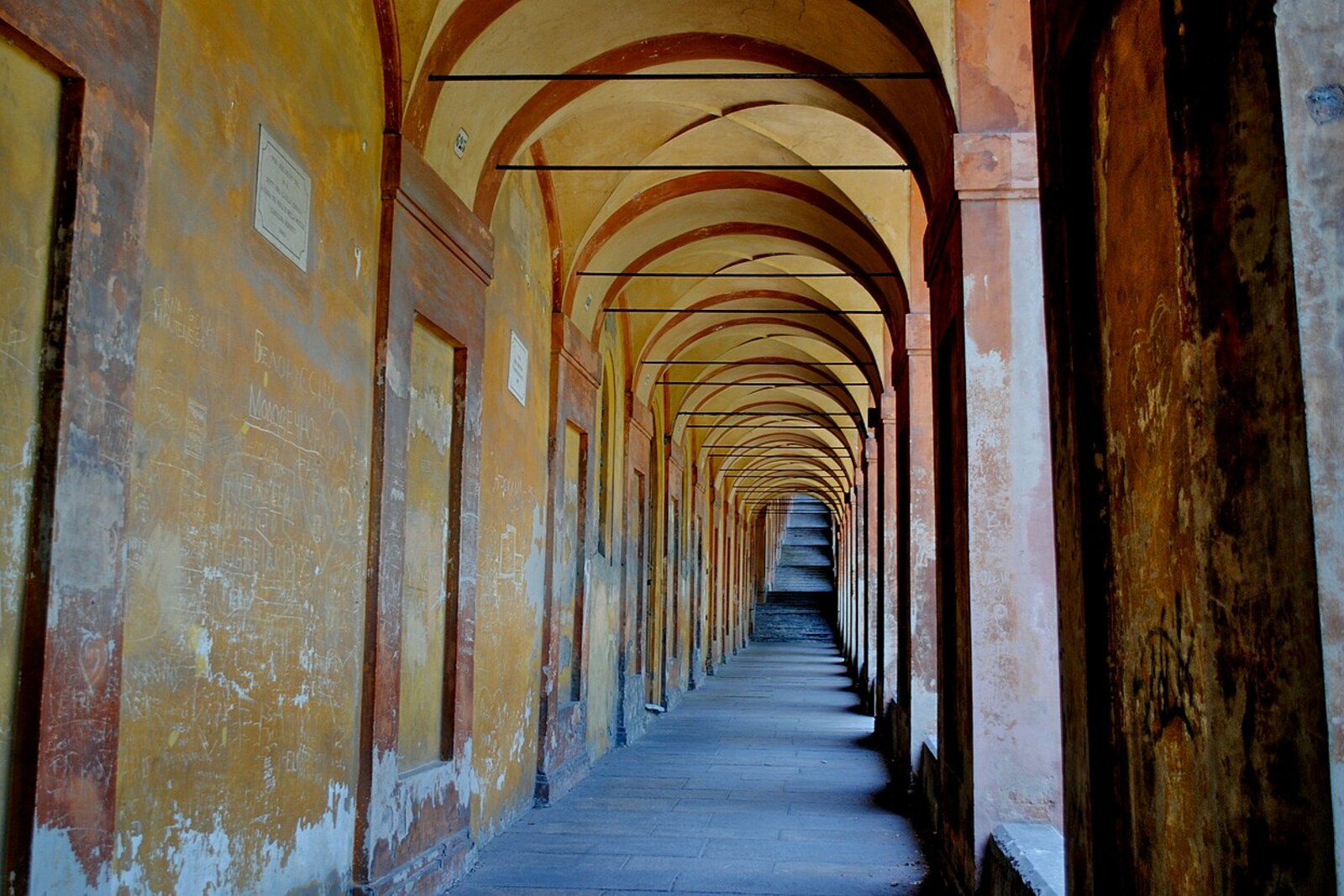
Look around first
What to notice
- Arches on the steep slope
- Stone chapels
- Turns in the covered gallery
The story of the place
The winding covered passage in this section runs up the slope toward the sanctuary on the mountain, and its lower part is noticeably steeper than the rest. Along it, at regular intervals, stand fifteen small stone chapels: pilgrims could interrupt their ascent, pray, and then continue upward. The route of the lower stretch was chosen to be steeper because it required less money for construction. Roughly after every twenty arches, one of the chapels again sets the rhythm of the road.
Olimpia Boccaferri began building chapels on this slope before the nuns received permission from the Bologna Senate. In sixteen thirty-nine, she became vicar—the senior member of a small community of sisters who looked after the Sanctuary of the Madonna di San Luca on Monte della Guardia. This position was passed on every two years. Boccaferri was given a sanctuary whose veneration had noticeably weakened by the beginning of the seventeenth century, and within a short time she had to bring pilgrims back to the mountain.
According to an anonymous eighteenth-century chronicle, people then hung images of the Mysteries of the Rosary on trees along the ascent. These are events from the lives of Mary and Christ that a believer recalls in sequence during prayer. The paper or fabric pictures turned the difficult road into a prayer route, but they remained outdoors.
Boccaferri ordered them replaced with fifteen permanent chapels—one for each Mystery of the Rosary. They were set at equal intervals so that a pilgrim could stop briefly, say a prayer, and continue the ascent. On June twenty-eighth, sixteen forty, the nuns received permission from the Bologna Senate. The document effectively legalized work that Boccaferri had begun a year earlier. By the end of her two-year term, the chain of prayer stops had been laid out.
The portico did not yet exist here. It appeared later and, on the hill, was meant to link the already placed chapels into one covered route. The current structures were rebuilt as the arches progressed, but they retained the sequence conceived by Boccaferri: the ascent is still divided into fifteen parts.
The steepness of the lower section is also tied to another human choice. In seventeen oh five, Giovanni Antonio Conti, architect of the archiepiscopal estate, proposed a route for the continuation of the portico. Other designers sought a gentler course, while Conti's option is described in the documents as steep but economical. The builders followed his line and erected the next eight arches that same year. The patrons saved money for continuing the work; pilgrims were left with a slope that still has to be climbed today.
The pictures on the trees have long been gone. Their place in the order of the ascent is held by fifteen stone chapels—roughly one every twenty arches.
Useful on site
Access is free and available around the clock.
Checked: June 28, 2026. Check the official source before visiting.Climb at your own pace and rest where the passage does not narrow. Keep quiet near the chapels; on wet steps, place your foot fully down.