 Guide On Map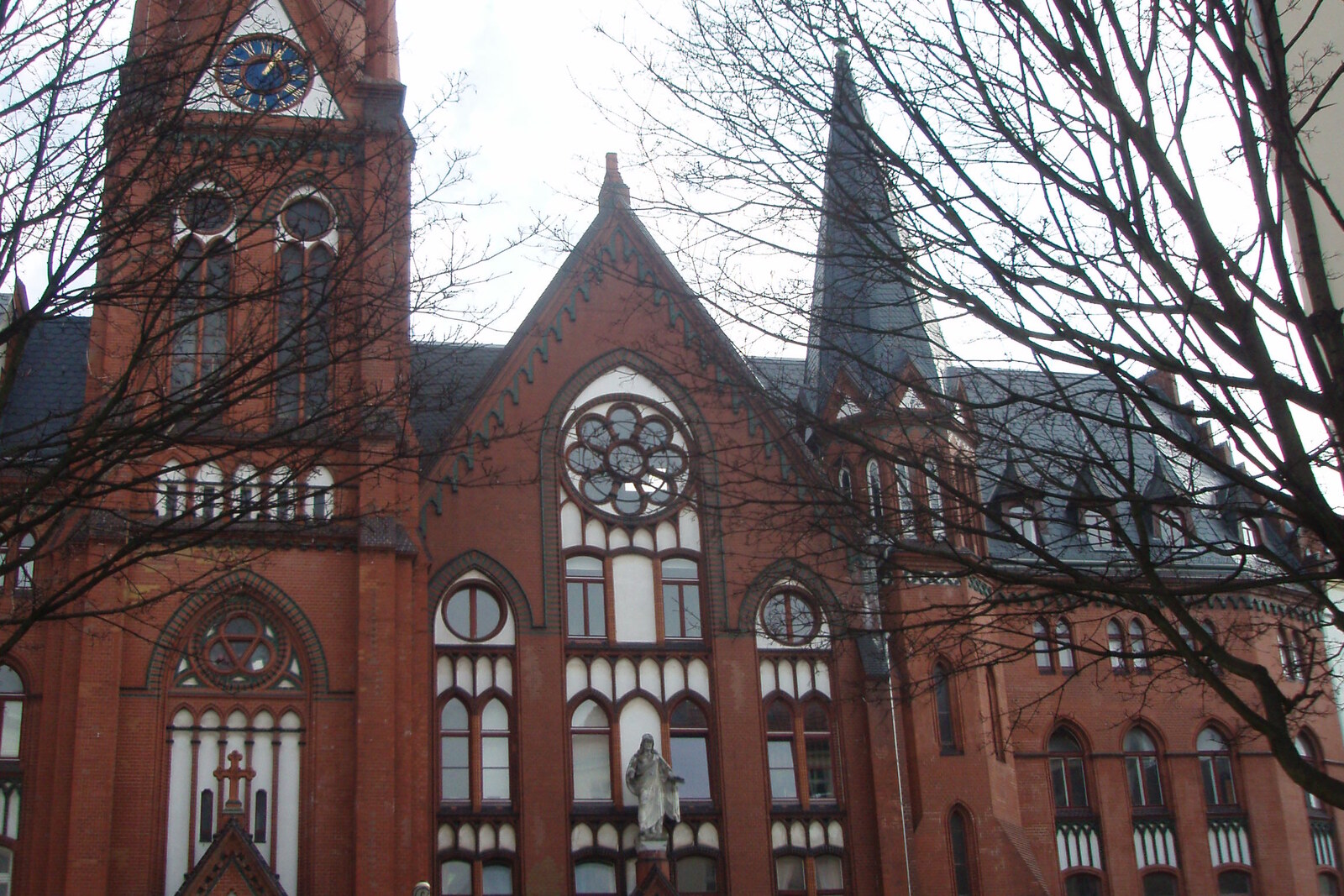
Look around first
What to notice
- Brick façade
- Short octagonal top of the tower
- Mosaic above the portal
The story of the place
Church tradition connected the mountain, unnamed in the New Testament, with Mount Tabor. The mosaic above the church’s brick portal shows Christ climbing it with Peter, Ioann, and Iakov; the parish received its name in honor of this transfiguration. The local tenement houses were so overcrowded that new parishes were separated from the mother congregation of Emmaus, which had more than one hundred thousand parishioners, and almost twenty-three thousand people were assigned to Tabor Church. When parishioners and money became fewer, the vast hall remained closed for most of the week.
Wrangelstraße ends at the façade of Tabor Church. Builders in the early twentieth century deliberately placed the church on this line: its seventy-one-meter tower closed off the street’s vista. After the bombing of nineteen forty-five, the damaged spire was dismantled, so a short octagonal top can now be seen above the rooftops.
The district came to be called Wrangelkiez only in the late nineteen eighties; before that, it was the Silesian Quarter. Kiez is a Berlin term for a small neighborhood. The surname came from Wrangelstraße, named in eighteen forty-nine after the Prussian general Friedrich von Wrangel. The year before, the king had ordered him to suppress the Berlin revolution. Wrangel brought thirteen thousand soldiers into the city, disarmed the citizens’ militia, and dispersed the assembly of deputies seeking a constitution. This took place in central Berlin, not on this street: development of the present-day district began later.
The church’s name is explained by the mosaic above the portal. It shows Christ climbing a mountain with the disciples Peter, Ioann, and Iakov, and appearing before them in a transfigured form. The mountain is not named in the New Testament; church tradition connected it with Mount Tabor. The congregation was named in honor of this event.
Such a large church was needed because people were crowded into the local tenement houses. The mother congregation of Emmaus had more than one hundred thousand parishioners, and new parishes were separated from it. When Tabor Church was consecrated in nineteen oh five, almost twenty-three thousand people were assigned to it. By the end of the twentieth century, there were far fewer parishioners and less money as well, and the vast hall stood closed for most of the week.
In nineteen ninety-two, Pastor Dieter Tag and members of the congregation separated off part of the church hall by the entrance with a metal wall containing glass. This created a small heated space: the Taborium. Soon, Tag and his colleagues were discussing with a staff member from the Arche shelter how to prevent homeless people from dying of hypothermia. Ordinary overnight shelters already existed, but some people could not or did not dare to turn to them. For them, the congregation proposed opening an overnight shelter directly in the Taborium.
From nineteen ninety-three onward, volunteers received people here once a week during the cold months. At the time, they did not even require a certificate showing the absence of lice, admitted people in the middle of the night, and took in those who had been drinking if they did not threaten others. The evening shift handed out food and tea; a doctor examined those who needed help; an interpreter spoke with Polish guests. The night shift handed out mats and blankets, the morning shift prepared breakfast, and by eight o’clock the room was cleaned for the congregation’s regular activities.
One night was not enough. Tag and his staff began persuading other Berlin parishes to take on one more day each. Gradually, so many congregations joined that by nineteen oh five, some church night café was open in the city every day of the week.
In the season from October two thousand twenty-five to April two thousand twenty-six, the Tabor Church night café still opened on Tuesdays and received up to forty people. These places were prepared in that very Taborium behind the glass partition, which the congregation had once separated from the church hall designed for thousands of parishioners.
Useful on site
The district is open around the clock; the church and community spaces keep their own schedules, and residential courtyards require quiet after 22:00.
Checked: June 28, 2026. Check the official source before visiting.The stele can be viewed from the street, but entry to the church is not guaranteed. This is a residential neighborhood: speak quietly and do not enter closed courtyards.