 Guide On Map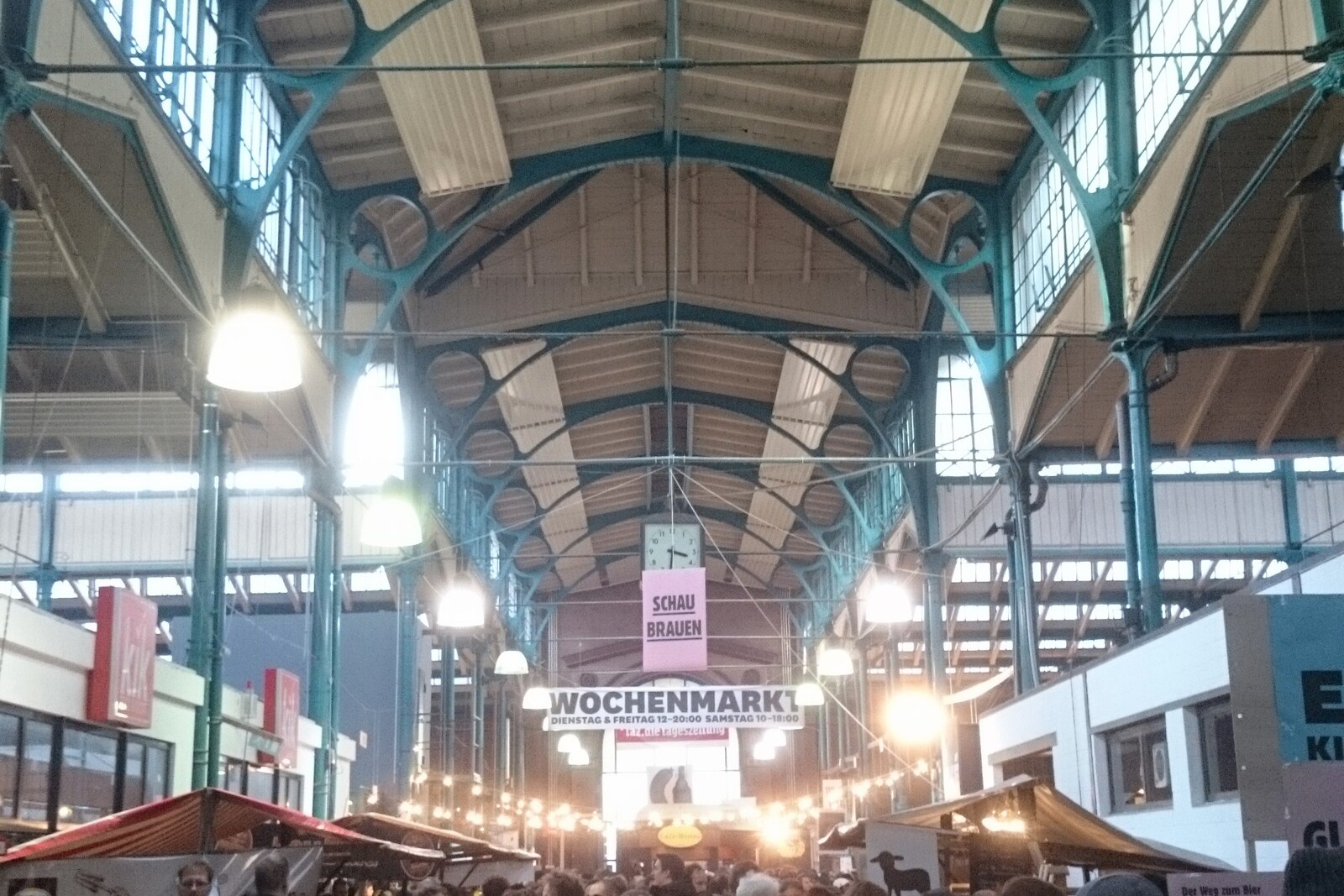
Look around first
What to notice
- Glass roof
- Passageway through the hall
- Rows of separate shops
- Brick entrance arches
The story of the place
The covered market was conceived as part of a Berlin network intended to bring trade in from open streets beneath a glass roof, where food would be easier to store and inspect. This hall was built inside a dense residential block, with access routes to two different streets: loaded carts entered from one side and left from the other without turning around in the courtyard. That is why a broad internal street still runs beneath the bright roof, with dozens of independent shops along its sides. From the outset, the space was divided into tiny places for many sellers, rather than for one single store.
In January two thousand ten, protests inside this market hall were banned. Then around two hundred neighbors came here to drink coffee. At the tables, they discussed the planned sale of the building and added messages to postcards for Berlin's mayor. The coffee gathering was perfectly legal, although everyone understood why the people had assembled.
It was market hall number nine that was to be sold—that is how the name Markthalle Neun translates. In eighteen eighty-one, Berlin city councilors planned fourteen covered markets: they wanted to replace street stalls with premises where food could be stored, inspected, and sold every day. The ninth hall opened in eighteen ninety-one in a densely populated neighborhood. The plot inside a residential block was comparatively inexpensive and opened directly onto both Eisenbahnstraße and Pücklerstraße, so loaded horse-drawn carts could enter from one side and leave from the other. Three hundred stalls were placed beneath the glass roof, with four square meters allocated to each one.
By the early two thousands, most of the stalls stood empty. The traders' cooperative closed, and the managers of the city-owned company that owned the hall decided to sell the building. One bidder planned to hand over most of the space to a chain supermarket. The very division into many independent sellers, for which the hall had once been built, was to disappear.
Christoph Albrecht, who lived nearby and brought residents together to defend local public spaces, wanted to make the seller take account of the building's intended purpose. Nikolaus Driessen, another neighbor, proposed bringing small traders and food producers back here. Together, they created the initiative Markt und Kultur auf der Eisenbahnstraße. Its twenty regular participants met here every Saturday at the coffee counter and prepared the next action.
Television showed a three-minute report about that very coffee gathering. Berlin's director of building, Regula Lüscher, publicly stated that a buyer for such a building should be chosen according to the program of use, rather than the highest sum. By February two thousand ten, the city had canceled the prepared deal. The price was set at one million one hundred fifty thousand euros, and bidders were required to preserve small-scale trade and add cultural and social activities. For the first time, Berlin was selling municipal real estate on such terms.
The residents did not stop at promises. In the vacated quarter of the hall, they organized twenty-five exhibitions, performances, and readings; more than ten thousand people came here over a year. This is how the initiative's participants showed that the empty section could be filled without a single large tenant.
Of seventeen applications, two made it to the final round. One was submitted by Driessen, Florian Niedermeier, and Bernd Maier. Niedermeier and Maier made their living from food retail: they ran a small shop selling Alpine cheeses, sausages, and other goods, and they already worked with bakers and farms. Now they needed to find money for an entire market hall and persuade producers to occupy it gradually. Their rival, an experienced organizer of mass events, proposed quickly rebuilding and relaunching the entire space all at once.
In March two thousand eleven, both teams presented their projects to more than three hundred neighbors right here in this hall. The majority chose the gradual plan of Driessen, Niedermeier, and Maier. The city took the vote into account and transferred the building to them. On October first, the market opened again. The three new owners ran it until two thousand twenty-five, and then handed management over to Olga Graf, who had long worked with their team.
There is still a large chain store here—it is now a drugstore occupying part of the hall. Separate fish and butcher shops, bakeries with glass walls, and small kitchens operate alongside it; beer is brewed in the basement. Temporary street-food stalls appear on Thursdays, and a large food market takes place on Fridays and Saturdays. Between them remains the broad passageway through the hall, once designed for horse-drawn carts, and the many trading spaces—the very layout for which the neighbors came here to drink coffee.
Useful on site
Hall doors: Mon–Wed 08:00–20:00, Thu 08:00–22:00, Fri–Sat 08:00–20:00; markets and events follow the current calendar; Street Food Thursday is usually Thu 17:00–22:00.
Checked: June 28, 2026. Check the official source before visiting.Entry depends on the market's current operations and events, so check them separately. You do not have to buy anything: this stop is about the hall's layout and the people who preserved it.