 Guide On Map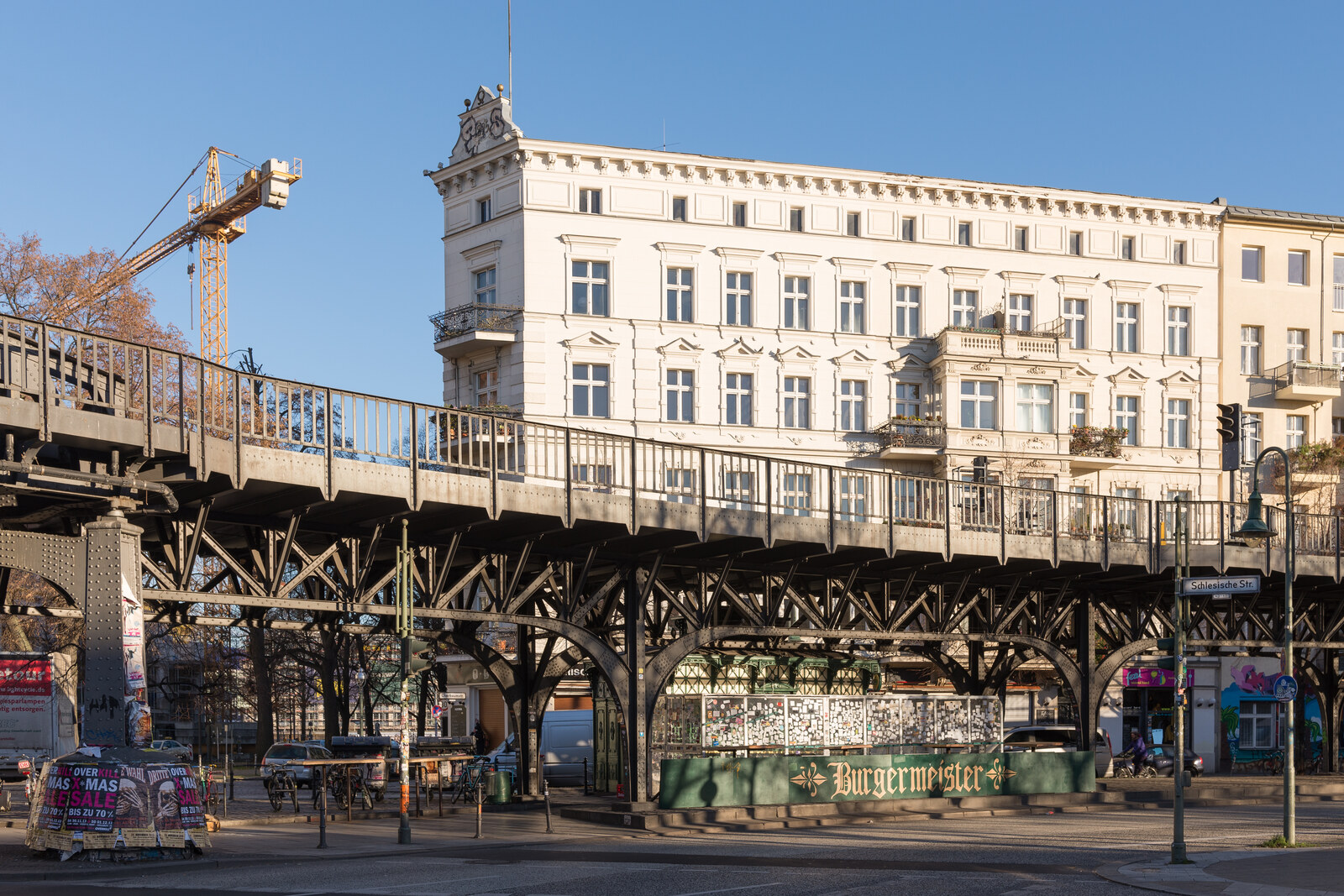
Look around first
What to notice
- The green cast-iron pavilion
- Signs for the men’s and women’s sections
- The station viaduct
The story of the place
A green cast-iron pavilion stands on the island between traffic lanes, with the station viaduct running above it. Signs for the men’s and women’s sections have survived on its shell. In the eighteenth century, Berlin was surrounded by a customs wall, and its easternmost crossing was called Schlesisches Tor because the road to Silesia began there; a tax was collected there on imported goods. The wall and gate were dismantled in the second half of the nineteenth century, and in nineteen oh two the new elevated station was given the former name.
In two thousand three, Berlin restaurateur Jebrail Karabelli was walking here one evening with a friend when he noticed a closed green pavilion in the middle of the roadway. It was a cast-iron public toilet from eighteen ninety-nine. No one had used it for about twenty years.
Karabelli decided to open a food stand inside. First, he had to find out who actually owned the pavilion. He was sent from one institution to another, including the heritage-protection authority. Finally, at city hall, he was told that the owner had once intended to reopen the toilet but had done nothing, and that the structure would probably now be dismantled and sent into storage.
Karabelli then offered an official different arithmetic: the city would not have to pay for dismantling and storage, and it would receive rent. The response was skeptical—who would go for food to a former toilet standing on a traffic island? Karabelli agreed to take sole responsibility if the venture failed and to pay for restoring the pavilion himself. In return, he was promised a lease if he met the requirements of the heritage-protection authority and Berliner Verkehrsbetriebe (BVG).
During the first inspection, the architect discovered dry rot in the basement and warned Karabelli that the repairs would bankrupt him. The entrepreneur nearly gave up on the idea, then called in another specialist. That specialist decided that the affected areas could be removed; a construction company dealt with them in two days. The rest of the conversion took months. Karabelli worked in a protective suit and mask: he tore down interior partitions, cleaned the rooms, painted, and filled out applications at the same time. The pavilion was required to remain as it had been on the outside, while new equipment had to be installed so that it could be removed and the former layout restored.
Three years passed from the first walk to the permit. Burgermeister opened in two thousand six, half a year before the 2006 FIFA World Cup. Visitors from nearby clubs, tourists, and journalists quickly made the tiny food stand famous. Karabelli turned it into a chain, although he had started with one kitchen that the architect had even advised him not to build.
The name of the station above the pavilion is older than both the toilet and the metro. Schlesisches Tor means “Gate to Silesia.” In the eighteenth century, Prussian officials surrounded Berlin with a customs wall and collected a tax on imported goods at its gateways. This crossing, the easternmost of them all, was closer than the others to the road to Silesia, which is how it got its name. The wall and gate were dismantled in the second half of the nineteenth century. When an elevated station opened here in nineteen oh two, it was given the name of the vanished crossing.
The first Burgermeister location still operates beneath the tracks. Signs for the men’s and women’s sections remain on its green cast-iron shell—the very exterior appearance that Karabelli undertook not to change.
Useful on site
The U-Bahn station operates according to the BVG schedule; check the hours for Burgermeister Schlesisches Tor on the location’s official page.
Checked: June 28, 2026. Check the official source before visiting.It is easy to listen to the story from outside: buying food is not necessary. If you decide to go into Burgermeister, allow for a possible line and do not stand in the way near the station.