 Guide On Map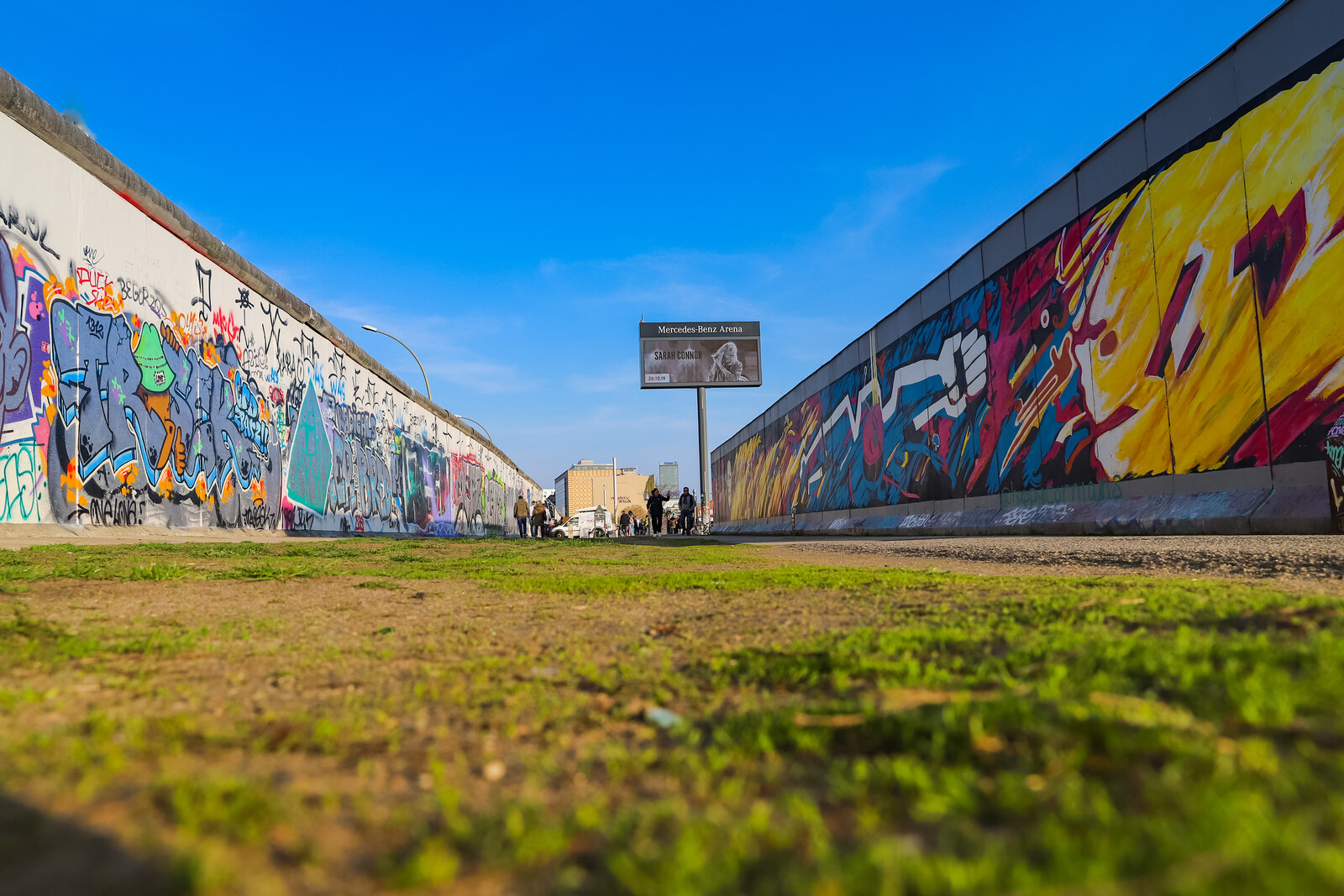
Look around first
What to notice
- Smooth concrete panels
- Hymn to Joy painting
- Hands painting
The story of the place
Along Mühlenstraße beside the Spree runs a row of smooth concrete panels that once closed off the border zone from East Berlin. The border lay by the opposite Kreuzberg bank, while the river’s entire width remained on the eastern side. Foreign visitors from Schönefeld Airport entered the center by this very route, so the wall here consisted of even panels three and a half meters high. Later, more than one hundred artists from twenty-one countries painted this entire row, and the former inner wall became the open-air East Side Gallery.
In May nineteen ninety-one, the Sardinian artist Fulvio Pinna asked for his own painting on the Berlin Wall to be declared a monument. He was seeking to keep Hymn to Joy on Mühlenstraße: at the top of the painting, a siren drove out dictatorship; below, an Italian landscape opened up. Pinna painted it in a few hours, without a prepared sketch. Fifteen years earlier, he had left his jobs as a teacher and an insurance clerk, and since then had lived by his own painting. Now his work was to be cut out of the concrete and sold.
This painting appeared on a particular section of the wall. The border ran along the opposite, Kreuzberg bank of the Spree; the river’s entire width belonged to East Berlin. The concrete along Mühlenstraße was an inner wall, closing off the border zone from the city side. Foreign visitors were driven along this street from Schönefeld Airport to the center, so the border guards installed smooth panels three and a half meters high here. They looked neater than the usual wall made of stacked slabs and formed an almost uninterrupted surface one thousand three hundred meters long.
The name East Side Gallery refers precisely to this East Berlin surface. While the border was guarded, painting it was forbidden. After the wall was opened, the East Berlin artist Heike Stephan and the West Berlin cultural-project organizer David Monty conceived the idea of turning the entire row of panels into an open-air gallery. Monty reached an agreement with the Ministry for National Defence of the GDR and received written permission in February nineteen ninety.
When Monty withdrew from the project, the coordinator Christine MacLean continued the preparations. She assigned sections and obtained paint and ladders. From February through September, one hundred eighteen artists from twenty-one countries worked here. Many were painting a work of this size for the first time. The whole group met only on September twenty-eighth, at the gallery’s official opening.
But on March first, the Friedrichshain district council transferred the same wall to the advertising-and-entertainment company Wuva. The company began paying the organizers’ expenses and offered the artists contracts: the rights to sell the images would pass to it for five years, while each artist was promised five hundred German marks after expenses were recouped. Only a few received this money. Wuva printed the paintings on postcards and T-shirts, planned to send the concrete panels on a world tour, and then hold an auction.
The tour fell through because of a lack of money and unclear rights to the former border. Then, in the spring of nineteen ninety-one, the company requested permission to cut out and sell the paintings separately. This was what Pinna opposed. After his application, the district administration set up a new council together with artists who insisted on preserving the gallery here. In June, Berlin’s senator for urban development, Volker Hassemer, announced the ensemble’s forthcoming protection. On November fifteenth, the wall with its paintings was entered in the state register of monuments; Wuva withdrew from the project, and the sale of the panels was stopped.
The paint from nineteen ninety nevertheless almost disappeared. The artists had worked without primer, and the images deteriorated from weather, exhaust fumes, and later graffiti. In two thousand nine, restorers cleaned the concrete with sandblasting equipment and then invited the artists to recreate their paintings. Pinna repainted Hymn to Joy on the section he had once protected from sale. The original paint layer survives on only one work—Hands by Margaret Hunter and Peter Russell.
Useful on site
The open-air gallery is accessible around the clock; tours and the information pavilion operate according to the current Stiftung Berliner Mauer schedule.
Checked: June 28, 2026. Check the official source before visiting.The gallery can be viewed outdoors without a separate entrance. Step back a few paces to see the compositions in full, and do not touch the paintings.