 Guide On Map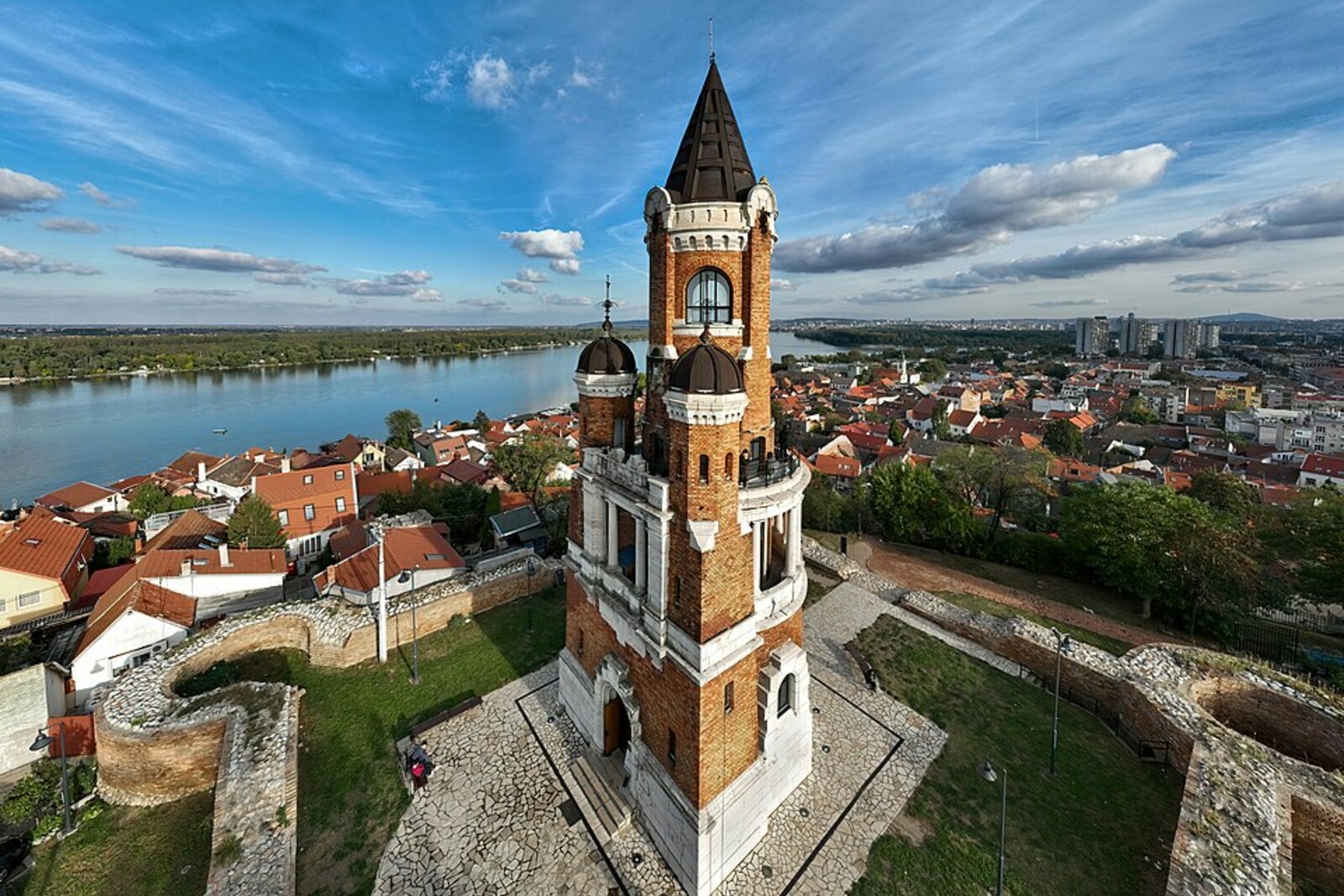
Look around first
What to notice
- Tall central block
- Two side turrets
- Conical roof
- Viewing platform
The story of the place
On Gardoš Hill stands one of the seven monuments erected by the Hungarian authorities for the jubilee marking the arrival of the Magyar tribes on the Middle Danube Plain. The tall central block, two small side turrets, and conical roof form the silhouette of an old fortress; a real medieval citadel stood here much earlier. The stone figure of Hungary, the lions, and the Turul bird with a sword were removed, smashed, or lost after the wars and the change of state. Exhibitions and a photography studio now occupy the lower part of the tower, while a viewing platform has been arranged at the top.
This tower was made thirty-seven meters tall because the Hungarian historian and member of parliament Kálmán Thaly wanted the neighboring church to look smaller—visually, at least.
Beginning in the early eighteen nineties, Thaly pushed for a grand celebration of the thousandth anniversary of the Hungarian tribes’ arrival on the Middle Danube Plain. He lived and breathed history and politics, and he put his weight as a deputy behind the jubilee. At his proposal, parliament resolved to raise seven provincial monuments—matching the number of chieftains who, in Hungarian tradition, led the Magyar tribes here.
Zemun was chosen for the southern monument. At that time, it stood at the edge of the lands of the Hungarian Crown, as part of Austria-Hungary, while Serbia began on the opposite bank. Gardoš was an even better fit: it was a high point above the Danube, within the remains of a medieval fortress associated with János Hunyadi. The land belonged to the military authorities, so Thaly’s committee obtained permission from Emperor Franz Joseph to transfer the site for construction.
Then Thaly looked toward Gardoš from Belgrade Fortress. The Orthodox Church of St. Demetrius stood out on the hill—the family tomb of the wealthy Hariš merchants of Zemun. Thaly decided that the new monument must not be lost beside the church’s dome. He required the architect Gyula Berczik to enlarge the tower so that from Belgrade the church would look small and the Hungarian symbol would be clearly visible across the Danube.
Berczik fulfilled this requirement. The tower received a tall central block and two side turrets recalling a medieval castle. Between them stood a stone figure of Hungary with a shield and a sword, with two lions seated beside it. Above was the coat of arms of the kingdom, and the roof was crowned by a four-meter Turul—a mythical bird in Hungarian tradition—with a sword in its talons. A plaque with the years from eight ninety-six to eighteen ninety-six explained the name: “Millennium” meant the thousand-year jubilee, not the age of the tower itself.
On September twentieth, eighteen ninety-six, the monument was unveiled and handed over to the city. Thaly achieved what he had intended: it turned out to be the largest of the seven provincial monuments, and from the opposite bank it really was more visible than the Hariš tomb.
But the original appearance did not last long. Artillery damaged the tower during the fighting in nineteen fourteen. After Austria-Hungary fell apart, the stone figure of Hungary was thrown down and smashed, while the removed Turul lay for some time in the fortress yard before disappearing. The tower itself was preserved. The people of Zemun already called it the Sibinjanin Janko Tower—this is what János Hunyadi is called in Serbian tradition. After his victory over the Ottoman army outside Belgrade in fourteen fifty-six, Hunyadi died during an outbreak of plague. The exact place of his death remains disputed: sources name both Belgrade and Zemun Fortress. The popular name therefore preserves the local version, but it does not literally apply to the building—it was erected four hundred forty years after the commander’s death.
By the early two thousands, the tower had again lost its purpose. Three lease tenders attracted no takers. The freelance photographer and artist Đorđe Čubrilo, who grew up nearby and was looking for premises for a studio, took it on lease nonetheless. His wife said she would divorce him: inside were heaps of trash, there was no water or electricity, the windows were missing, and someone had even stolen the lightning rods. Čubrilo had to hire two watchmen, bring together family, friends, and donors, coordinate the work with the city’s restorers, and together with them restore the tower’s stairs, doors, and utilities.
Today, a gallery and Čubrilo’s studio operate on the lower level, while a viewing platform is open above. Above it remains the tall conical roof that Thaly wanted to show Belgrade; the Turul, the figure of Hungary, and the stone lions are no longer on the tower.
Useful on site
The current arrangements for interior access are unstable and depend on the season, the tenant, and events; check the exact hours on the day of your visit. Viewing the exterior and the view from the plateau still make this stop worthwhile.
Checked: July 1, 2026. Check the official source before visiting.The tower can be fully viewed from outside. Check the possibility of going inside separately, and do not build your whole schedule around it.