 Guide On Map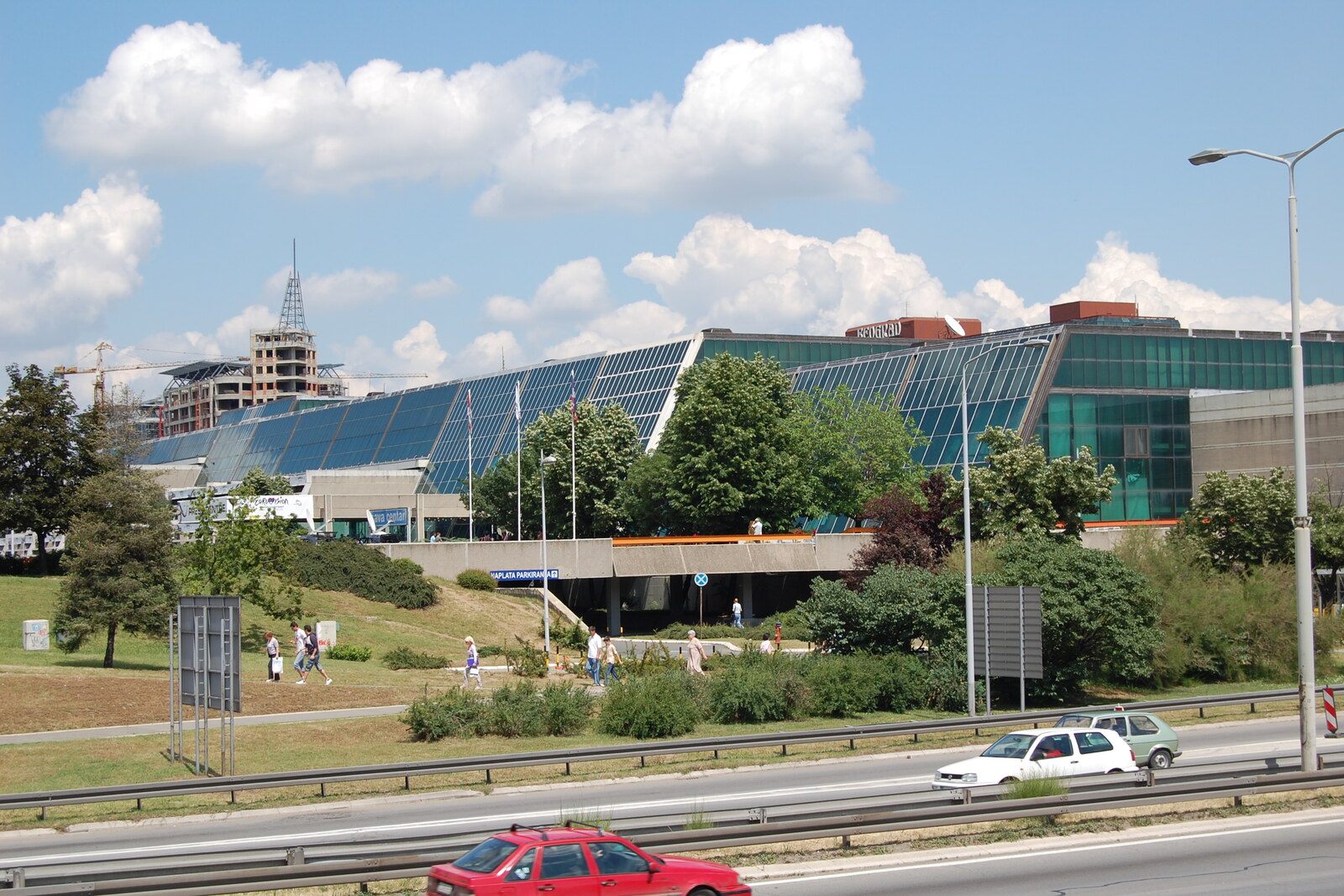
Look around first
What to notice
- Sloping glass facade
- Western wing
- Congress halls behind the glass
- Blue Hall
The story of the place
Behind Sava Centar’s sloping glass facade are dozens of halls for negotiations, congresses, and exhibitions. Concerts take place in the neighboring Blue Hall. The Sava in the name is the river nearby, and the site in the nineteenth block was chosen for the city highway: foreign delegates could be brought here quickly from the airport and from here to old Belgrade.
The reason for the construction was a promise by Josip Broz Tito. After the European conference in Helsinki, he agreed to hold the next meeting of the Conference on Security and Co-operation in Europe in Belgrade—the predecessor of today’s Organization for Security and Co-operation in Europe. In February nineteen seventy-six, Foreign Minister Lazar Mojsov informed Belgrade Mayor Živorad Kovačević of this. There was no suitable venue in the city, and fifteen months remained before the diplomats arrived.
Kovačević decided to build a new center and assigned the project to Stojan Maksimović, the chief architect of the city construction directorate. Maksimović agreed on the condition that he would choose the engineers himself and be free to make decisions. They completed the first part of the building in eleven months. Tito opened it in May nineteen seventy-seven, and representatives of thirty-five countries came here in June.
The real struggle began in the fall. All decisions required general agreement: one delegation could stop the entire document. The meetings took place behind closed doors, without transcripts. Western diplomats wanted to check how states were fulfilling the human-rights commitments signed in Helsinki. The Soviet delegation considered discussion of specific prisoners to be interference in internal affairs.
The American group was led by Arthur Goldberg, a former justice of the Supreme Court of the United States and former United States representative to the United Nations. By then he was again earning a living through legal practice; after half a year in Belgrade, Goldberg joked that a diplomatic salary was noticeably lower than a lawyer’s income. His stake was more serious than money: pushing too hard could break up the conference, while being too cautious would leave the meeting meaningless.
On November ninth, Goldberg named Yuri Orlov, a physicist who had created the Moscow Helsinki Group to monitor the very commitments being discussed here. Orlov was already under arrest. Soviet representatives demanded that the discussion of specific people stop, then responded with accusations of racial discrimination, unemployment, and unfair courts in the United States itself.
After the Christmas break, the Soviet negotiator Yuli Vorontsov brought a draft final document of only three pages: in his view, the sides would agree on nothing more substantive. Goldberg replied with eleven demands. For another month, the delegates tried to bring them together into a common text, but in March they signed only a short conclusion: an exchange of views had taken place, disagreements remained, and the next meeting would be held in Madrid.
These negotiations did not save Orlov. Two months later, a Soviet court sentenced him to seven years in a strict-regime labor camp and five years of exile. The Soviet delegation, however, did not leave the conference, and discussion of prisoners named individually remained part of subsequent meetings.
The western wing behind the glass facade is still occupied by congress halls. This was the part first opened to diplomats in nineteen seventy-seven; the Blue Hall appeared later. After reconstruction, closed negotiations, international congresses, and public conferences are once again held here—in the premises that Belgrade managed to build by the deadline Tito had promised.
Useful on site
The facades and exterior passageways can be viewed from the street. The interior halls are accessible with tickets, accreditation, or under the rules of a particular event.
Checked: June 29, 2026. Check the official source before visiting.Access inside depends on operating public areas and events; concert and conference spaces are visited under the conditions of the particular event.