 Guide On Map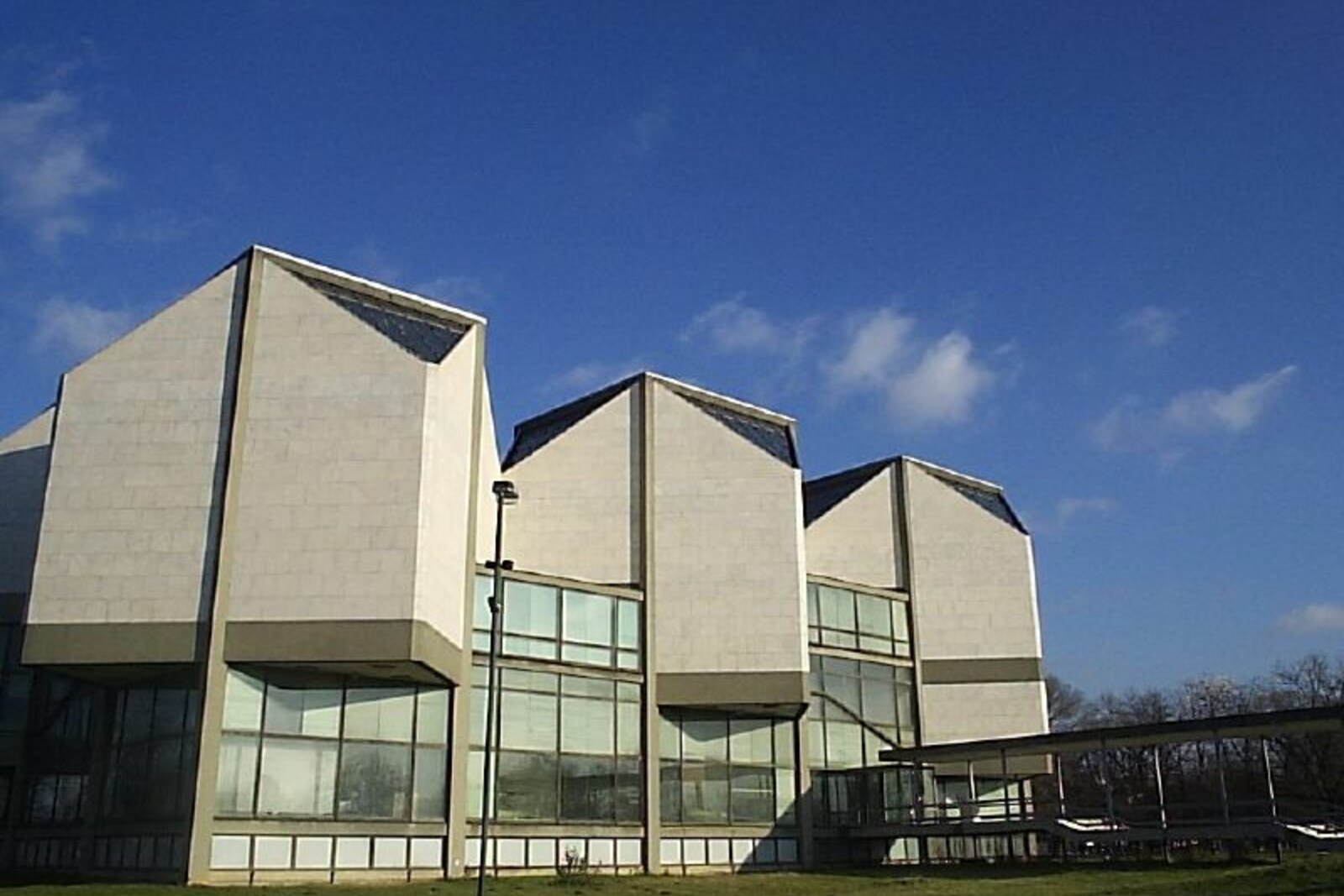
Look around first
What to notice
- White marble volumes
- Large windows
- A cascade of half-levels
- Sculptures in the park
The story of the place
The white marble volumes among the park form an exhibition building where the space is deliberately not divided into identical little rooms. It was created for a collection of twentieth-century art that had been growing even before the building appeared: works were bought at exhibitions and directly from artists. Inside, galleries of varying heights step into one another, so from a landing several levels of the exhibition open up at once; broad windows keep the river, the fortress, and the old city beside the paintings. A large museum district was once planned around it, but only this building, with sculptures in the park, was realized.
In nineteen fifty-nine, Miodrag B. Protić, head of the newly created Museum of Contemporary Art, Belgrade, asked for its future home to be moved. The gallery had been assigned a site by the main road, opposite the future Central Committee building—today's Ušće Tower. Protić wanted to place the museum farther from the road, closer to where the Sava flows into the Danube. The request was granted. That is how he chose this exact spot.
By then, Protić had been campaigning for a separate museum for eight years. His regular job was at the Republican Council for Education and Culture; at the same time, he painted and worked as an art critic. At the council, he was assigned to represent the modernists while cultural institutions tried to maintain a balance between them and supporters of realist art.
In nineteen fifty-four, it was proposed that the twentieth-century art collection be housed on an additional floor of the National Museum of Serbia. After that, an independent gallery might have remained only a name on paper. Protić surveyed artists, critics, and museum specialists: all spoke in favor of a separate institution. A committee formed afterward rejected the proposed old buildings, arguing that converting and maintaining them would cost more than a new building.
In nineteen fifty-eight, Belgrade finally established the Museum of Contemporary Art, Belgrade—the name first given to the future Museum of Contemporary Art, Belgrade. Protić and his staff began in several modest rooms on Obilićev Venac. There was no building yet, but works were already being bought from exhibitions and directly from artists' studios. By the opening at Ušće, the collection contained around three and a half thousand works.
The project was assigned to the competition winners, Ivan Antić and Ivanka Raspopović. They were required to create galleries of varying heights, able to change with the exhibitions. The architects removed the walls between conventional museum cells and linked the floors in a cascade of half-levels. That is why, from a single landing inside, several galleries are visible at once: an individual painting remains in view alongside works from another period. Through the large windows, the Sava, the fortress, and old Belgrade enter this sequence.
On October twentieth, nineteen sixty-five, the building opened under the name Museum of Contemporary Art, Belgrade. On the same day, Antić and Raspopović received the October Prize of Belgrade for it. Protić directed the museum until his retirement in nineteen eighty; the collection created under him grew to around eight thousand works.
A whole museum zone was planned around it: the Ethnographic Museum, the Museum of the Revolution, storage facilities, and a party school. None of this was built here. The white marble building remained among the park and sculptures exactly where Protić had asked for it to be moved—closer to the confluence of the rivers and away from the former Central Committee, Ušće Tower.
Useful on site
Officially: Monday, Wednesday, Friday, Sunday 11:00–19:00; Thursday and Saturday 12:00–20:00; Tuesday closed. Ticket 600 dinars, reduced ticket 300 dinars.
Checked: June 29, 2026. Check the official source before visiting.To explore the collection, check visitor access in advance; even without going inside, the building is worth walking around from several sides.