 Guide On Map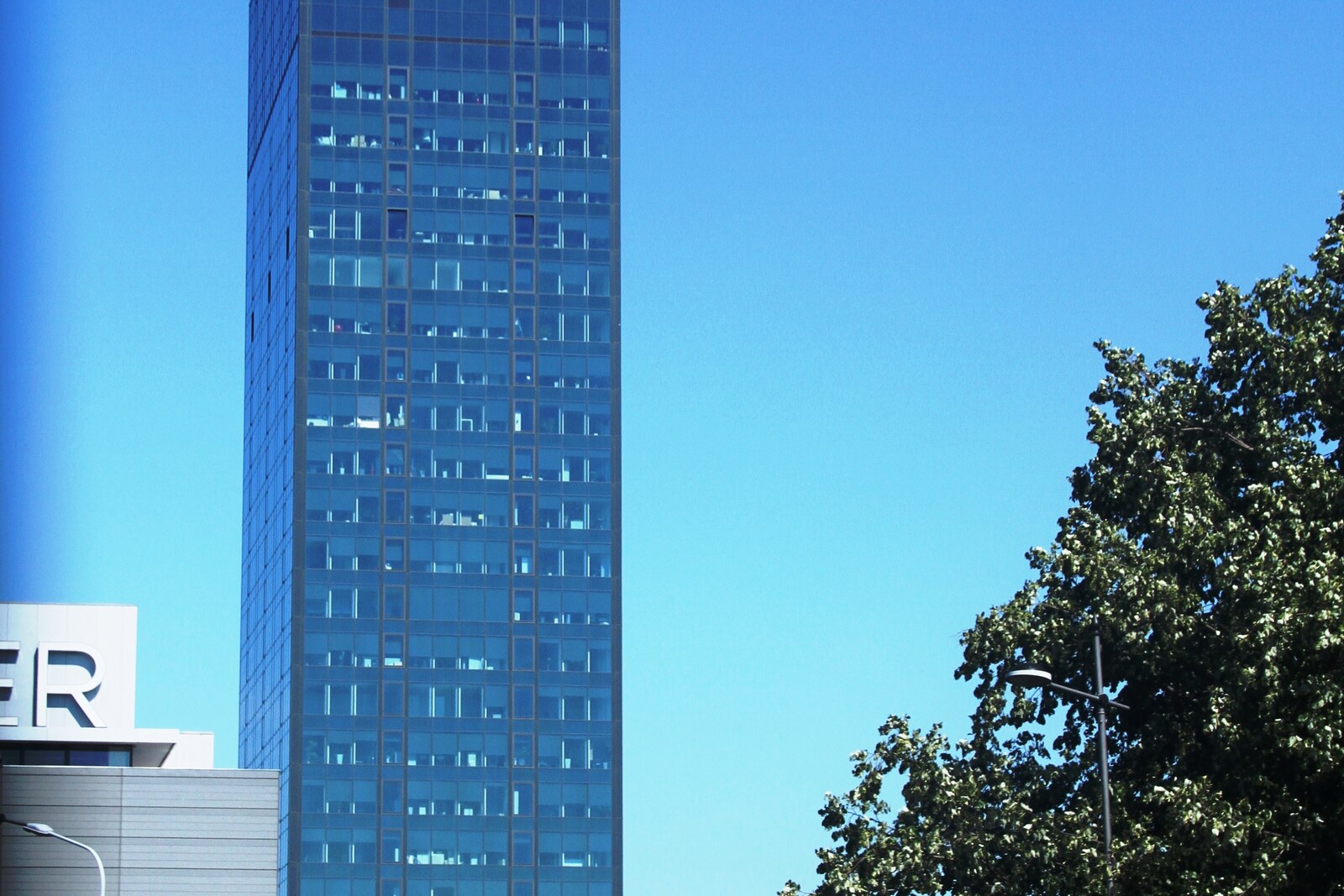
Look around first
What to notice
- Glass facade
- High-rise block
- Shopping center by the tower
- River confluence in the distance
The story of the place
The glass shell of the high-rise block encloses a reinforced-concrete frame, while the shopping center at its base stands separately. The tower was built for the Palace of Social and Political Organizations, when the federal center of New Belgrade was taking shape here. The main floors were occupied by the leaders of the League of Communists of Yugoslavia, which gave the building its local name, the Central Committee; later, radio stations, television companies, and private offices worked alongside the party offices. The current name, Ušće, is connected with the nearby confluence of the Sava and the Danube, visible in the distance.
About twenty minutes before the first missile strike, employees of TV Pink took the elevators down and left the tower. They edited films here and prepared programs for broadcast; studios, transmitters, and the equipment they relied on to make a living remained on the floors. The police led out the last person, the guard on duty, about ten minutes before the attack.
The television workers were here because of the building's former purpose. In the nineteen sixties, this site was incorporated into the new federal center of New Belgrade. In nineteen sixty-four, the Palace of Social and Political Organizations opened here. The Central Committee of the League of Communists of Yugoslavia, its permanent leadership, occupied most of the tower. This is why the building is still known in Belgrade as the “Central Committee.”
After the League of Communists dissolved, the Socialist Party of Serbia took its place. The party leadership kept several floors for itself and rented out the rest to companies. By the end of the nineteen nineties, TV Pink, BK TV, and TV Košava, radio stations, and private firms were working here. Party offices shared one tower with people producing entertainment and news broadcasts.
On April twenty-first, nineteen ninety-nine, NATO forces struck the building for the first time. They declared it the headquarters of the ruling party and a television and radio communications hub. The missiles destroyed the studios, damaged the facade, and caused fires on several floors. The channels lost their premises and transmitters, but thanks to the evacuation, no one in the tower was killed or injured. Six days later, the forces struck it again.
After the bombing, the owners had to decide whether to demolish the burned-out frame or restore it. Structural engineer Ljubomir Vlajić had to determine whether the old reinforced concrete was fit for further use. The survey showed that the load-bearing structure had survived far better than the exterior walls and interiors. Vlajić persuaded the owners to keep it.
Reconstruction began in two thousand three. Builders removed the damaged shell, reinforced the old structure, added two floors, and enclosed it in a glass facade. Offices reopened inside in two thousand five. The shopping center next door occupies a separate building; the tower itself remains a business building.
The name “Ušće” means a river confluence—nearby, the Sava flows into the Danube. Under this new name and the glass, the same reinforced-concrete frame still stands, the one the television workers managed to leave before the strikes. And the old name “Central Committee” preserves the memory of the people for whom this tower was erected here in the nineteen sixties.
Useful on site
There are no public visits to the tower; it is an active business complex. Access is possible only for business with tenants or for separate events.
Checked: June 29, 2026. Check the official source before visiting.This is an active commercial building, so the account is intended primarily for viewing from outside; do not plan on unrestricted access to the office floors.