 Guide On Map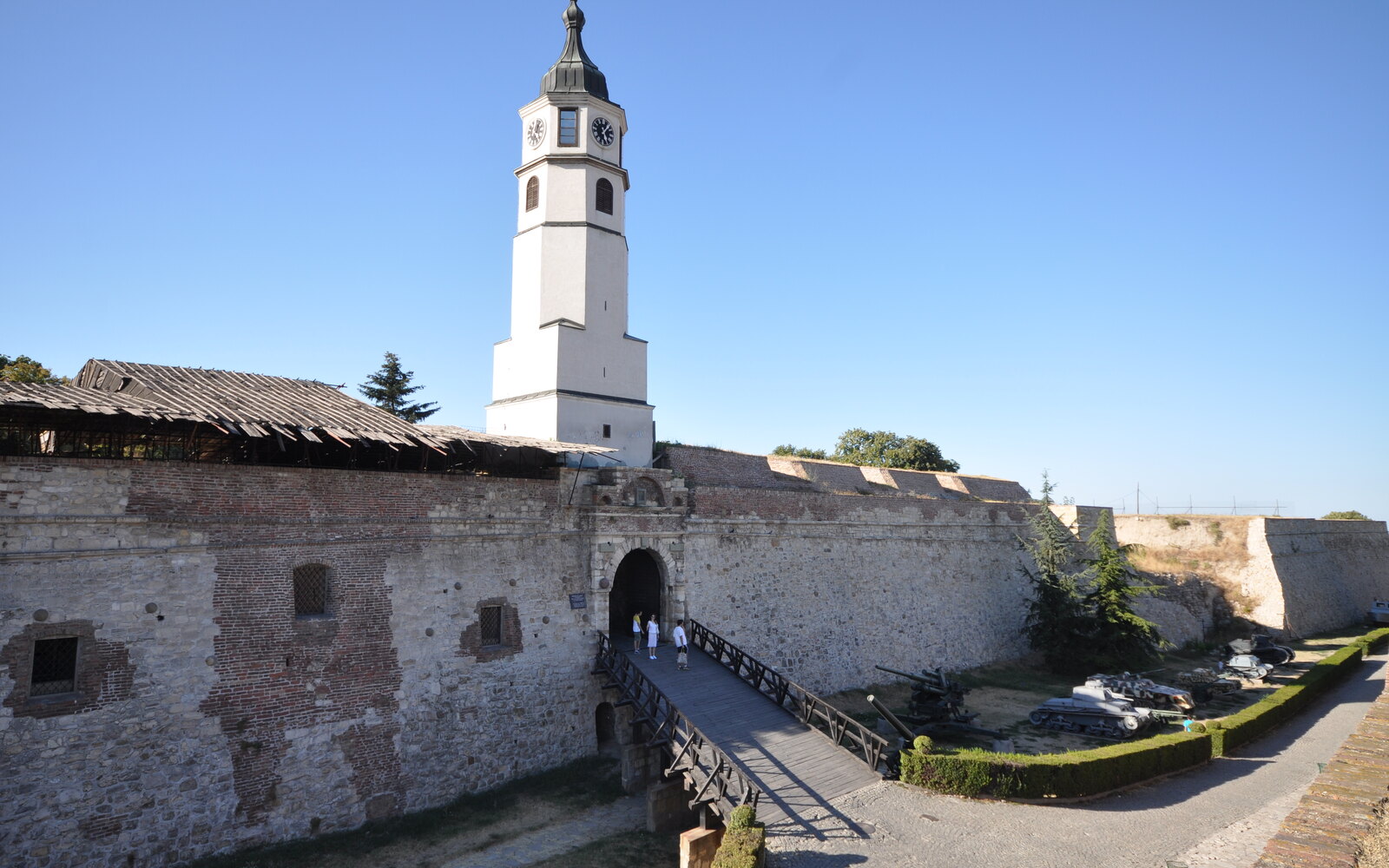
Look around first
What to notice
- Octagonal clock tower
- Stone outer portal
- Walled-up passage of the Baroque Gate
- Brick vault
The story of the place
The Russian name “Clock Gate” can be misleading. A guard really was stationed here: rooms for guards and weapons were built on either side of the passage. But the gate was named after the clock above the arch. The Serbian word sahat means clock. Today, most people heading from the city into the Upper Fortress enter through this passage; at the end of the seventeenth century, this was one of the most vulnerable sections of the landward defenses.
In the summer of sixteen eighty-eight, the Austrian army captured Belgrade from the Ottomans. The war continued, and the damaged fortifications had to be urgently prepared for another siege. The Austrian command assigned this work to Andrea Cornaro, a Venetian military engineer from Crete, who was to turn the old walls into fortifications capable of withstanding artillery fire.
Cornaro began with the southeastern rampart. A new entrance was cut through the medieval wall—the future Clock Gate. When the Ottoman army approached to retake Belgrade in the autumn of sixteen ninety, the portal with its heavy doors was still unfinished. Archaeologists can only suppose that the open passage was temporarily walled up or blocked off. Cornaro had managed to create an entrance to the fortress, but had not managed to close it securely.
During the assault, the engineer was captured along with two assistants. Austrian reports later explained his subsequent career as treason: Cornaro was accused of setting fire to the powder magazine and of opening the gates to the Ottomans. There is no evidence that he changed sides voluntarily. Documents describe him as a prisoner whom the victors forced to continue the work.
The Ottoman military needed specialists in modern fortification. As early as the spring of sixteen ninety-one, Cornaro resumed construction on the same gate, now for the army that had captured him. Under his direction, a new outer rampart and a stone portal were built. It is this portal, with minor alterations, that survives in front of the passage.
His knowledge gradually changed the prisoner’s position. Cornaro was freed and appointed mimar-bashi, the fortress’s chief engineer. Instead of a regular salary, he was given the right to receive income from the village of Miroyane near Sofia. In sixteen ninety-five, he received another two hundred gold coins and a ceremonial caftan. Cornaro bought a house and a city bathhouse in Belgrade and directed the fortification of the fortress until his death in sixteen ninety-eight. After his death, a court official took the real estate; five years later, the engineer’s sons secured a sultan’s decree restoring their father’s property.
There was no clock above the gate in Cornaro’s time. Later, Austrian engineers closed its passage and built another one beside it, now known as the Baroque Gate. When the fortress passed once again to the Ottoman garrison in seventeen forty, its commanders walled up the new passage and put the old one back into use. In the middle of the eighteenth century, an octagonal tower with clockwork was erected above it. After that, the entrance, formerly associated with Cornaro’s name, came to be called the Clock Gate.
The clock tower remains above the arch, the walled-up passage that once replaced this gate is visible beside it, and part of the old vault made of thin brick survives inside. The outer portal was completed not by an Austrian engineer serving his own army, but by Andrea Cornaro, a prisoner of the Ottomans.
Useful on site
The gate is accessible as an exterior passage; the Clock Tower is usually open Tue–Sun 11:00-19:00 in summer / 10:00-17:00 in winter.
Checked: June 28, 2026. Check the official source before visiting.Examine the gate from both sides: from one, the tower is easier to make out; from the other, the thickness of the fortifications and the tight structure of the entrance are clearer.