 Guide On Map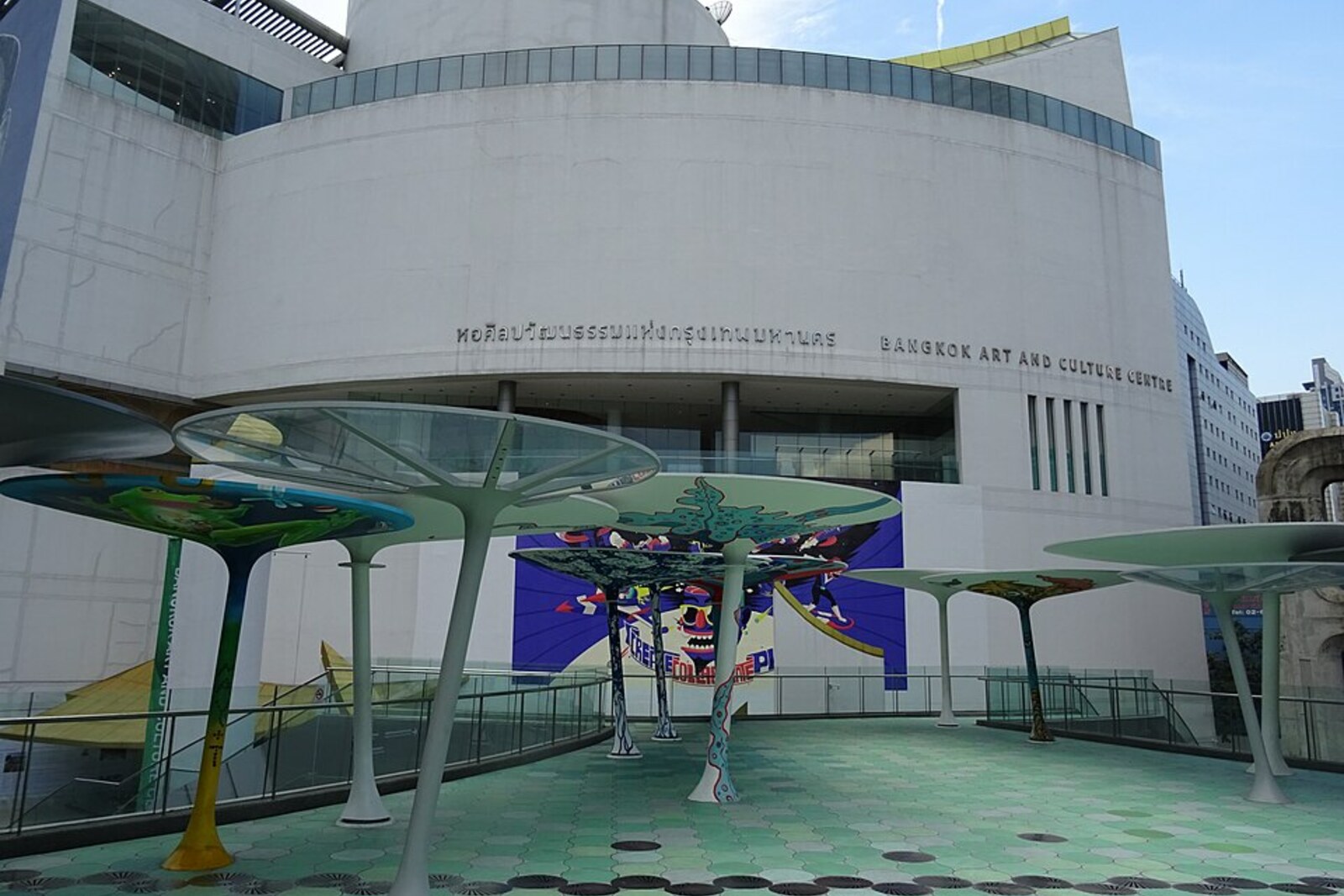
Look around first
What to notice
- Round atrium
- People’s Gallery
- Library
- Exhibition halls on the upper floors
The story of the place
The floors of the Bangkok Art and Culture Centre rise around a round interior space. Art shops, the People’s Gallery, and the library operate below; above are an auditorium, studios, and small exhibition halls. The main temporary exhibitions occupy the seventh, eighth, and ninth floors. Thus, artists’ work, reading, and public exhibitions come together in one building.
On November third, two thousand one, around one hundred members of the Thai Artists’ Network set out from this site at the Pathumwan intersection. They were demanding the return to the city of the promised contemporary art center. Each carried five paintings sewn together; the entire strip stretched for four kilometers—from here to Bangkok City Hall. Three pickup trucks carried the remaining works. In front of City Hall, four thousand paintings were laid out for one hour.
The reason for the march was the foundation already laid here. In nineteen ninety-five, Bangkok governor Bhichit Rattakul agreed to build a public art center on this site. He chose the intersection, where young people pass daily between transit stations, educational institutions, and shopping districts. An architectural competition was held, Robert G. Boughey’s design was approved, and the foundation stone was laid in two thousand.
The next governor, Samak Sundaravej, wanted to hand the construction over to a private investor for thirty years. He replaced the former plan with a shopping complex in which the art center was left with a secondary part. For Bangkok, this meant losing a rare site already intended for publicly accessible contemporary art: there were few private galleries at the time, and exhibition life was concentrated mainly around universities.
Artists Wasan Sitthiket and Pratuang Emjaroen led the campaign “Return Our Art Center.” Professor Preecha Thaothong, who headed the Council of Fine and Applied Arts Deans of Thailand, sought a public hearing and, together with other participants, filed a case with the administrative court. The campaign was funded through the sale of works: at one auction, fifteen paintings brought in six hundred thousand baht. For its participants, a canvas served both as a demand upon the city and as what allowed them to continue making that demand.
In two thousand two, the court agreed to hear the lawsuit, after which the shopping center project was canceled. Construction of the art center had not yet resumed, however, and the site was turned into a small public park. Two years later, the People’s Network, created by artists, held Art Vote here—a vote for the art center. Ballot boxes were also placed at universities; the organizers hoped to collect fifty thousand votes and demanded a response from every candidate for governor.
Candidate Apirak Kosayodhin personally dropped a ballot into one of these boxes. After being elected, he received representatives of the network and returned the project to its original competition scheme. The Bangkok Metropolitan Administration allocated funds, artists joined the committees, and on July twenty-ninth, two thousand eight, the Bangkok Art and Culture Centre opened to the public.
Its round atrium connects the institution’s different parts: art shops, the People’s Gallery, and a library operate on the lower floors; above are an auditorium, studios, and rooms for small exhibitions, while the main temporary exhibitions occupy the seventh, eighth, and ninth floors. Retail remained within the original project as support for art programs. The thirty-year shopping center, in which art would have been assigned a small corner, never appeared on this site.
Useful on site
Open Tue–Sun 10:00–20:00; closed on Mondays; free admission.
Checked: June 28, 2026. Check the official source before visiting.Exhibitions change, so do not expect to see a particular work without checking the program in advance.