 Guide On Map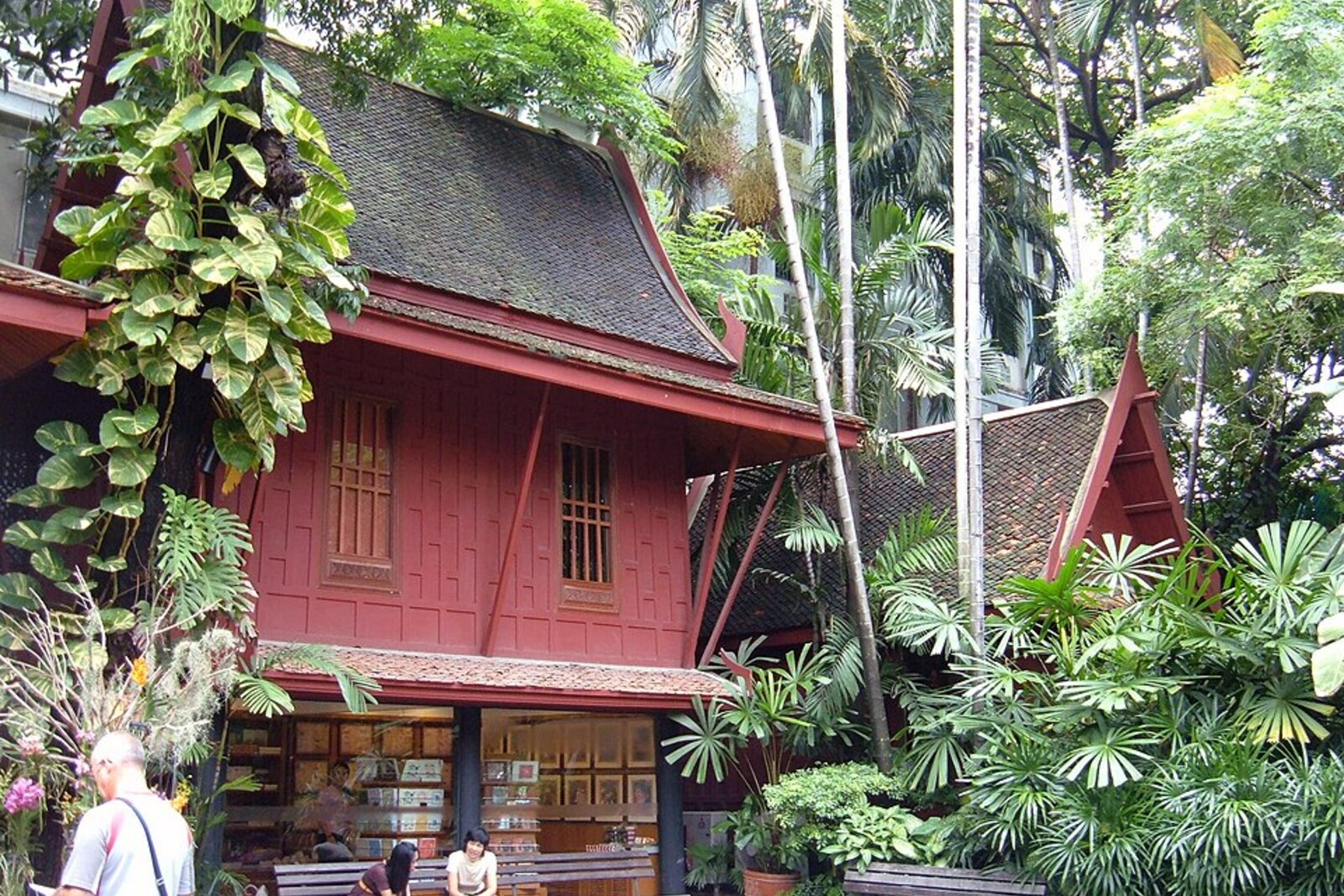
Look around first
What to notice
- Teak walls
- Shared corridor
- Interior staircase
- Carved wall panels
The story of the place
The largest room at Jim Thompson House once stood on the other side of the canal. In nineteen fifty-seven, one of Baan Krua’s weavers was planning to replace his old family home with a new one. Jim Thompson, an American merchant who made money selling this community’s silk, arranged to take the wooden building. It was dismantled into separate walls and moved across the water.
Thompson needed space for the paintings, bronzes, and ceramics that he bought with the proceeds from the silk company. To the weaver’s house, he added five more old Thai buildings. Carpenters from Ayutthaya assembled them on the site from prefabricated teak sections joined without nails. The resulting house did not reproduce any earlier building: Thompson linked six different houses with a shared corridor, installed an interior staircase, and had the carved wall panels turned with their outer sides facing the rooms so that the ornament could be seen from inside.
On the third of April, nineteen fifty-nine, he moved in here. The house served as his home, exhibition space, and venue for receptions. Within a few years, volunteers were already leading morning tours through the rooms and giving the proceeds to charity. Thompson intended to leave the house and the collection to The Siam Society, a scholarly association that studied the country’s history and art.
Five stone Buddha heads changed this plan. In nineteen sixty-two, the Fine Arts Department challenged the legality of their acquisition. After a police visit, Thompson handed the disputed sculptures over to the National Museum, Bangkok. In a letter written two years later, he claimed that the heads had been promised back to him, but the promise had not been kept. Fearing further seizures, the collector sold some of the Thai Buddhist sculpture and revoked his bequest to The Siam Society. The five heads never returned to this house.
On the twenty-seventh of March, nineteen sixty-seven, Thompson disappeared during a trip to Malaysia. Seven years later, a court declared him dead, and his nephew Henry Thompson became the heir. He could dispose of the house and the remaining works separately, but transferred them to a foundation created to preserve the collection in Thailand. In nineteen seventy-five, the house and collection were registered as a national museum.
Almost everything that remains of Thompson’s collection is still arranged in his rooms. And the largest of them is the former home of a Baan Krua weaver, moved across the canal for the sake of a collection that its owner nearly sold off, yet did not allow to be dispersed after his disappearance.
Useful on site
Open daily 10:00–17:00; the last guided tour begins at 17:00; the main house is accessible only with a guide.
Checked: June 28, 2026. Check the official source before visiting.The main house is viewed with a museum guide; check visiting conditions and available languages separately.