 Guide On Map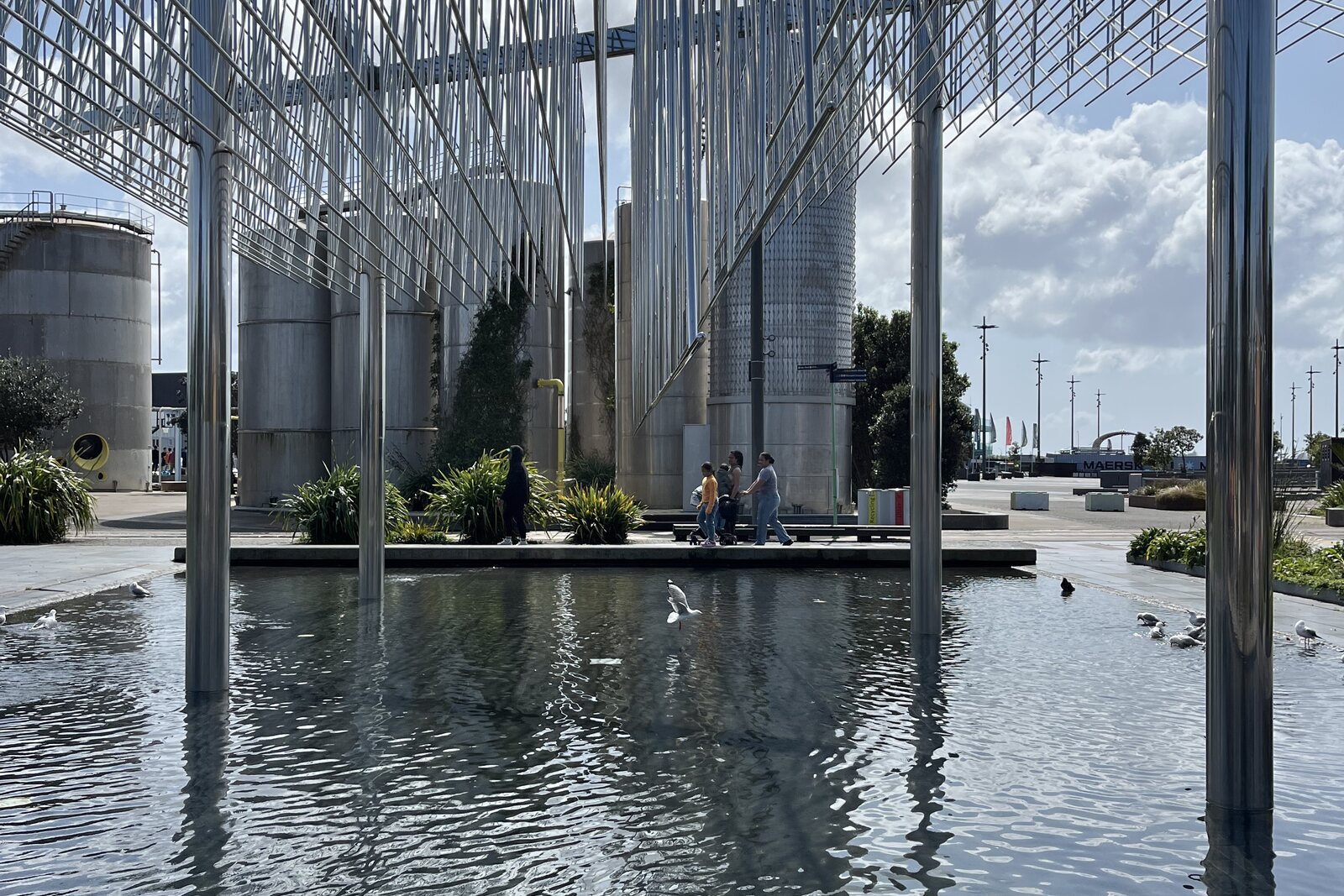
Look around first
What to notice
- Six connected cylinders
- The separate Silo 7 tower
- Former railway tracks
- Exterior stairs
The story of the place
First, this shore was occupied by oil and chemical tanks, which gave the whole district the name Tank Farm. Later, six connected concrete cylinders rose beside the wharf and railway, where dry cement arriving by sea was stored before being sent onward in railcars. The exterior stairs, tracks, and separate tower beyond them still reveal this place’s former working layout. Inside the main block, the machinery and hoppers through which cement once passed have been preserved.
In nineteen sixty-one, the young practical engineer Ross Johnson was transferred from the estimating department of A & G Price to a construction site by the harbor. He was appointed to oversee the installation of six cement silos. Along with the position, he received a substantial increase in pay and standing—and responsibility for the work of thirty to forty people.
Cement was brought by sea from the Whangārei area. From the holds, the powder was sent through pipes and a pneumatic chute into storage bins, then forwarded by rail across Auckland. That is why the silos were built beside both the wharf and the tracks. According to Johnson’s recollections, the concrete workers poured all six cylinders continuously, in a single pour; for New Zealand, it was the first experience of its kind. His crew prepared the steel structures, machinery, and internal hoppers.
Johnson was afraid of heights. Yet he had to climb to the top and move between sections of formwork. Some gaps were wider than an ordinary step, and he had to jump across them. Six months later, he was sent to oversee construction of the next silo, this time in Te Rapa. Before he turned thirty, he became production manager with two hundred subordinates.
The six connected cylinders are now called Silo 6. The separate tower behind the former railway tracks is Silo 7. The nickname of the whole district, Tank Farm, arose from the oil and chemical storage tanks that began to be installed here in the nineteen thirties. The concrete silos in front of you stored dry cement, not fuel.
After the former operation closed, the silos were due to be demolished. Designers from the city agency retained them when creating the public waterfront, which opened in twenty eleven. The six cylinders now host exhibitions and public events, while firefighters use the stairs for training. In summer, films are projected onto the wall of the solitary silo.
In twenty twenty-two, eighty-eight-year-old Ross Johnson returned here with three generations of his family. He entered on a motorized wheelchair and, on seeing the old loading hopper, remembered the pneumatic chute through which cement had arrived. He no longer wanted to climb the exterior stairs, although he remarked that he would have climbed them if necessary. The hopper remains inside, the tracks between the two complexes no longer lead anywhere, and Johnson’s first site serves as an exhibition hall.
Useful on site
Open public space; the schedules of events, venues, and neighboring establishments change separately.
Checked: June 28, 2026. Check the official source before visiting.The silos are easy to make out from outside; access inside depends on the events and open venues operating there.