 Guide On Map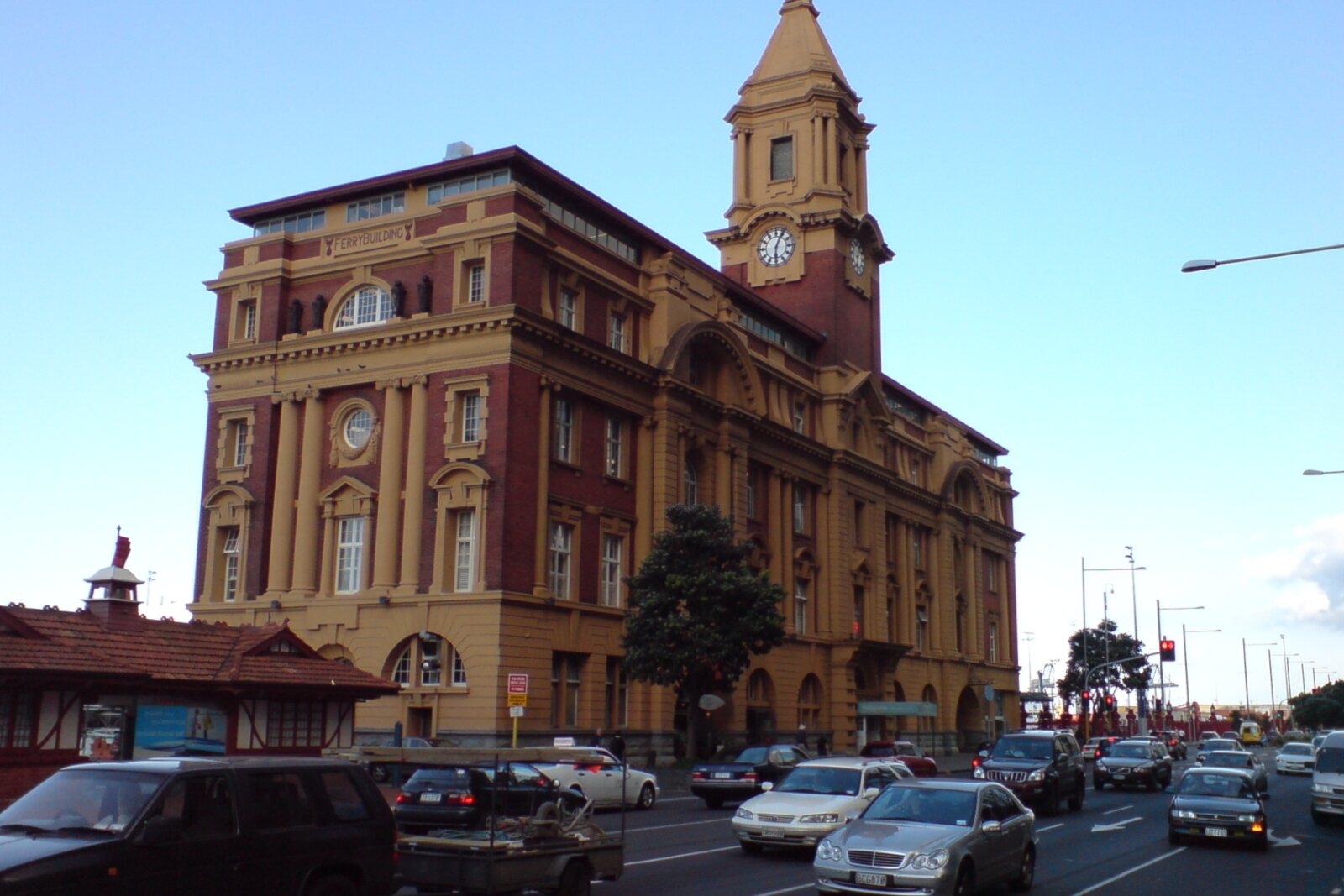
Look around first
What to notice
- Ferry Building facade
- Old entrances
- Ferry wharves
- The basin in front of the building
The story of the place
At the end of Queen Street, the city street runs into the broad facade of the Ferry Building and the water beyond it. The old doors still lead people from central Auckland to the neighboring piers, where ferries depart. While some hurry to a sailing, others linger by the entrance, disappearing into the flow of waiting and meeting. Much of this address’s past happened not indoors, but outside, by the facade.
The name “Ferry Building” literally means “building of ferries.” In the early twentieth century, William Henry Hamer, chief engineer of the Auckland Harbour Board, was responsible for rebuilding a cramped and disorderly harbor. By nineteen oh four, ferries from here served nine coastal districts, and Hamer proposed bringing the carriers together at the end of Queen Street, opposite a shared ferry basin. By nineteen twelve, a building had opened here: its ground floor was occupied by the two largest ferry companies, while the upper rooms were rented out so that the harbour board could receive a steady income.
The flow of passengers gave this address a use that had not been part of the plan. After evening passengers had made their way to ferries for the North Shore, men looking for other men remained by the facade. In the crowd, people could meet without explaining why they were standing there; sailors from merchant and naval vessels came from neighboring wharves, soon to leave the city again. Already in the first decades after it opened, the Ferry Building became a well-known meeting place for homosexual men and male sex workers.
One such meeting became part of a criminal case in nineteen forty-one. A historian who studied the court papers replaced the participants’ real names with pseudonyms. A worker called Bert Simkins looked for men here and introduced acquaintances to sailors. Once, right by the Ferry Building, he met Victor Andrews, a grocery assistant, and told him about a ship’s steward whom he had met at a party. Andrews and his friends wanted to see the steward; Simkins promised to take them to him and introduce them.
After a complaint about indecent behavior, police charged Simkins with meeting men for sex. Three participants were offered that no charges would be brought if they testified as witnesses. Andrews agreed. In court, he explained that there had been no money in these relationships: the men were looking for love and intimacy. He then named a doctor, a postal employee, several sailors, and a man who was already in prison.
The stakes for them were literal. Sexual relations between men were considered a crime; in the nineteen forties, the law still allowed imprisonment with hard labor, up to life, for some of them. Simkins lived on a worker’s wages, Andrews on the salary of a shop assistant. For one, an acquaintance at the ferry terminal brought a trial; for the other, a promise not to prosecute him in exchange for testimony. Simkins was brought before the then Supreme Court of New Zealand, the predecessor of today’s High Court of New Zealand. The published study does not say how his trial ended.
The court case preserved another consequence: no longer did only individuals who had happened to recognize each other gather by the facade, but a circle of acquaintances who exchanged names and arranged meetings with sailors. After the war, such circles grew in Auckland, and then some meetings shifted to coffeehouses, bars, and clubs. Criminal prosecution of consensual relationships between adult men ended only in nineteen eighty-six.
There is no plaque on the Ferry Building about these meetings. Ferries still leave from the neighboring wharves, passengers still pass through the old entrances, and the place where Simkins promised to introduce the ship’s steward to his friends was outside, by this facade, at the end of Queen Street.
Useful on site
Exterior viewing is open as part of the waterfront; ferry services and terminal areas depend on the current Auckland Transport schedule.
Checked: June 28, 2026. Check the official source before visiting.By the wharves, keep clear of queues and passageways; no ferry is needed to continue the route.