 Guide On Map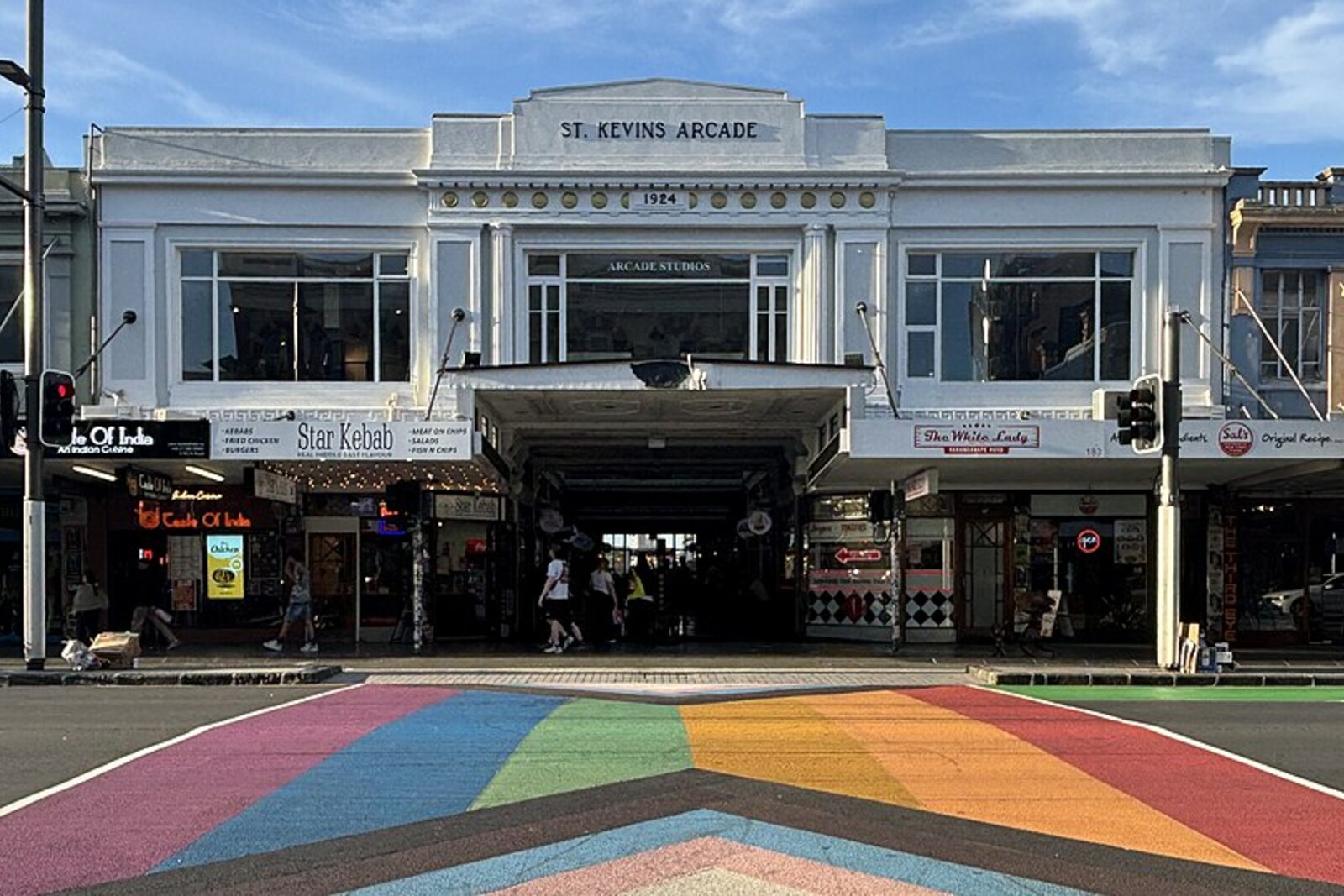
Look around first
What to notice
- The central through-corridor
- Shop windows along the passage
- The staircase to Myers Park
- Windows above the slope
The story of the place
From Karangahape Road, a through-corridor with shop windows along its sides runs into the building; beyond it, a staircase descends into Myers Park, and windows above it look out over the slope. The shopping arcade was built to the design of William Arthur Cumming and enlarged soon afterward. Cafes and shops now operate here, while below, music plays from the clubs Whammy and Double Whammy.
The name above the entrance remained from a house that has long been gone. In eighteen fifty-three, the shoemaker Thomas Henry Kaven bought a large stone mansion on the ridge. Four years later, the house burned down. It was uninsured, and Kaven paid to rebuild it to the previous plan. Later, the owner sold the estate, but the name St Kevins stuck to it—after the surname of its former owner. The name had nothing to do with an actual Kevin. Over time, one vowel was changed, and the surname Kaven came to resemble the name of a saint.
By the beginning of the twentieth century, the Nathan family owned the estate again. Shops were already crowding it on both sides, and Karangahape Road had become a busy shopping street. The merchant David Laurence Nathan intended to sell the site for development. At the same time, the city council needed an upper entrance to the recently created Myers Park.
On May sixteenth, nineteen sixteen, Nathan signed an agreement with the council. Along the eastern boundary of the estate, he left a strip about six meters wide—an eternal pedestrian passage from Karangahape Road to the park. The land remained private, but new owners could no longer eliminate this route when developing the site.
Nathan also took care of the price of the site. Future owners were allowed to build above the passage, provided the overhead structure was no lower than about five and a half meters, and to excavate rooms beneath it. The council took responsibility for paving and lighting the path. The restriction concerned the existence of the passage, not round-the-clock access: the same document allowed the gates to be locked at the owner’s request from ten in the evening until dawn.
The deal nearly fell through because of its own deadline. Nathan and the council had to agree on the plans within six months, but did not manage to do so. The site had already been sold, the drawings were nevertheless approved, and in nineteen twenty Parliament kept the agreement in force by a separate decision despite the delay.
Four years later, the new owners commissioned the architect William Arthur Cumming to build a shopping arcade here. He placed shops along the sides of the preserved corridor, and in nineteen twenty-six the building was enlarged. In this way, private development gained retail space above the passage, while city residents gained an exit to Myers Park through it.
Now cafes and shops operate along the sides of the corridor, while the music clubs Whammy and Double Whammy are below. Their visitors walk on the same floor as passersby who need nothing from the building. The staircase to the park begins exactly within the strip that David Laurence Nathan excluded from the ordinary sale of the site in nineteen sixteen.
Useful on site
The passage and its tenants operate on different schedules; check individual shops and cafes.
Checked: June 28, 2026. Check the official source before visiting.This is an operating shopping arcade, so do not disturb the tenants and keep in mind that its premises operate independently of one another. If the passage is closed, limit yourself to the facade and do not try to enter.