 Guide On Map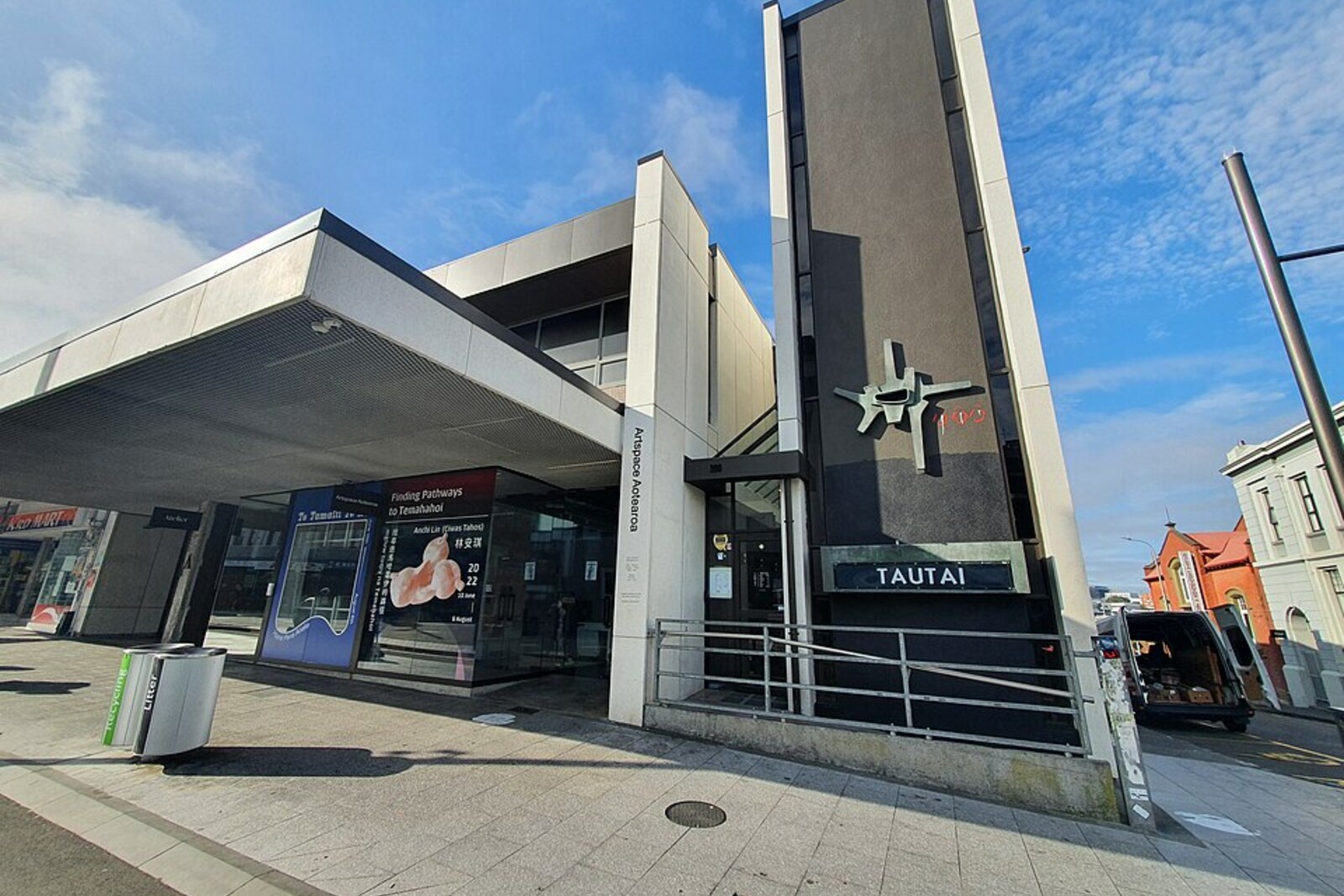
Look around first
What to notice
- The bronze Star above the entrance
- The facade of the former post office
- The staircase beneath Star
- The gallery entrance
The story of the place
Above the staircase by the entrance hangs a bronze star that survived changes to the facade: the brown tiles that served as its background were removed over time. Behind this facade once operated the Newton Post Office, where paper dispatches entered a larger network of communications. For its interior, the artist and architectural designer Guy Ngan made an aluminum mural connected to the star: its lines recalled postal routes, telegraph wires, and road interchanges. A free public gallery now operates in the former service building, with changing exhibitions, meetings, research, and publications.
In nineteen ninety-nine, the artist and curator Stella Brennan was preparing the exhibition Nostalgia for the Future here. Artspace had just moved into the former Newton Post Office. Brennan was looking for things in which a recent idea of the future had already become outdated, and she found the main exhibit in the basement of the same building: forty-one aluminum panels, removed from the wall of the postal hall about ten years earlier.
The panels were created by Guy Ngan—an artist and architectural designer who sought to have art enter everyday life together with buildings, rather than appear in them after construction was complete. In nineteen seventy-three, the Ministry of Works commissioned architects to design a new post office on the corner of Karangahape Road and East Street. Ngan worked with them and made two related things for the building. The bronze Star was fixed outside above the staircase. Inside, he assembled a mural almost three meters high and more than seven meters wide.
In the mural, lines emerged from a postal postmark reading “Newton, nineteen seventy-three,” passed between figures resembling letters or houses, and converged near two built-in light fixtures. They could be read as telegraph wires, postal routes, and highway interchanges. The post office transmitted messages, and Ngan depicted transmission itself—from a paper dispatch to an electrical signal.
In the late nineteen eighties, the postal services were reorganized, the building was altered, and parts of it began to be leased out. Workers dismantled the mural and stored it in the basement. They did not touch Star. When Brennan included the find in her exhibition, the aluminum panels returned from the basement to the hall for which Ngan had created them for the first time in a decade. They were not permanently installed on the wall, however. Five years later, the postal company transferred the work to Auckland Art Gallery.
Its history here did not end there. In two thousand nineteen, curators Remco de Blaij and Lachlan Taylor began an exhibition of Guy Ngan’s work with the bronze Star above the entrance. They borrowed the mural from Auckland Art Gallery and assembled it again inside the former post office. Then the researcher Bronwyn Holloway-Smith invited city residents to search for Ngan’s other works: his sculptures and reliefs had been removed during renovations, moved, covered by walls, and sometimes people had stopped remembering the artist’s name. As a result of the search begun here, it was possible to establish the fate of almost forty works across New Zealand and enter information about them in an open public-art register.
This is also how Artspace Aotearoa operates: it is a free public gallery created for contemporary art that could not find a place at more conservative venues. It hosts changing exhibitions, meetings, and research, and publishes publications; the current director determines the program for several years.
The brown tiles that served as Star’s background deteriorated over time and were removed. The bronze itself remains above the entrance. Its aluminum counterpart is once again in the Auckland Art Gallery storage collection and is not currently on display—but it now has Guy Ngan’s name, an exact date, and a museum registration number.
Useful on site
Tue–Wed/Fri 10:00–18:00, Thu 10:00–20:00, Sat 11:00–16:00; Tue 10:00–12:00 — low-sensory hours.
Opening hours by day
The bronze Star can be viewed from the street regardless of access inside. If you want to see an exhibition, check the current program and visiting conditions separately.