 Guide On Map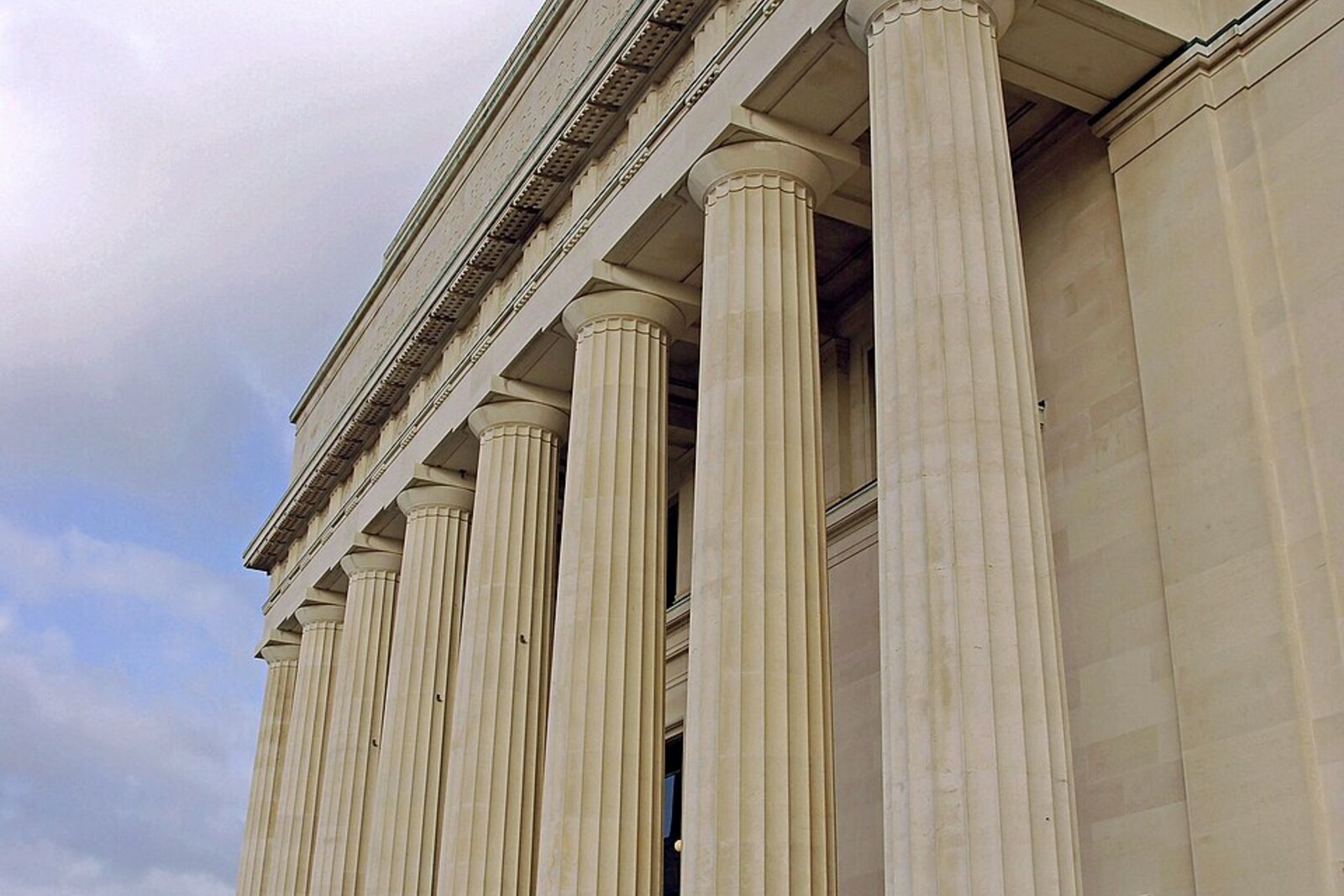
Look around first
What to notice
- Greek portico
- Stone frieze beneath the cornice
- Battle names on the facade
The story of the place
City residents needed to find space for the expanded museum collections and create a memorial to local people who had died. The old museum, founded in eighteen fifty-two, had already outgrown its building on Princes Street. Exhibition halls surround a space of remembrance, and the facade is composed as a Greek temple: military scenes and battle names run along the stone band beneath the roof. On the upper floor, seven thousand two hundred ninety-seven names of dead people from Auckland Province are carved on Italian marble slabs, including fourteen military nurses.
In nineteen twenty-two, judges spent nine days examining seventy-four designs for a new building on this summit in a waterfront warehouse. The drawings were anonymous. The winners were named only after the vote: they were three Auckland architects—Hugh Grierson, Kenneth Aimer, and Malcolm Keith Draffin.
All three returned from the First World War. Grierson served in France with the New Zealand Rifle Brigade; his brother Walter was killed at Gallipoli. Aimer was wounded at Passchendaele and sent home, while his older brother George, a pilot in the Royal Flying Corps, crashed in England. Draffin was at Gallipoli from the landing to the evacuation, then served as a military engineer in France, was commissioned in the field, wounded twice, and awarded the Military Cross.
Before the war, they studied architecture in Auckland. After demobilization, Grierson and Draffin continued their studies in London on full army support, then returned and joined Aimer. The competition gave them a major commission and the chance to decide for themselves what the memorial would be like for the people among whom were their fellow servicemen and brothers.
The commission arose from two Auckland needs. The old city museum, founded as early as eighteen fifty-two, had long since outgrown its building on Princes Street. At the same time, the families of the dead demanded a worthy provincial memorial. In nineteen twenty, city residents decided to unite them under one roof. Pukekawa—the upper terrace of Auckland Domain, visible from the city center and the harbor—had already been chosen for the museum. Mayor James Gunson led the civic committee that raised funds; residents and local institutions provided the main share of the two hundred thousand pounds.
Grierson, Aimer, and Draffin arranged the exhibition halls around a space of remembrance and raised the building as a Greek temple. Battle names and a stone frieze with military scenes appeared beneath the cornice. The judges did not know the biographies of the designers when they chose this proposal; after the names were revealed, the civic committee commissioned the same three to oversee construction. The museum opened in nineteen twenty-nine.
Three years later, seven thousand two hundred ninety-seven names of dead people from Auckland Province, including fourteen military nurses, were carved on Italian marble slabs on the upper floor. It is they whom the phrase “war memorial” in the name refers to. The exhibitions, meanwhile, preserved the former scope of the city museum: the natural world of New Zealand, the history of Auckland, and the heritage of Māori and the peoples of the Pacific.
After the Second World War, Keith Draffin had to return to his principal building. Together with his son Rodney, also an architect, he designed a rear extension for the new Hall of Memory. In nineteen sixty, another four thousand seven hundred two names were added there. The front section remained a memorial to the war Draffin had himself lived through; behind it stands an extension for those killed in the following war, which he completed together with his son.
Useful on site
Check the official website: the hours page may show the standard schedule and a separate closure notice.
Checked: June 28, 2026. Check the official source before visiting.You can listen to this account in front of the facade; plan your visit to the collections separately and check the current entry conditions.