 Guide On Map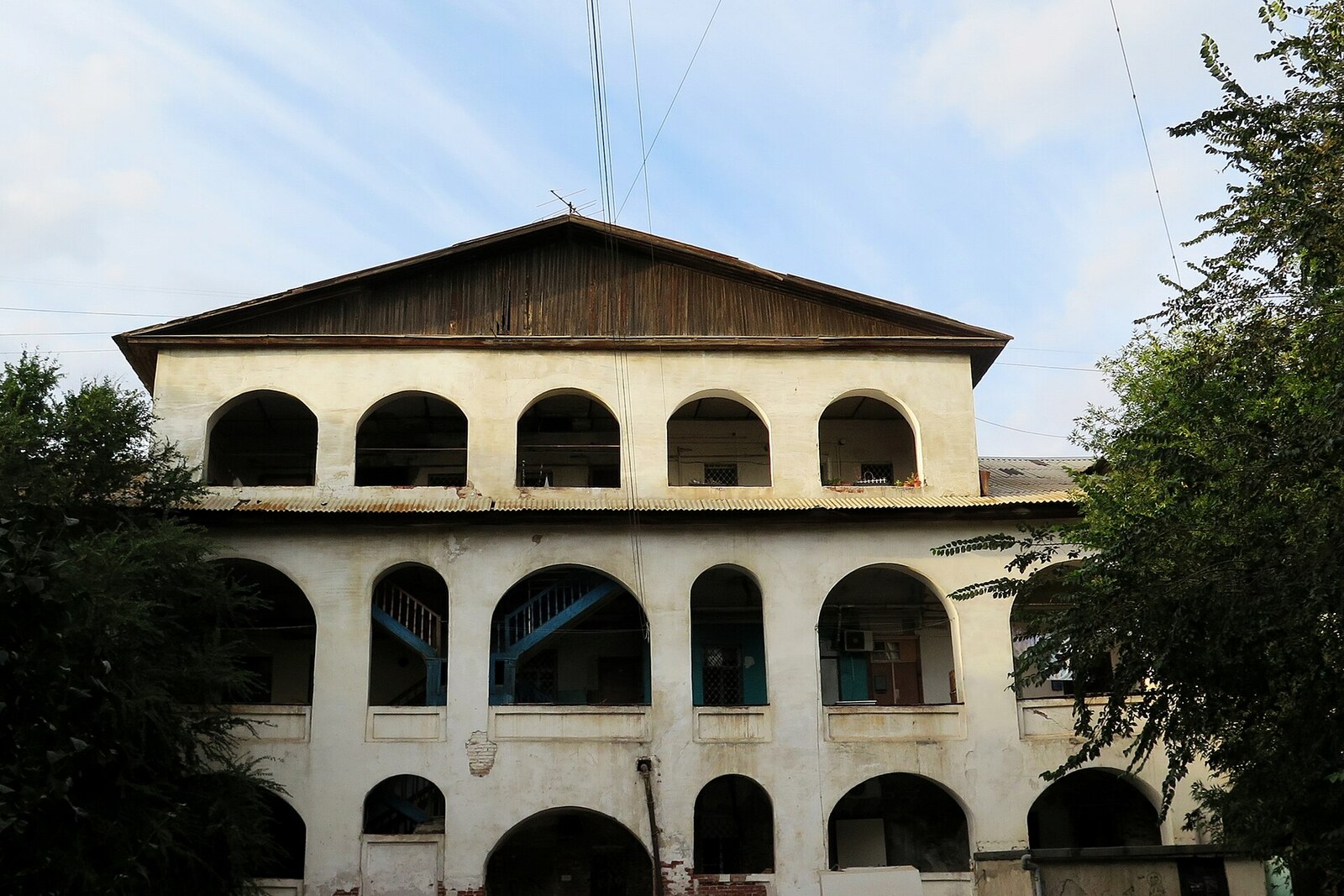
Look around first
What to notice
- Wide entrance arch
- Enclosed courtyard
- Two-tier galleries
- Doors along the galleries
The story of the place
The wide arch leads into a courtyard that is still enclosed by buildings with two-tier galleries. The stone walls appeared here after the wooden compound: it was rebuilt from eighteen fifty-two to eighteen sixty-three. In the White Town's business district, opposite the governor's house, a lodging place for Persian traders arriving in Astrakhan with Caspian Sea goods was taking shape. The courtyard is now part of a residential building, but its former purpose can still be discerned in the arch, cellars, and galleries.
Aji Useinov made his living from Caspian Sea shipping. In the eighteen thirties and forties, his vessels carried through Astrakhan as much as sixty to seventy percent of Russia's trade in this direction. The merchant risked money and cargo on every sea voyage, but his business's annual turnover reached seven hundred thousand rubles.
Sea transport ended at the shore. Visiting traders needed lodging, goods needed storage, and buyers and sellers needed to be brought together for a transaction. Useinov chose a site near the Persian trading rows, opposite the governor's house, in the very heart of the White Town's business district. A wooden compound already stood here. In eighteen fifty-two, the merchant began rebuilding it in stone; the work was completed in eighteen sixty-three.
The result was an enclosed quadrangle with wide gates. The cellars and lower floor were set aside for goods and shops, the upper floor for rooms for visitors. Doors opened onto shared galleries around the courtyard. A merchant could live above his own warehouse, go down to his goods, and find a partner for a transaction right here. That is why the name “Persian Compound” referred to the entire community of traders, while “Aji Useinov House” recalled who had brought their businesses together under one roof. In Russian documents, the word “gadzhi” was often written as “adzhi.”
In eighteen seventy-five, the traveler Pavel Ogorodnikov was passing through Astrakhan on his way to Persia. Aji-Aga, the compound owner's son, led him from the trading rows into the courtyard and invited him to drink sherbet. In the room, high bunks served at once as seating, a place to rest, and an office desk. Carpets, embroidered slippers, bales, and cashmere shawls lay in the corners. Ogorodnikov called the building at once a warehouse, a hotel, and an exchange for Persian merchants. Thus, Useinov's decision continued to bring the family income, while giving visitors lodging, safe storage for their goods, and a place to trade. The merchant's heirs owned the compound until nineteen seventeen.
It is now a residential building. There are no bales, office bunks, or merchants' exchange here. The wide entrance arch, enclosed courtyard, cellars, and two-tier galleries remain; only the doors along them now lead to apartments.
Useful on site
You can view it from the street at any time; entry into the courtyard and premises is not part of the route.
Checked: date not specified. Check the official source before visiting.View the complex only from publicly accessible street space. Residential, commercial, and interior areas are not part of the route; closed gates do not mean you have missed a stop.